impact
impact
open science
subheadline
careers and opportunities
subheadline
people & teams
people & teams
subheadline
allenites
subheadline
allen institute advisors
subheadline
board of directors
subheadline
shanahan foundation fellowship
subheadline
next generation leaders
subheadline
research
overview
our approach
subheadline
publications
subheadline
open science
subheadline
accelerator
brain science
subheadline
cell science
subheadline
neural dynamics
subheadline
immunology
subheadline
synthetic biology
subheadline
education
education
science education
subheadline
education resources
subheadline
field trips
subheadline
open science
subheadline
open science quest
subheadline
news
news
stories
subheadline
podcast
subheadline
sign up for our newsletter
subheadline
events
events
all events
subheadline
conferences
subheadline
event code of conduct
subheadline
events
open science quest
subheadline
summer workshop on the dynamic brain
subheadline
open science week
subheadline
brain fest
subheadline
science resources
science resources
allencell.org
subheadline
allenimmunology.org
subheadline
allenneuraldynamics.org
subheadline
brain-bican.org
subheadline
brain-map.org
subheadline
microns-explorer.org
subheadline
impact
back to menu
impact
open science
subheading
careers and opportunities
subheading
people & teams
people & teams
subheading
allen institute advisors
subheading
board of directors
subheading
shanahan foundation fellowship
subheading
next generation leaders
subheading
research
back to menu
impact
Label
subheading
Label
subheading
people & teams
education
back to menu
research
Label
subheading
Label
subheading
Heading
news
back to menu
research
Label
subheading
Label
subheading
Heading
events
back to menu
research
Label
subheading
Label
subheading
Heading
science resources
back to menu
science resources
allencell.org
subheading
allenimmunology.org
subheading
allenneuraldynamics.org
subheading
brain-bican.org
subheading
brain-map.org
subheading
microns-explorer.org
subheading
search
stories
news

Projects launch to map the nucleus, the information center of our cells

Teams from two divisions of the Allen Institute, the Allen Institute for Cell Science and the Allen Institute for Brain Science, are participating in...

October 15, 2020
 min read
share/
Teams from two divisions of the Allen Institute, the Allen Institute for Cell Science and the Allen Institute for Brain Science, are participating in newly launched projects to address unanswered questions in nuclear biology. Both projects are part of 4DN Centers for Data Integration, Modeling and Visualization of the National Institutes of Health Common Fund 4D Nucleome program.
Thank you! Your submission has been received!
Oops! Something went wrong while submitting the form.

in this article

table of contents will display on published page only
set h2 to populate the table of contents here
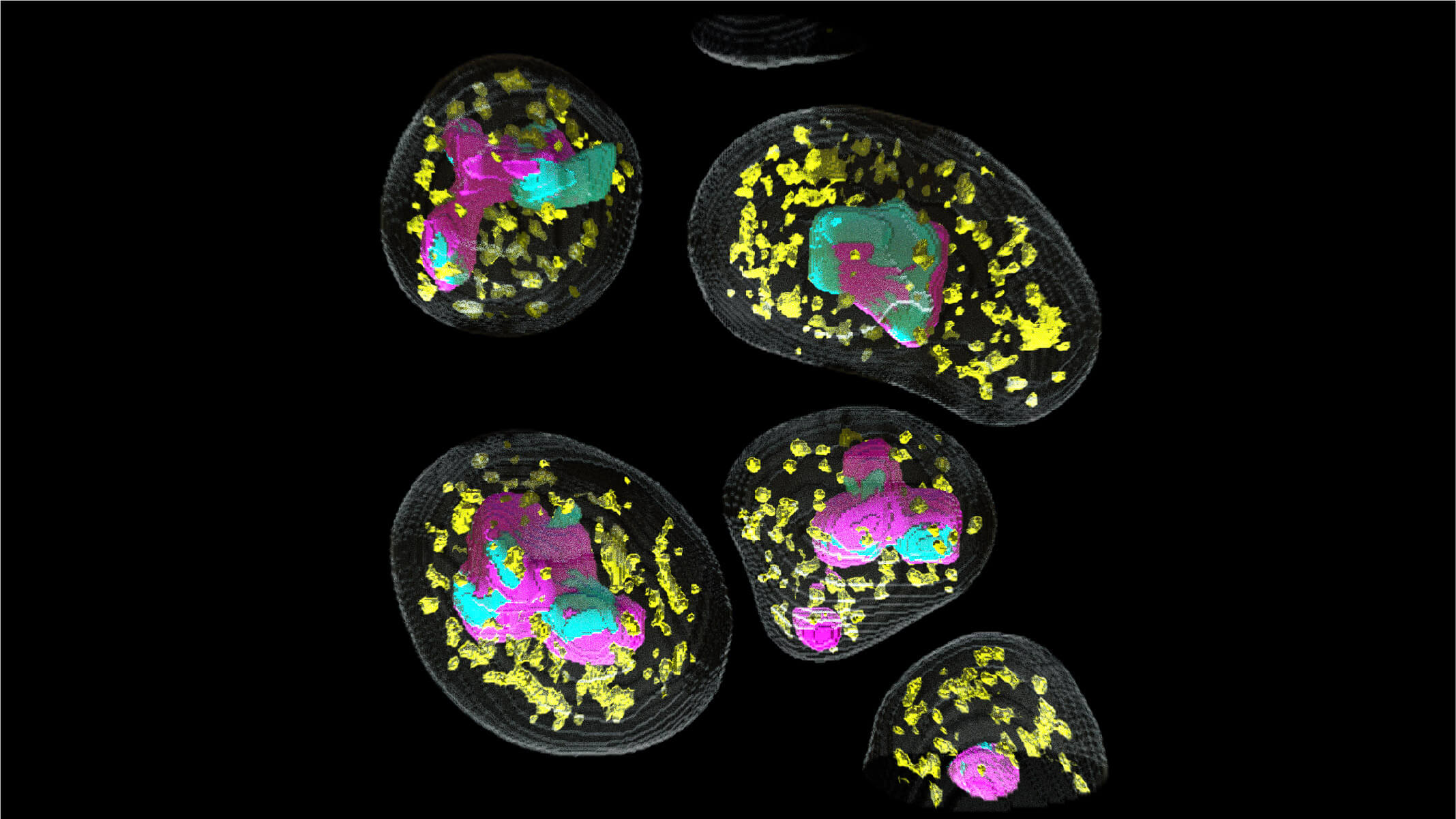
Colorful CT or MRI scan cross-sections showing multiple organ tissues highlighted in yellow, magenta, and cyan
Research teams at the Allen Institute are part of newly launched efforts to understand the cell nucleus. Here, an image from the Allen Institute for Cell Science shows models of nuclei from human stem cells, highlighting two different structures inside each nucleus: nuclear speckles (yellow) and nucleoli (cyan and magenta).

New research is underway to better understand the nucleus, the control center of our cells.

Teams from two divisions of the Allen Institute, the Allen Institute for Cell Science and the Allen Institute for Brain Science, are participating in newly launched projects to address unanswered questions in nuclear biology. Both projects are part of 4DN Centers for Data Integration, Modeling and Visualization of the National Institutes of Health Common Fund 4D Nucleome program.

The nucleus houses all of our chromosomes — our genome — and our DNA’s many associated proteins that regulate its organization and gene activity. If laid end-to-end, the entire string of a single human cell’s genome would stretch about 6.5 feet long. But each of our cells has to fit all that DNA into the nucleus, a microscopic structure less than a fifth the width of a human hair.

It’s not just a packing problem — the nucleus’s organization needs to grant proteins access to DNA to read out its genes, to replicate the DNA every time the cell divides, to switch off genes that need to remain silenced. This organization also changes in different cell states, between cell types, and in disease. There’s a whole city’s worth of architecture inside each human nucleus, and scientists still understand very little about its rules and structure.

The 4D Nucleome Program was launched in 2015 to tackle these problems through large research collaborations. The newly announced grants are part of the second phase of the program.

Both Allen Institute projects will focus on how mammalian genomes are organized in 3D in the nucleus, and how that organization changes over time or between cell states or types, one with a focus on human stem cells and the other focused on human and mouse brain cell types.

The Allen Institute for Cell Science project is part of a collaborative center titled “Multiscale Analyses of 4D Nucleome Structure and Function by Comprehensive Multimodal Data Integration,” which is headquartered at Carnegie Mellon University and led by Jian Ma, Ph.D., associate professor of computational biology. The CMU center aims to develop a better understanding of the three-dimensional structure of cell nuclei and how changes in that structure affect cell functions in health and disease. Susanne Rafelski, Ph.D., Deputy Director and Director of Assay Development at the Allen Institute for Cell Science is leading a team that will construct 3D models of the nucleus and some of its major internal compartments based on image data from live human stem cells. These models will then be merged into 3D models of the human genome that are being constructed by their collaborators in the CMU-led center

This merging of models will help the researchers understand important details about how the genome fits into the actual 3D structure of the nucleus and its functional compartments, how this varies in different cell states, and, ultimately, uncover new findings about how the nucleus and genome function in health and disease.

“We’re really excited to be a part of this interdisciplinary, iterative scientific effort,” Rafelski said. “You need this kind of integrative and holistic approach to address such a big question: What are the rules that connect nuclear organization and function?”

Ed Lein, Ph.D., Senior Investigator at the Allen Institute for Brain Science, is leading a project that is part of the “Center for Integrated Multi-modal and Multi-scale Nucleome Research,” headquartered at the University of California San Diego and led by Bing Ren, Ph.D., professor of cellular and molecular medicine. This project aims to study the nuclear organization in brain cells across development in both the laboratory mouse models and in humans with the goal to better understand the 3D organization of the mammalian genome. Lein and his Allen Institute for Brain Science colleagues will develop experimental and computational tools to understand how genome organization varies in different brain cell types and across species.

Research described in this article is supported by the National Human Genome Research Institute of the National Institutes of Health under Award Number UM1HG011585. The content is solely the responsibility of the authors and does not necessarily represent the official views of the National Institutes of Health.

Citations
No items found.

about the allen institute

The Allen Institute is an independent, 501(c)(3) nonprofit research organization founded by philanthropist and visionary, the late Paul G. Allen. The Allen Institute is dedicated to answering some of the biggest questions in bioscience and accelerating research worldwide. The Institute is a recognized leader in large-scale research with a commitment to an open science model. For more information, visit alleninstitute.org.
explore related stories

explore more stories
No articles for the category
we acceleratedevelopcatalyzeimpact

science done differently. shared with the world.

explore our accelerators

brain science

Mapping every cell, connection, and circuit in the brain—openly shared with the world.

cell science

Decoding how cells become tissues, then programming that knowledge into powerful new research tools.

neural dynamics

Revealing the brain's hidden algorithms that transform neural activity into real-world behavior.

immunology

Creating the deepest open reference for the healthy human immune system ever built.

synthetic biology

Engineering cells to record their own histories, transforming how we understand disease over time.

research

Big questions, open answers, and science built to be shared.

education

Inspiring the next generation of scientists through open science resources.

impact

Our science is empowering researchers and advancing health worldwide.
advancing science through open, collaborative research
Get the allen institute newsletter
Stay informed on the latest breakthroughs in neuroscience, bioscience, and AI-driven research.
allen institute
impactpeople & teamscareers & opportunitiesalumnihistory & founder
science resources
allencell.orgallenimmunology.orgallenneuraldynamics.orgbrain-bican.orgbrain-map.orgmicrons-explorer.org
research
brain sciencecell scienceneural dynamicsimmunologysynthetic biologypublications
education
science educationfield tripsprofessional developmenteducation resources
quick links
newseventsopen sciencepodcastscience resourceshuman brain donationvisit uscontact
follow us/

allen institute, 615 Westlake Ave North, Seattle, WA 98109 +12065487055

© 0000 allen institute. all rights reserved.
privacy policyterms of usecitation policyemployee portalpolicy & compliance