
in this article
Even the simplest networks of neurons in the brain are composed of millions of connections, and examining these vast networks is critical to understanding how the brain works. An international team of researchers, led by R. Clay Reid, Wei Chung Allen Lee and Vincent Bonin from the Allen Institute for Brain Science, Harvard Medical School and Neuro-Electronics Research Flanders (NERF), respectively, has published the largest network to date of connections between neurons in the cortex, where high-level processing occurs, and have revealed several crucial elements of how networks in the brain are organized. The results are published this week in the journal Nature.
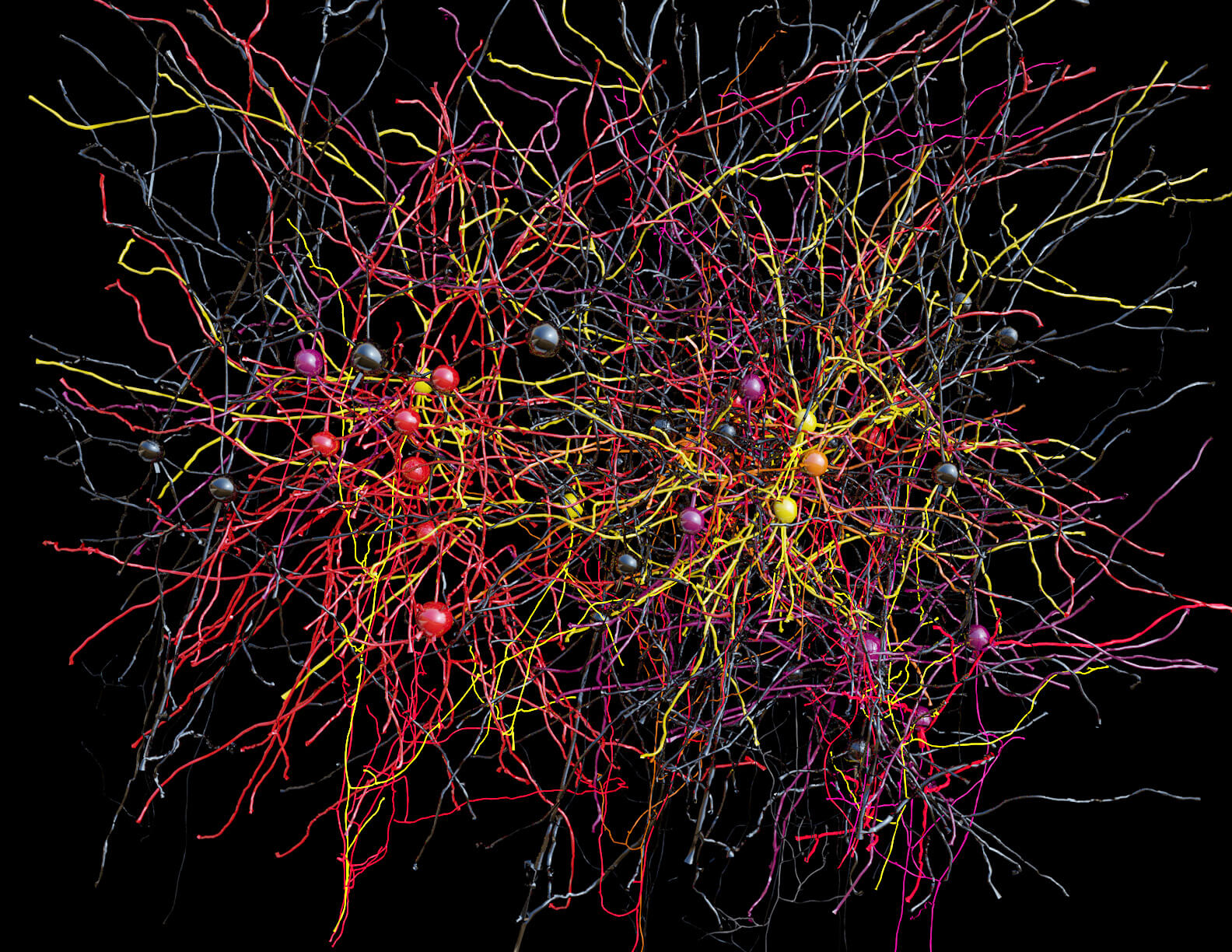
“This is a culmination of a research program that began almost ten years ago. Brain networks are too large and complex to understand piecemeal, so we used high-throughput techniques to collect huge data sets of brain activity and brain wiring,” says R. Clay Reid, M.D., Ph.D., Senior Investigator at the Allen Institute for Brain Science. “But we are finding that the effort is absolutely worthwhile and that we are learning a tremendous amount about the structure of networks in the brain, and ultimately how the brain’s structure is linked to its function.”
“Although this study is a landmark moment in a substantial chapter of work, it is just the beginning,” says Wei-Chung Lee, Ph.D., Instructor in Neurobiology at Harvard Medicine School and lead author on the paper. “We now have the tools to embark on reverse engineering the brain by discovering relationships between circuit wiring and neuronal and network computations.”
“For decades, researchers have studied brain activity and wiring in isolation, unable to link the two,” says Vincent Bonin, Principal Investigator at Neuro-Electronics Research Flanders. “What we have achieved is to bridge these two realms with unprecedented detail, linking electrical activity in neurons with the nanoscale synaptic connections they make with one another.”
“We have found some of the first anatomical evidence for modular architecture in a cortical network as well as the structural basis for functionally specific connectivity between neurons,” Lee adds. “The approaches we used allowed us to define the organizational principles of neural circuits. We are now poised to discover cortical connectivity motifs, which may act as building blocks for cerebral network function.”
Lee and Bonin began by identifying neurons in the mouse visual cortex that responded to particular visual stimuli, such as vertical or horizontal bars on a screen. Lee then made ultra-thin slices of brain and captured millions of detailed images of those targeted cells and synapses, which were then reconstructed in three dimensions. Teams of annotators on both coasts of the United States simultaneously traced individual neurons through the 3D stacks of images and located connections between individual neurons.
Analyzing this wealth of data yielded several results, including the first direct structural evidence to support the idea that neurons that do similar tasks are more likely to be connected to each other than neurons that carry out different tasks. Furthermore, those connections are larger, despite the fact that they are tangled with many other neurons that perform entirely different functions.
“Part of what makes this study unique is the combination of functional imaging and detailed microscopy,” says Reid. “The microscopic data is of unprecedented scale and detail. We gain some very powerful knowledge by first learning what function a particular neuron performs, and then seeing how it connects with neurons that do similar or dissimilar things.
“It’s like a symphony orchestra with players sitting in random seats,” Reid adds. “If you listen to only a few nearby musicians, it won’t make sense. By listening to everyone, you will understand the music; it actually becomes simpler. If you then ask who each musician is listening to, you might even figure out how they make the music. There’s no conductor, so the orchestra needs to communicate.”
This combination of methods will also be employed in an IARPA contracted project with the Allen Institute for Brain Science, Baylor College of Medicine, and Princeton University, which seeks to scale these methods to a larger segment of brain tissue. The data of the present study is being made available online for other researchers to investigate.
This work was supported by the National Institutes of Health (R01 EY10115, R01 NS075436 and R21 NS085320); through resources provided by the National Resource for Biomedical Supercomputing at the Pittsburgh Supercomputing Center (P41 RR06009) and the National Center for Multiscale Modeling of Biological Systems (P41 GM103712); the Harvard Medical School Vision Core Grant (P30 EY12196); the Bertarelli Foundation; the Edward R. and Anne G. Lefler Center; the Stanley and Theodora Feldberg Fund; Neuro-Electronics Research Flanders (NERF); and the Allen Institute for Brain Science.
About the Allen Institute for Brain Science
The Allen Institute for Brain Science, a division of the Allen Institute (alleninstitute.org), is an independent, 501(c)(3) nonprofit medical research organization dedicated to accelerating the understanding of how the human brain works in health and disease. Using a big science approach, the Allen Institute generates useful public resources used by researchers and organizations around the globe, drives technological and analytical advances, and discovers fundamental brain properties through integration of experiments, modeling and theory. Launched in 2003 with a seed contribution from founder and philanthropist Paul G. Allen, the Allen Institute is supported by a diversity of government, foundation and private funds to enable its projects. Given the Institute’s achievements, Mr. Allen committed an additional $300 million in 2012 for the first four years of a ten-year plan to further propel and expand the Institute’s scientific programs, bringing his total commitment to date to $500 million. The Allen Institute’s data and tools are publicly available online at brain-map.org.
About Harvard Medical School
HMS has more than 7,500 full-time faculty working in 10 academic departments located at the School’s Boston campus or in hospital-based clinical departments at 15 Harvard-affiliated teaching hospitals and research institutes: Beth Israel Deaconess Medical Center, Boston Children’s Hospital, Brigham and Women’s Hospital, Cambridge Health Alliance, Dana-Farber Cancer Institute, Harvard Pilgrim Health Care Institute, Hebrew SeniorLife, Joslin Diabetes Center, Judge Baker Children’s Center, Massachusetts Eye and Ear/Schepens Eye Research Institute, Massachusetts General Hospital, McLean Hospital, Mount Auburn Hospital, Spaulding Rehabilitation Hospital and VA Boston Healthcare System.
About NERF
Neuro-Electronics Research Flanders (NERF; www.nerf.be) is a neurotechnology research initiative is headquartered in Leuven, Belgium initiated by imec, KU Leuven and VIB to unravel how electrical activity in the brain gives rise to mental function and behaviour. Imec performs world-leading research in nanoelectronics and has offices in Belgium, the Netherlands, Taiwan, USA, China, India and Japan. Its staff of about 2,200 people includes almost 700 industrial residents and guest researchers. In 2014, imec’s revenue (P&L) totaled 363 million euro. VIB is a life sciences research institute in Flanders, Belgium. With more than 1470 scientists from over 60 countries, VIB performs basic research into the molecular foundations of life. KU Leuven is one of the oldest and largest research universities in Europe with over 10,000 employees and 55,000 students.
Citations
about the allen institute
The Allen Institute is an independent, 501(c)(3) nonprofit research organization founded by philanthropist and visionary, the late Paul G. Allen. The Allen Institute is dedicated to answering some of the biggest questions in bioscience and accelerating research worldwide. The Institute is a recognized leader in large-scale research with a commitment to an open science model. For more information, visit alleninstitute.org.




