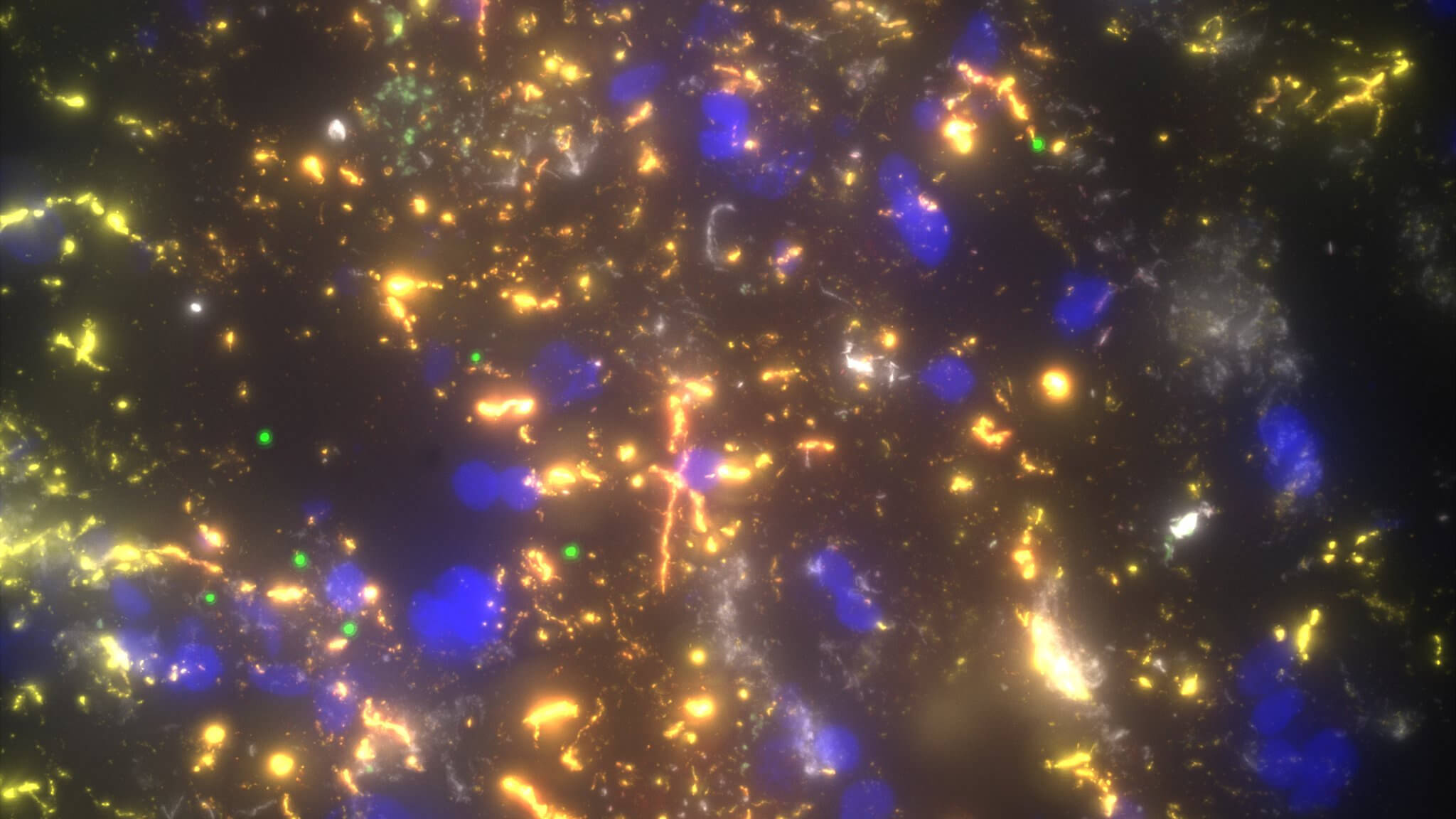

A project newly underway at the Allen Institute aims to better understand the early stages of Alzheimer’s disease by identifying changes in the neurons and other brain cells as the disease progresses. Through collaborations with UW Medicine and Kaiser Permanente Washington Health Research Institute, Allen Institute scientists are comparing brain cells across patients with different stages of the disease (using brain tissue from patients who agreed to donate their brains to science after they die) with the goal of pinpointing how and where the neurodegenerative disease starts. Their experiments will look for the specific types of neurons and other brain cells that die off or are otherwise changed in early stages of the disease. This image, captured by Allen Institute researcher Zoe Maltzer, shows brain tissue from a patient who died with Alzheimer’s disease. Bright orange specks label a molecule called phosphorylated tau, which accumulates in the brain as Alzheimer’s progresses; blue dots stain the chromosomes of every cell present in the tissue. Eventually, Maltzer and others on the team will work to combine tau labeling with labels to detect specific kinds of neurons in the same tissue.
Citations
about the allen institute
The Allen Institute is an independent, 501(c)(3) nonprofit research organization founded by philanthropist and visionary, the late Paul G. Allen. The Allen Institute is dedicated to answering some of the biggest questions in bioscience and accelerating research worldwide. The Institute is a recognized leader in large-scale research with a commitment to an open science model. For more information, visit alleninstitute.org.