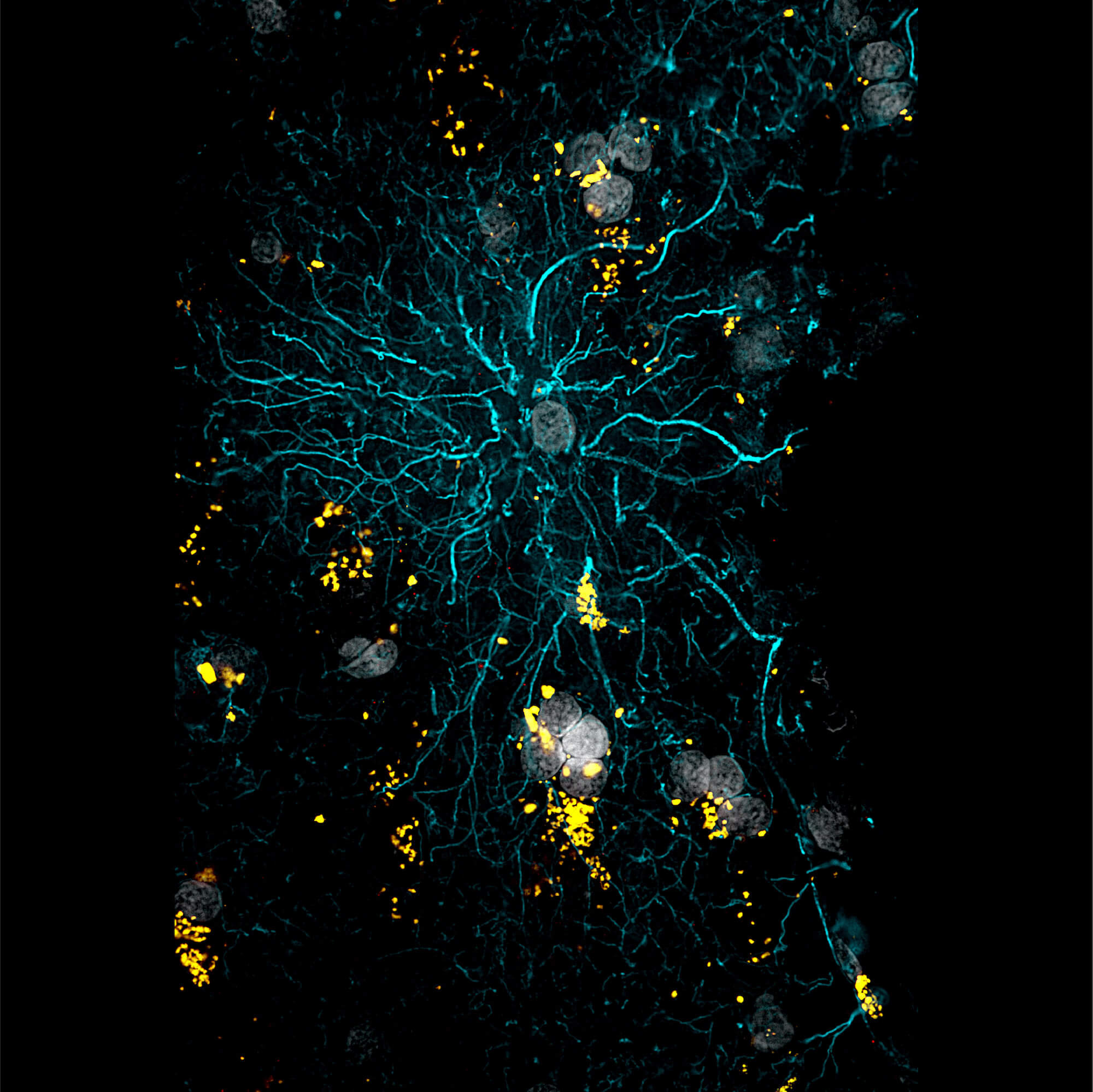

What is a human brain cell but not a neuron? It sounds like a riddle, but our brains are full of other, lesser-known cells besides the textbook-famous electrical-signal-conducting neurons. Some of these cells, known collectively as glial cells, seem to be just as complicated as neurons but because they don’t send signals in the same way, are even harder to study in the lab. Shown here, in a microscopy image taken by Allen Institute for Brain Science Assistant Investigator Rebecca Hodge, Ph.D., a delicate type of brain cell known as an astrocyte, named for their star-like shape. Hodge and other Allen Institute scientists recently published a study that compares brain cell types, including astrocyte types, in the brains of mice, monkeys and humans. This particular human astrocyte appears to be a rare type known as a varicose projection astrocyte, so-called because it makes contact with blood vessels in the brain. This kind of astrocyte has only been found in the brains of humans and other apes.
Microscopic viewpoints, computer-generated models, intricate tracings and more — see a new side of science with SciShots.
Citations
about the allen institute
The Allen Institute is an independent, 501(c)(3) nonprofit research organization founded by philanthropist and visionary, the late Paul G. Allen. The Allen Institute is dedicated to answering some of the biggest questions in bioscience and accelerating research worldwide. The Institute is a recognized leader in large-scale research with a commitment to an open science model. For more information, visit alleninstitute.org.




