in this article
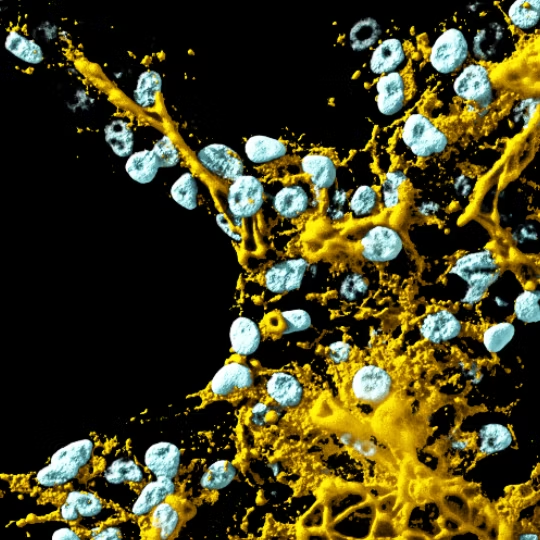
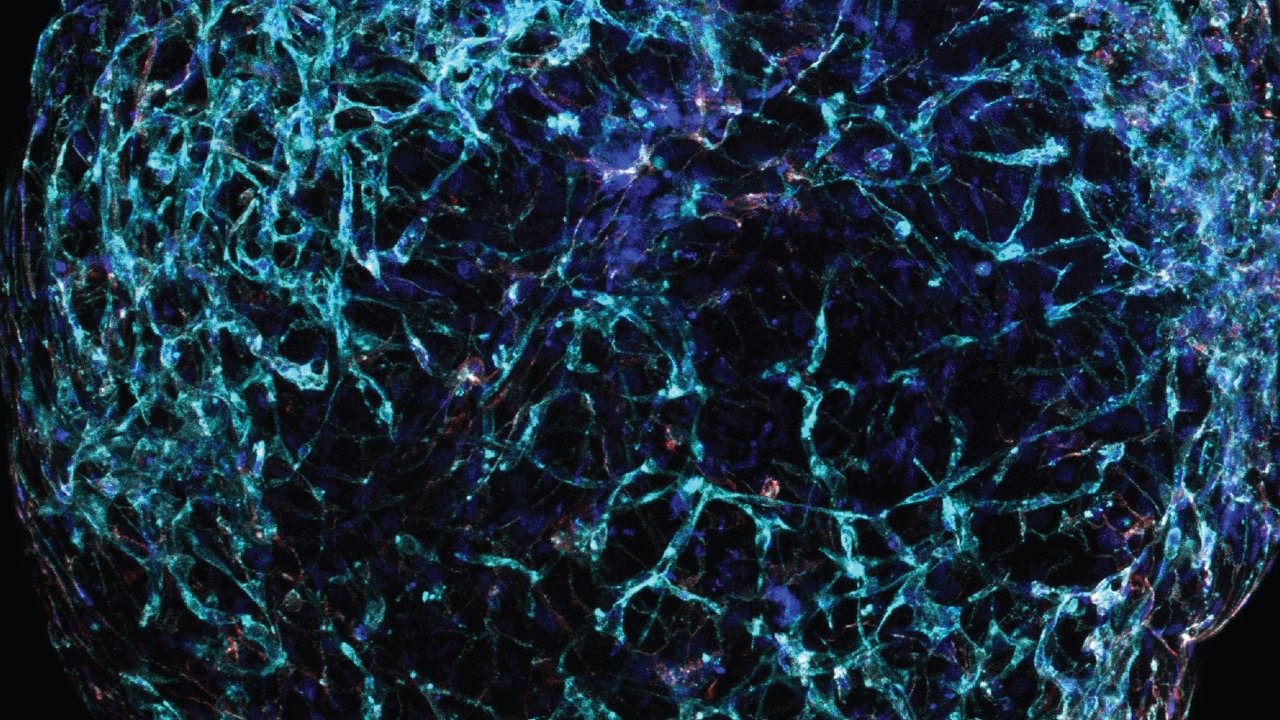
Organoids, lab-grown mini-organs that embody some aspects of our actual organs, hold the promise for better understanding of human biology. But these microscopic organ-like blobs of cells fall short of real organs in a lot of ways. For one, their size is limited to less than half of a millimeter in diameter — any larger and their internal cells start dying because nutrients from the liquid they’re grown in can’t diffuse past a certain distance. To make large, more life–like mini-organs, Allen Distinguished Investigators Josef Penninger, M.D., Nika Shakiba, Ph.D., Nozomu Yachie, Ph.D., and Nico Werschler, all with the University of British Columbia, are working to grow organoids with blood vessels to supply the cells with oxygen and nutrients. This image captured by Alexandra Leopoldi shows an organoid made of blood vessel cells — cells that line the inside of vessels, known as endothelial cells, are shown in turquoise and the nucleus of each cell is shown in royal blue. Eventually, the team wants to integrate these so-called vascular organoids with other kinds of cells to generate more complex organoids.
Citations
about the allen institute
The Allen Institute is an independent, 501(c)(3) nonprofit research organization founded by philanthropist and visionary, the late Paul G. Allen. The Allen Institute is dedicated to answering some of the biggest questions in bioscience and accelerating research worldwide. The Institute is a recognized leader in large-scale research with a commitment to an open science model. For more information, visit alleninstitute.org.