in this article
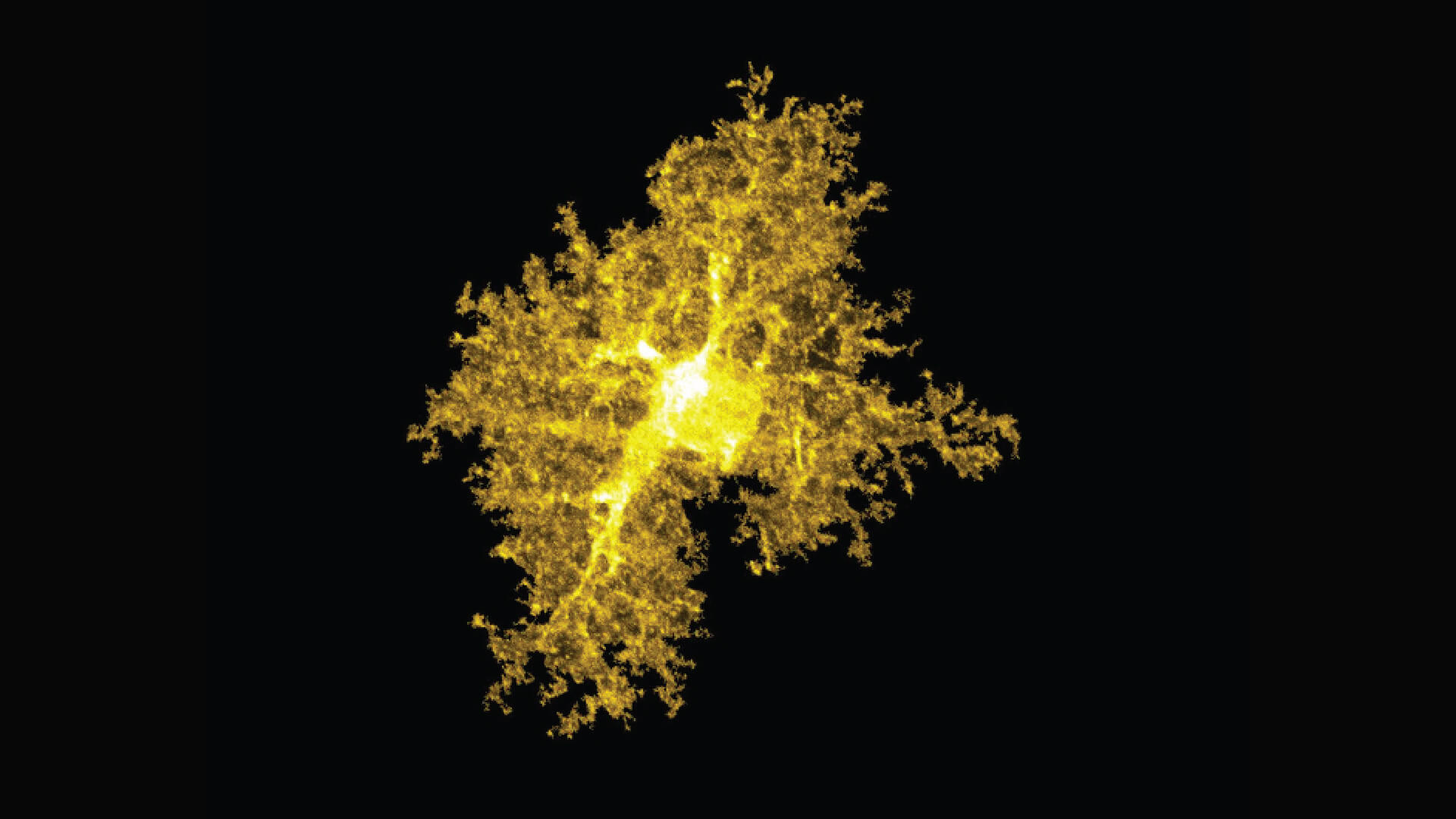
A new study has pinpointed a previously unknown role for a certain kind of brain cell in obsessive-compulsive disorder, or OCD, a common psychiatric disorder. A team of researchers were surprised to find a protein implicated in OCD throughout the structural support systems of the star-shaped brain cells known as astrocytes. The team at the University of California, Los Angeles, led by Allen Distinguished Investigator Baljit Khakh, Ph.D., wanted to understand the protein makeup of mouse astrocytes and neurons. The OCD-linked protein, known as SAPAP3, showed up in large amounts in their experiments in both kinds of brain cells. In this pair of images captured by UCLA graduate student Joselyn Soto, a healthy mouse astrocyte (left) is compared to an astrocyte from a mouse missing the SAPAP3 protein (right). The team found that in mice missing SAPAP3, which were already known to exhibit behaviors akin to human OCD, astrocytes are much smaller and less complex than in healthy mice. Adding the SAPAP3 protein back to astrocytes in these mice also improved some of their OCD-like behaviors. — Rachel Tompa, Ph.D.
Microscopic viewpoints, computer-generated models, intricate tracings and more — see a new side of science with SciShots.
Citations
about the allen institute
The Allen Institute is an independent, 501(c)(3) nonprofit research organization founded by philanthropist and visionary, the late Paul G. Allen. The Allen Institute is dedicated to answering some of the biggest questions in bioscience and accelerating research worldwide. The Institute is a recognized leader in large-scale research with a commitment to an open science model. For more information, visit alleninstitute.org.