in this article
Around half of your brain is made up of cells that are not neurons. Among those are octopus-like microglia, which act as the brain’s janitor and paramedic, consuming dead cells, pathogens and harmful protein clusters that cause disease. These shape-shifting cells, the primary immune cells in the brain, are closely related to blood cells. Their tentacle-like arms can move around to touch nearby neurons to check up on whether they’re functioning properly.
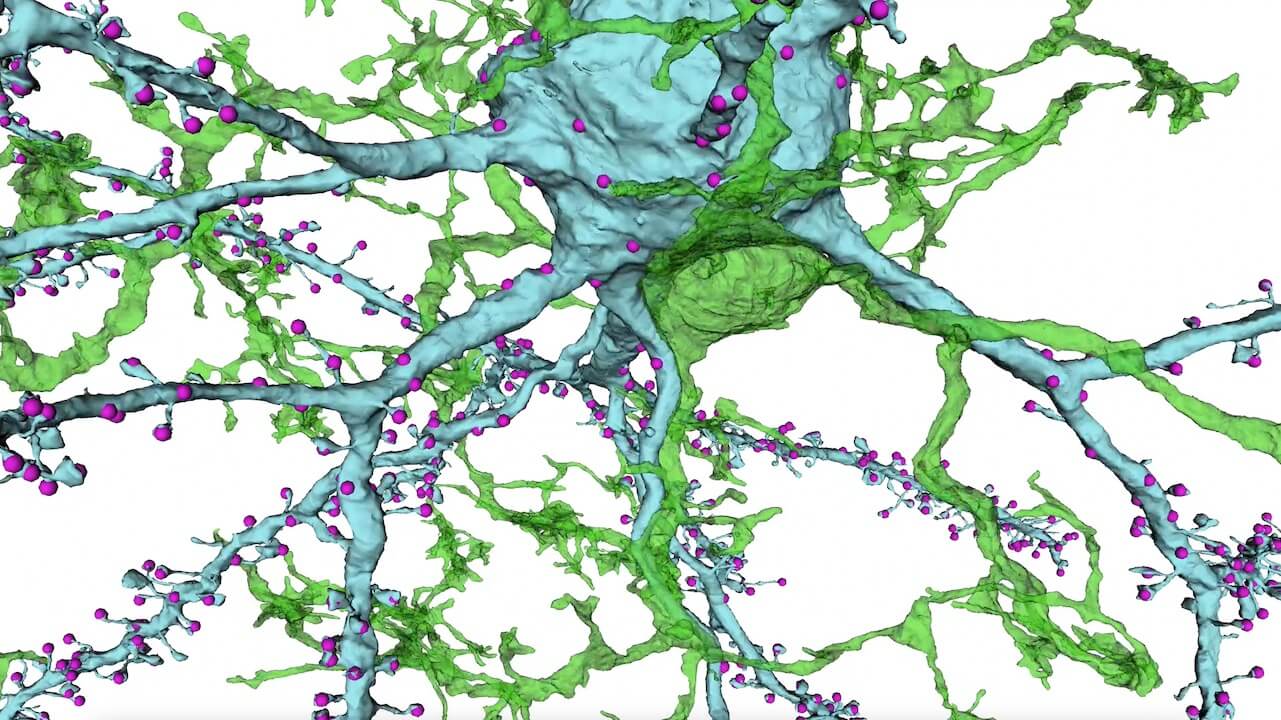
This image and corresponding video, created by Forrest Collman, Ph.D., assistant investigator at the Allen Insitute for Brain Science, was created using data from MICrONs-explorer, a database and library of visualizations aimed at mapping the function and connectivity of brain circuits. It shows microglia (green), wrapped around a kind of neuron known as a pyramidal cell (light blue), one of two types of excitatory neurons in the brain named after its pyramid shape. Excitatory cells are responsible for the firing of electrical signals in the brain from neuron to neuron. Like a game of telephone, the transmission of these electrical pulses from one cell to the next is how brain cells talk to one another.
This particular image is from the region of the mouse’s brain where visual information received from the eyes is processed. Pyramidal neurons are the most numerous kind of excitatory neurons in the brain. They make up about two-thirds of all neurons in the cerebral cortex, the outermost shell of the brain. They also have extremely long axons that project across brain regions, sometimes out of the brain altogether. The purple spheres denote where the two different cells touch and this electrical communication can take place from one cell to another.
Citations
about the allen institute
The Allen Institute is an independent, 501(c)(3) nonprofit research organization founded by philanthropist and visionary, the late Paul G. Allen. The Allen Institute is dedicated to answering some of the biggest questions in bioscience and accelerating research worldwide. The Institute is a recognized leader in large-scale research with a commitment to an open science model. For more information, visit alleninstitute.org.




