in this article
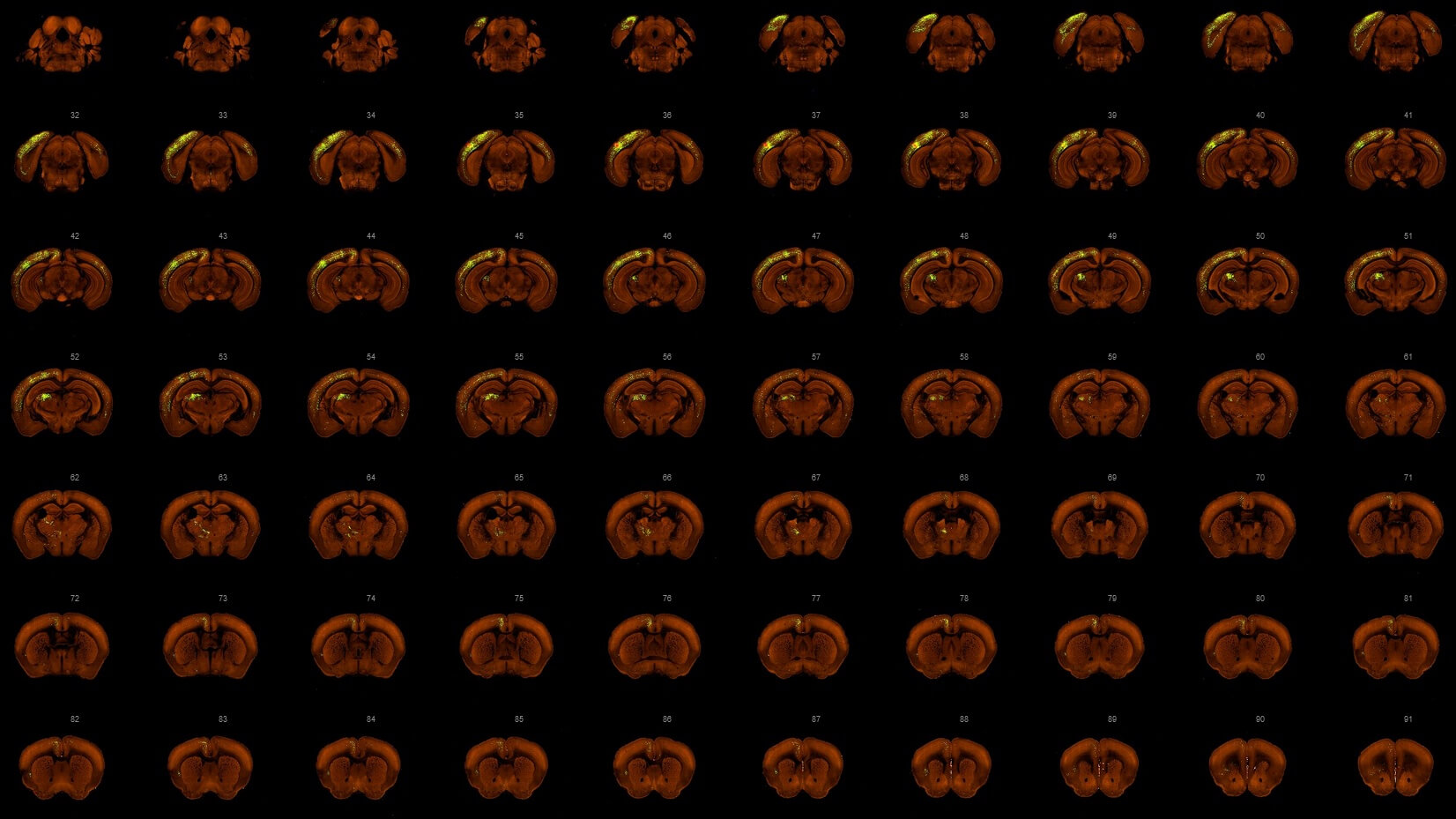
In its natural form, the rabies virus possesses a terrifying ability to zip “backwards” along nerve cells, traveling from the ends of nerve fibers embedded in a muscle (the site of an infected bite) to neuron bodies in the spinal cord and, eventually, the brain. But over the past few decades, neuroscientists have hijacked the path traced by this virus to use as a tool for understanding the pathways information travels in the brain. By engineering rabies virus to carry fluorescent markers (and to lose its deadliness), scientists were able to light up so-called retrograde neural connections — pinpointing the neurons that talk to the original “infected” neuron. Researchers at the Allen Institute for Brain Science, a division of the Allen Institute, have adapted this method to trace the vast suite of connections that input into the mouse visual cortex, one of the parts of the brain that processes what the animal sees. In this image composite created by Senior Scientist Shenqin Yao, Ph.D., neurons in the entire mouse brain that connect to the visual cortex are lit up in green. The team recently published their findings in the journal Nature Neuroscience. — Rachel Tompa, Ph.D.
Microscopic viewpoints, computer-generated models, intricate tracings and more — see a new side of science with SciShots.
Citations
about the allen institute
The Allen Institute is an independent, 501(c)(3) nonprofit research organization founded by philanthropist and visionary, the late Paul G. Allen. The Allen Institute is dedicated to answering some of the biggest questions in bioscience and accelerating research worldwide. The Institute is a recognized leader in large-scale research with a commitment to an open science model. For more information, visit alleninstitute.org.




