in this article
First-of-its-kind research initiative will develop technologies to reveal how changes in cells and genes over time influence human health and disease.
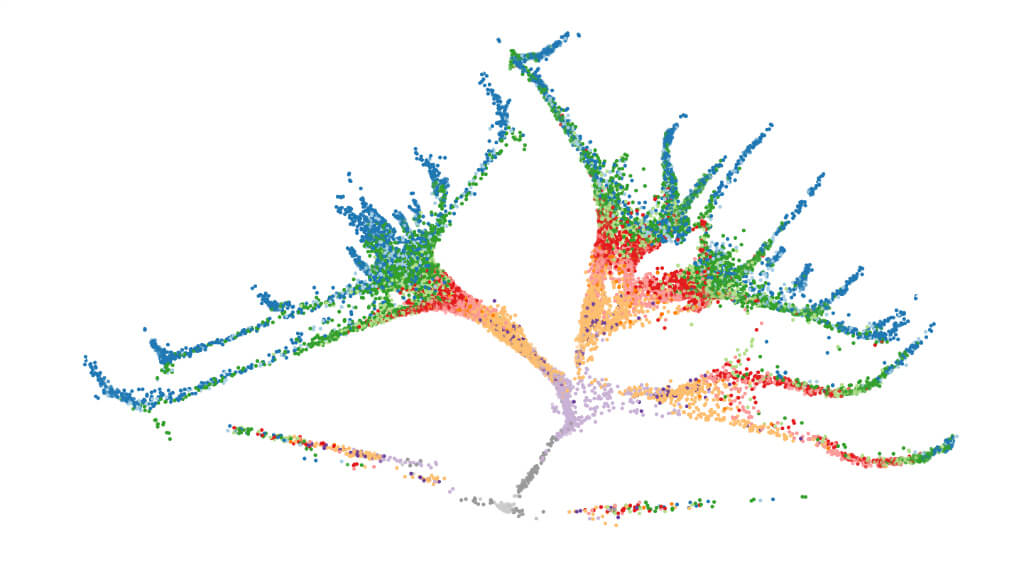
The Allen Institute, the Chan Zuckerberg Initiative (CZI), and the University of Washington (UW) today announced the launch of the Seattle Hub for Synthetic Biology: a landmark collaboration that will build new technologies to record the history of cells over time. These technologies will help researchers crack the code and understand not just end point measurements of cells and genes in health and disease but the dynamics of their trajectories over time. The Seattle Hub for Synthetic Biology brings together the best of large-scale science and philanthropy with proven academic power to develop, refine, and share this paradigm-shifting single-cell technology. Led by UW Medicine researchers Jay Shendure, M.D., Ph.D., Marion Pepper, Ph.D., Cole Trapnell, Ph.D., and Jesse Gray, Ph.D., the Seattle Hub for Synthetic Biology will build on technology pioneered at the Allen Discovery Center for Cell Lineage Tracing and UW Medicine’s Brotman Baty Institute for Precision Medicine to reimagine living cells and genomes as devices for recording complex biological information over time.
“We are incredibly excited to enter this new era of collaboration to tackle big moonshot projects in partnership with others,” says Rui Costa, D.V.M., Ph.D., President and Chief Executive Officer of the Allen Institute. “We’re bringing together experts in genomic engineering and synthetic biology to advance a new age of experimentation that will allow us to record the history of biological events in our cells, and eventually to design new, smart interventions for disease.”
The Allen Institute and the Chan Zuckerberg Initiative share a joint commitment to open science, and as such, findings from the new institute will be shared widely with the scientific community to fuel progress in labs around the world.
“Every cell in our body has its own unique history. By developing new technologies to measure and understand the history of our cells over time, including how they are impacted by the environment around them, genetic mutations, and other factors, we can expand scientists’ understanding of what happens at the cellular level when we go from healthy to sick and help pinpoint the earliest causes of disease,” says Priscilla Chan, co-founder and co-CEO of the Chan Zuckerberg Initiative.
“The Seattle Hub for Synthetic Biology demonstrates the enormous potential impact of values-driven partnerships, and it represents a new way of thinking about how we can solve problems more quickly and effectively through scientific collaboration. Our shared values, paired with our complimentary perspectives and strengths, are a recipe for success, and I can’t wait to see what this team will accomplish together.”
“Imagine being able to put a smart watch into each of your cells to record the genome itself and everything that cell is experiencing,” says Dr. Jay Shendure, Lead Scientific Director of the Seattle Hub for Synthetic Biology and a professor of genome sciences at the University of Washington School of Medicine. “Currently, when biologists take measurements, we’re limited to either observing how a few things change over time with a microscope, or to measuring everything but only at the moment in time that we break open the cell. With the kind of genomic smart watch that we’re aiming to build, one could recover the full autobiography of each cell, rather than only the last page.”
This new paradigm has the potential to revolutionize how scientists study the role of cells and genes in human health by providing unprecedented clarity into how biological events unfold over time, including the causal chain of molecular and cellular events that begins with a genetic mutation and culminates in a developmental disease seen in the clinic. The technology will be proven out in the form of a research tool to study changes in cells in the context of development and immunology, with the vision to potentially extend the project into diverse research, diagnostic, and clinical applications.
About the Chan Zuckerberg Initiative
The Chan Zuckerberg Initiative was founded in 2015 to help solve some of society’s toughest challenges — from eradicating disease and improving education, to addressing the needs of our communities. Through collaboration, providing resources and building technology, our mission is to help build a more inclusive, just and healthy future for everyone. For more information, please visit chanzuckerberg.com.
MEDIA CONTACT: Nicki Ghafari
About the University of Washington
Established in 1861, the University of Washington is one of the pre-eminent public higher education and research institutions in the world. With an enrollment of 60,000 students across more than 200 academic majors, the UW is dedicated to providing access to an excellent education for all students. The University is home to more than 100 members of the U.S. National Academies and elite programs in many fields, and is consistently among the nation’s top five universities in receipt of federal research funding. The UW has campuses in Seattle, Bothell and Tacoma, as well as UW Medicine, a world-class academic medical center with hospitals and clinics across the Puget Sound region.
MEDIA CONTACT: Susan Gregg
Citations
about the allen institute
The Allen Institute is an independent, 501(c)(3) nonprofit research organization founded by philanthropist and visionary, the late Paul G. Allen. The Allen Institute is dedicated to answering some of the biggest questions in bioscience and accelerating research worldwide. The Institute is a recognized leader in large-scale research with a commitment to an open science model. For more information, visit alleninstitute.org.