in this article
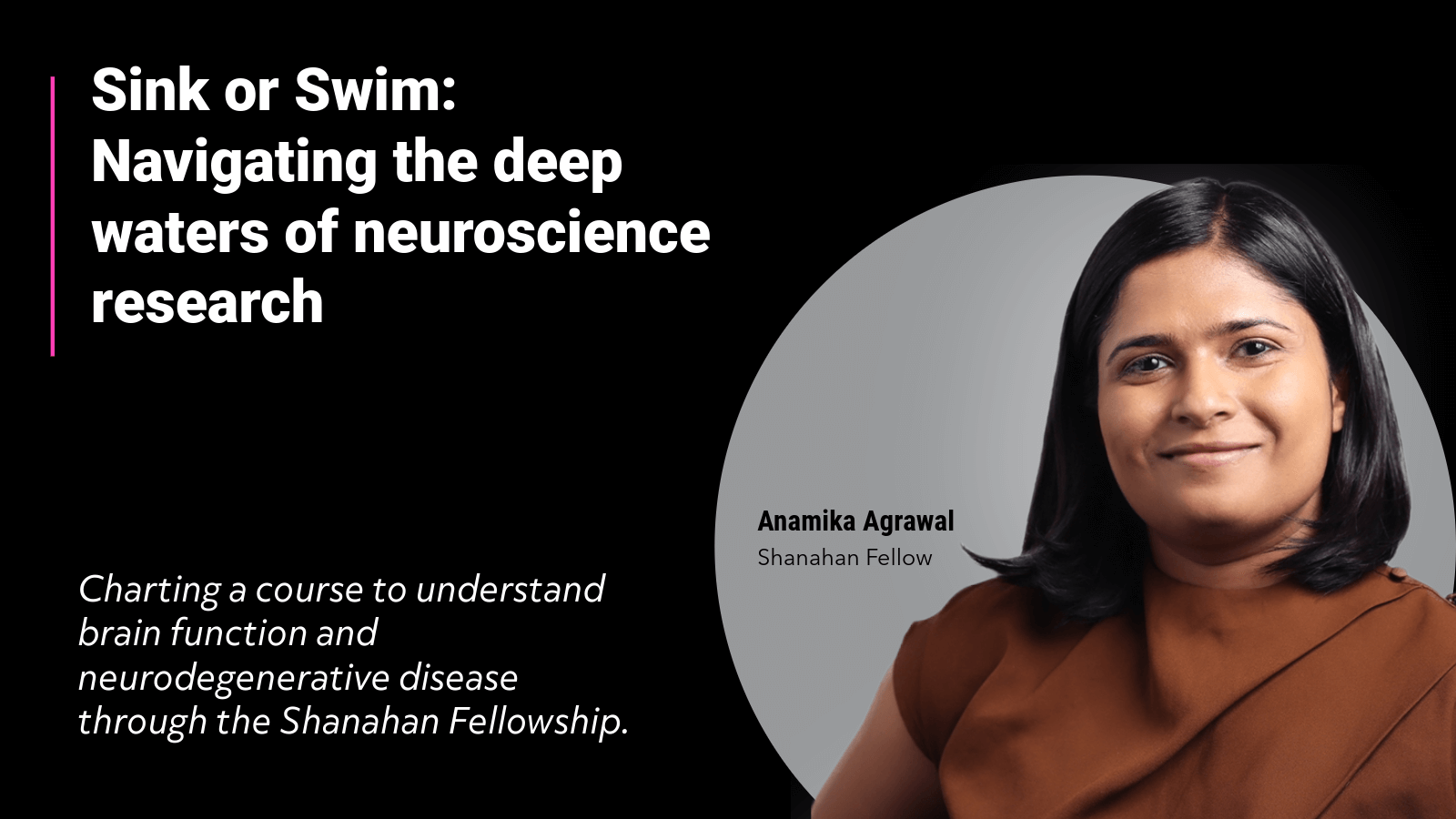
When Anamika Agrawal, Ph.D., applied for the Shanahan Fellowship at the Allen Institute, she was already eyeing a shift—from the world of physical biology to the vast, complex territory of computational and theoretical neuroscience. What she didn’t fully realize at the time was just how immersive, challenging, and transformative the experience would be.
“I was already looking for jobs at the Allen Institute, so when I saw the opportunity pop up, I applied readily!” she recalls. “The fellowship seemed like a perfect fit for my pivot.”
Because this fellowship doesn’t come with a playbook, Agrawal describes her experience as both enriching and humbling—a true “sink or swim” situation.
“Neuroscience is such a fascinating area with plenty of open questions that require new approaches. The Shanahan Fellowship program brings in fresh perspectives and people willing to explore fearlessly,” said Agrawal.
“You either figure out that you love doing independent research and want the life of a principal investigator,” she said. “Or you quickly learn that the life is not for you.”
For Agrawal, the challenges were immediate—and multifaceted. “I thought my toughest challenge would be re-learning a new field’s language and practices,” she says. “But that was nothing compared to the highs and lows of developing and managing my own research program.”
Over the course of the fellowship, she embraced the programs choose-your-own-adventure structure. With the support of mentors and peers at both the Allen Institute and the University of Washington, she began exploring multiple research directions, encountering the freedom—and responsibility—that comes with charting your own course.

“In the first year, it felt like the world had opened up to me,” she says. “So many ideas, and so many things to learn. I already knew I loved being an independent agent in research where I could gather an even bigger team to work with and collaborate with towards my interdisciplinary research program.”
Her research program ultimately landed on a critical question in neuroscience: How can we understand brain function—and dysfunction—across multiple scales, from single neurons to large neural systems? And how can we make interpretable and scalable models that can bridge multiple scales successfully?
The first major part of her research dove into the computational power of individual neurons. Working with Michael Buice, Ph.D., associate investigator, Agrawal explored how the structure of dendrites—the tree-like branches of neurons—impacts a neuron’s ability to perform complex computations. Traditionally, neurons have been modeled as simple threshold units, flipping on or off based on input, but Agrawal’s work challenges this view.
She developed a neural network model combining deep learning and computational complexity theory, incorporating dendritic geometry and nonlinear processing. Her findings reveal that neurons function as powerful processors, not just relays. Various dendritic structures enable different types of computations.
“A single neuron can act like a tiny neural network capable of solving high-dimensional problems all on its own,” she explained. “These findings suggest that the incredible diversity of neuron types in the brain isn’t just biological noise — it’s powerful design.”
Agrawal aimed to propose and test this theory with real-world data. She collaborated with Kaspar Podgorski’s group to analyze calcium and glutamate imaging datasets, which offer insight into dendritic activity. Additionally, she worked with the Electron Microscopy connectomics team, including Forrest Collman, Ph.D., and Casey Schneider-Mizell, Ph.D., to analyze differences across cortical cell types.
Her other research tackled another problem: understanding the progression of neurodegenerative disease. Through her work with the SEA-AD consortium, Agrawal got access to a dataset cataloging Alzheimer’s disease pathology across multiple brain regions and donors. The challenge, however, was the data wasn’t longitudinal (over time)—each donor provided only a single snapshot. She developed a model to map Alzheimer’s progression, in collaboration with Mariano Gabitto, Ph.D. and Gonzalo Mena, Ph.D. This method combines multiple markers into a timeline using biophysical dynamics, leading to better insights into the disease’s spatial and temporal spread in the brain.
“We tested the model on the Middle Temporal Gyrus region, and the results were promising, that harmonize multiple markers of AD into one progression timeline,” she said. She then went on to mentor Janna Hong, a talented Shanahan researcher who performed initial tests on disease progression in the Hippocampus.
Beyond the research, the fellowship also prepared her for the workplace, including presenting and communicating her work with experts in different fields, while juggling multiple projects, but says she couldn’t have done it without the team spirit of the Allen Institute.
“The institute has instilled a huge amount of respect for the scientists who perform such large-scale, collaborative work. Everyone’s open to discussion and willing to help. Even when I was not directly involved in a project, people were always available to chat or help,” she says.
Outside of the Institute, her time in Seattle also shaped her personally. “Growing up in India, and living in San Diego during my Ph.D., it took me some time to get used to the gray weather of Seattle,” she said.
Agrawal says she grew to love Seattle—especially the outdoor beauty and the walkability of the city—and says it now holds a special place in her heart. “I adopted two adorable cats here, got married in Discovery Park, and had my colleague and fellow Shanahan Fellow, Lu Mi, photograph the wedding!”
Looking back, Agrawal sees the fellowship as a rapid-fire simulation of what leading a research group would be like.
“I developed a deep appreciation for my Ph.D. advisor, who shielded me from a lot of difficulties of research management,” she said, “My fellowship mentors continue to put faith in me and help me at all steps without stifling my agency.”
For those considering the Shanahan Fellowship, Agrawal has clear advice: “Think deeply about what you want to achieve in those three years. The challenge is to manage your time and find mentors who align with your goals.”
As for what’s next, Agrawal is now looking for new opportunities, hoping to make even more of a splash in science and research.
“Neuroscience is such a fascinating area with plenty of open questions that require new approaches,” she says. “The Shanahan Fellowship program brings in fresh perspectives and people willing to explore fearlessly.”
If the Shanahan Fellowship is a proving ground for the next generation of interdisciplinary scientists, then Anamika Agrawal has done more than just stay afloat—she’s charted a bold, thoughtful course toward the future.
Citations
about the allen institute
The Allen Institute is an independent, 501(c)(3) nonprofit research organization founded by philanthropist and visionary, the late Paul G. Allen. The Allen Institute is dedicated to answering some of the biggest questions in bioscience and accelerating research worldwide. The Institute is a recognized leader in large-scale research with a commitment to an open science model. For more information, visit alleninstitute.org.