in this article
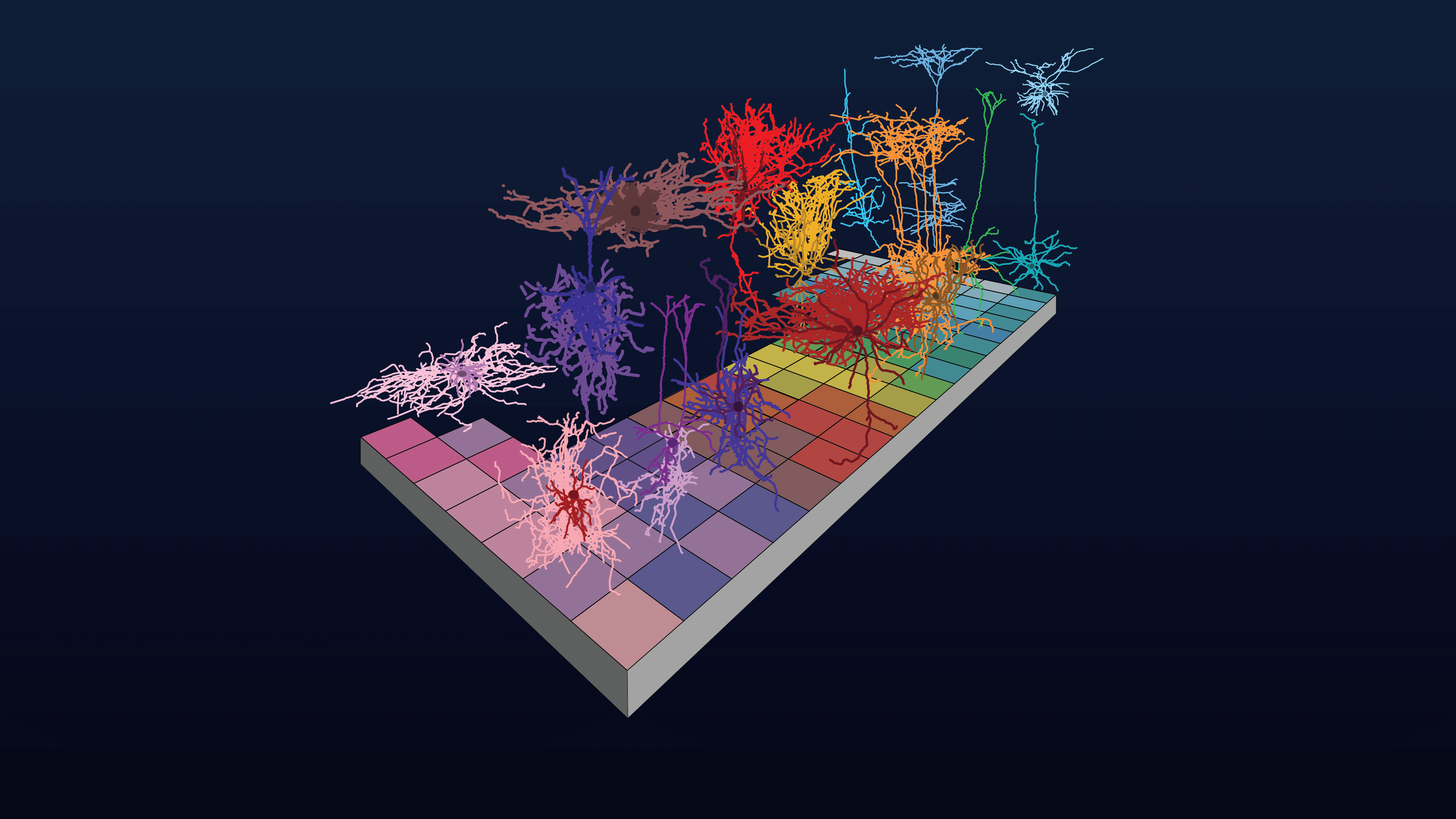
With the mouse’s 80 million neurons and our 86 billion, sorting through those delicate, microscopic building blocks is no small feat. A new study from the Allen Institute for Brain Science, which was published today in the journal Nature Neuroscience, describes a large profile of mouse neuron types based on two important characteristics of the cells: their 3D shape and their electrical behavior.
The study, which yielded the largest dataset of its kind from the adult laboratory mouse to date, is part of a larger effort at the Allen Institute to discover the brain’s “periodic table” through large-scale explorations of brain cell types. The researchers hope a better understanding of cell types in a healthy mammalian brain will lay the foundation for uncovering the cell types that underlie human brain disorders and diseases.
If you think of the classical periodic table, chemical elements can be described and sorted in a number of ways: their mass, their chemical properties, whether they are metal or not. Neuroscientists are faced with a similar challenge. A given neuron will have many different personality traits that distinguish it from other neuron types: its shape, its behavior, the unique set of genes it switches on, its location in the brain, the other types of cells it interacts with.
How do you define a cell type?
To understand what a single cell type does, researchers need to explore all these attributes, said Hongkui Zeng, Ph.D., Executive Director of Structured Science at the Allen Institute for Brain Science, a division of the Allen Institute, and senior author on the study.
“A cell type is a group of cells that have similar functional properties to each other, but we don’t understand what all those properties are,” Zeng said. “We shouldn’t just be looking at a single feature; we need to look at as many features of the cells as possible and ask whether they are consistent with each other.”
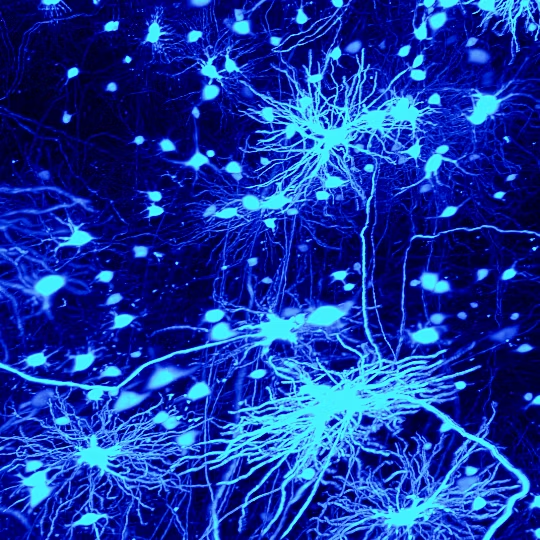
In the study, the research team sorted through neurons from the visual processing part of the mouse brain to find a few dozen different brain cell types, carefully analyzing close to 2,000 neurons’ electrical activity and their detailed 3D shape (also known as morphology) of nearly 500 of those same cells. The researchers also saw that these new cell type categories line up with categories from a complementary study published last year. In that earlier study, Allen Institute researchers used gene expression, or the list of genes that are switched on in any one cell, to sort nearly 24,000 brain cells into different types.
The fact that different features yield similar cell type groups gives the researchers confidence that they’re on the right track in their categorization, said Staci Sorensen, Ph.D., a neuroscientist who leads the morphology team at the Allen Institute for Brain Science and is a lead author on the study along with Nathan Gouwens, Ph.D., and Jim Berg, Ph.D. “If we get alignment across multiple properties of a cell, then we can feel more confident that we have a biologically meaningful cell type,” Sorensen said.
Why shape and activity matter
Their activity and shape also give the researchers clues about what the individual cells are doing in the larger context of neural circuits in the brain. Electrical signaling using pulses, so-called spikes or action potentials, is the near universal idiom of the way neurons communicate with each ones. Different neurons are tuned to send and receive different patterns of such spikes. Understanding those signals helps researchers reconstruct how these neurons might connect to others in a circuit. And their shape gives a clue as well.
“A cell’s shape is a proxy for how it’s connected to other cells,” said Gouwens, a computational neuroscientist at the Allen Institute. “We care about how cells are connected to each other because that’s how they form circuits to process information.”
Data for the community
The researchers hope that these publicly available data — along with the data about brain cell types’ gene expression, all of which are part of the Allen Cell Types database — will enable deeper exploration into specific cell types in health and disease. If a research team is interested in a specific disease-related gene in the brain, for example, they can see which cell types have that gene switched on, or expressed, and then explore the shape and activity of those neurons to form new hypotheses about how the gene might act — and what might go wrong in disease if the gene is mutated or missing.
“They can form a hypothesis as to how the gene dysfunction might change that cell type, how it might lead to specific effects,” said Berg, a neuroscientist at the Allen Institute for Brain Science who leads the team that measures neurons’ electrical activity. “It takes a lot of numbers to get that coverage so that people can trust the data, but I think we’re finally at that phase.”
An unbiased approach
To study a neuron’s morphology, researchers need to first identify a single cell amidst the tangled mess of other neurons and supporting cells in the mouse brain and then inject that one cell with a special dye-containing probe to stain it in its entirety within a slice of brain. The team used mice that were engineered at the Allen Institute to carry genes that make certain neurons glow bright colors under the microscope, letting the researchers more easily pick out individual neurons. The researchers then used those same microscopic probes to read out the cells’ electrical activity by studying their responses to different types of electrical input.
Because these experiments are so labor-intensive, research groups typically explore one or a handful of cell types at a time, which are often selected based on a specific question. The Allen Institute team, however, wanted to tackle the problem in a broad, unbiased fashion, studying cells under the same experimental conditions and from the same region of the brain so they can be more easily compared to each other.
“Instead of having a list of cell types already in mind and then putting the cells into those categories, we’re letting the categories emerge from the data,” Gouwens said. “We’re trying to be fairly broad and then see what shape the data have.”
The study was supported in part by award number U01Mh405982 from the National Institute of Mental Health and Eunice Kennedy Shriver National Institute Of Child Health & Human Development, parts of the National Institutes of Health. The content in this story and the associated study do not necessarily represent the official views of the NIH.
The study was a team effort at the Allen Institute for Brain Science. To view the full list of 95 authors, see the article here.
Citations
about the allen institute
The Allen Institute is an independent, 501(c)(3) nonprofit research organization founded by philanthropist and visionary, the late Paul G. Allen. The Allen Institute is dedicated to answering some of the biggest questions in bioscience and accelerating research worldwide. The Institute is a recognized leader in large-scale research with a commitment to an open science model. For more information, visit alleninstitute.org.