in this article
OpenScope is now open for round two. The Allen Institute’s “shared observatory” for neuroscience has selected three new research projects to pursue this year, following a successful launch of the program with three inaugural projects in 2018.
The new projects will explore how flashing light might alleviate symptoms of Alzheimer’s disease, how the visual system distinguishes different types of motion, and how context matters for vision.
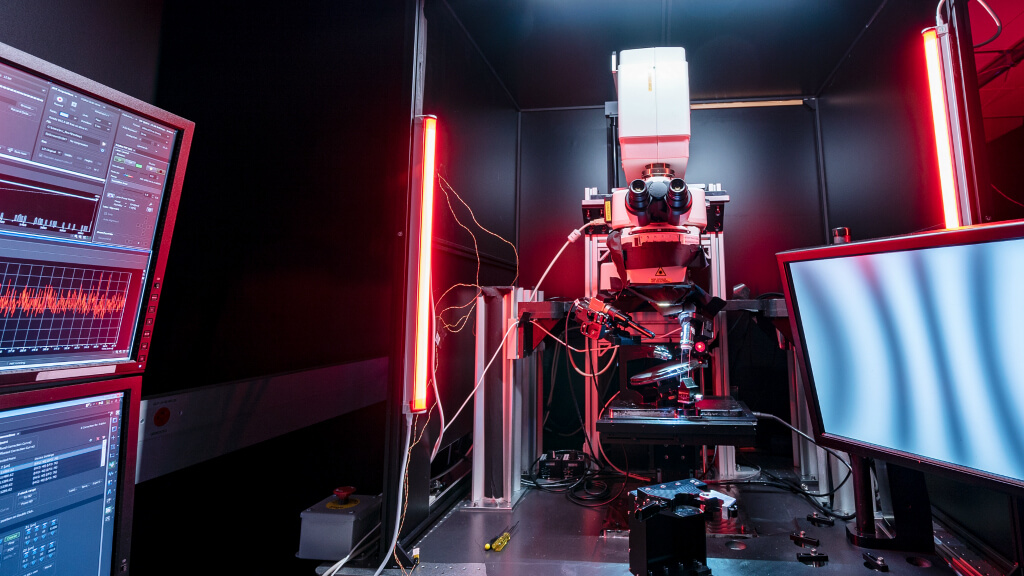
The OpenScope program allows researchers outside the Allen Institute access to a standardized, high-throughput experimental platform, the Allen Brain Observatory. Launched in 2016 and run by a team of nearly 100 different experts, the Allen Brain Observatory captures neurons and circuits in action in the mouse visual system.
Last year, the researchers opened the experimental platform to outside use through OpenScope. Scientists can propose one-year research projects to be reviewed by a scientific committee, who selects projects “blind,” without knowing the names or institutions of the research teams. Each project’s experiments are funded and carried out by the Allen Institute.
“Two of the three projects this year are collaborations across different research organizations. That’s a huge success for us,” said Jérôme Lecoq, Ph.D., Senior Manager of Optical Physiology at the Allen Institute for Brain Science, a division of the Allen Institute. Lecoq oversees OpenScope, along with neuroscientist Matthew Valley, Ph.D.
Proposals at this stage are limited to external researchers who had attended the Summer Workshop on the Dynamic Brain, an intensive computational neuroscience course that centers around data from the Allen Brain Observatory; Allen Institute Next Generation Leaders, early-career scientific advisors for the Allen Institute for Brain Science; and Allen Institute scientists.
Flickering light and Alzheimer’s research
One of the collaborative projects, a joint effort between the Allen Institute and the Massachusetts Institute of Technology, will delve into the mechanism behind an intriguing phenomenon recently uncovered by the MIT team: Flashing light at a certain frequency might alleviate memory loss and cognitive problems in a mouse model of Alzheimer’s disease.
The scientists are now testing the flickering light in an early-stage clinical trial in Alzheimer’s patients, but they still don’t understand why this particular frequency of light works to combat neurological symptoms, said Li-Huei Tsai. Ph.D., director of the Picower Institute for Learning and Memory at MIT.
Tsai and her colleagues will attempt to answer that question through their OpenScope project. They will look for the kinds of neurons that switch on when mice see light flashing at this frequency, with the goal of understanding which cells are ultimately responsible for the anti-Alzheimer’s effect. If the therapy proves beneficial in humans as well, understanding the specific cells behind the effect might allow the researchers to improve the therapy further, Tsai said.
The idea for the project came about after she visited the Allen Institute in 2018 and spoke with Allen Institute computational neuroscientist Anton Arkhipov, Ph.D., about a collaboration to use computational modeling to explore the flickering phenomenon. The pair quickly realized that the experimental setup in OpenScope could also be used to address the team’s research questions, and decided to submit a joint proposal, along with MIT’s Mitchell Murdock, Jennie Young, and Chinnakkaruppan Adaikkan, Ph.D., all researchers working in Tsai’s laboratory team.
“Individual labs could try to set up an experiment like this, but the Allen Institute is the powerhouse where they know how to do it right,” Tsai said. “It definitely gives us much more confidence doing the work through this collaboration.”
Vision in context
The second collaborative project was proposed by three Next Generation Leaders and two Allen Institute scientists. Next Generation Leaders convene at the Allen Institute twice a year to hear research talks and give their feedback; the project developed out of those meetings.
“We were all on-site, being inspired by the work at the Allen Institute on the visual system and discussing the many unsolved mysteries in neuroscience,” said Lucy Palmer, Ph.D., a former Next Generation Leader and one of the researchers leading a 2019 OpenScope project. “We would talk and dream up experiments.”
The research team includes Palmer, who leads the Neural Network Laboratory at the Florey Institute of Neuroscience and Mental Health at the University of Melbourne, Jens Kremkow, Ph.D., who leads a visual neuroscience laboratory team at the Neuroscience Research Center at the Charité – Universitätsmedizin Berlin, Richard Naud, Ph.D., a computational neuroscientist at the University of Ottawa, and Allen Institute for Brain Science neuroscientists Saskia de Vries, Ph.D., and Dan Millman, Ph.D. Kremkow and Naud are also former Next Generation Leaders.
The group is looking at how the brain encodes visual information by studying a phenomenon known as center-surround suppression, in which neurons’ response to something an animal is seeing depends on what surrounds that object. The team will ask which regions in the brain are responsible for this context-dependence and whether dendrites, the branching parts of neurons that convey information to the neuron’s cell body, are involved.
“This project is bringing together people who each have a unique area of expertise,” said Kremkow, who studies other aspects of vision in his Berlin laboratory. “I’m looking forward to what we will all learn from this endeavor.”
Motion response
De Vries is also part of the third selected OpenScope project, along with Allen Institute neuroscientist Corbett Bennett, Ph.D. The two will study how the mouse brain distinguishes different types of visual motion — think the difference between your entire visual field changing as you walk and the motion of someone throwing a ball to you. Your brain needs to understand these different kinds of motion — global motion or object motion — and respond accordingly.
De Vries and Bennett will ask whether parts of the brain known as higher visual areas are specialized to detect different types or speeds of motion in the mouse. Researchers have tracked how motion information first enters the cortex through the region known as the primary visual cortex, but don’t yet understand how higher-level processing occurs that lets us respond appropriately.
“Motion is such an important visual signal, and more broadly we’re trying to understand how our brain takes information from the outside world and drives different behaviors,” de Vries said. “OpenScope is really well-suited to explore this question.”
Citations
about the allen institute
The Allen Institute is an independent, 501(c)(3) nonprofit research organization founded by philanthropist and visionary, the late Paul G. Allen. The Allen Institute is dedicated to answering some of the biggest questions in bioscience and accelerating research worldwide. The Institute is a recognized leader in large-scale research with a commitment to an open science model. For more information, visit alleninstitute.org.




