
impact
impact
open science
subheadline
careers and opportunities
subheadline
people & teams
people & teams
subheadline
allenites
subheadline
allen institute advisors
subheadline
board of directors
subheadline
shanahan foundation fellowship
subheadline
next generation leaders
subheadline
research
overview
our approach
subheadline
publications
subheadline
open science
subheadline
accelerator
brain science
subheadline
cell science
subheadline
neural dynamics
subheadline
immunology
subheadline
synthetic biology
subheadline
education
education
science education
subheadline
education resources
subheadline
field trips
subheadline
open science
subheadline
open science quest
subheadline
news
news
stories
subheadline
podcast
subheadline
sign up for our newsletter
subheadline
events
events
all events
subheadline
conferences
subheadline
event code of conduct
subheadline
events
open science quest
subheadline
summer workshop on the dynamic brain
subheadline
open science week
subheadline
brain fest
subheadline
science resources
science resources
allencell.org
subheadline
allenimmunology.org
subheadline
allenneuraldynamics.org
subheadline
brain-bican.org
subheadline
brain-map.org
subheadline
microns-explorer.org
subheadline
impact
back to menu
impact
open science
subheading
careers and opportunities
subheading
people & teams
people & teams
subheading
allen institute advisors
subheading
board of directors
subheading
shanahan foundation fellowship
subheading
next generation leaders
subheading
research
back to menu
impact
Label
subheading
Label
subheading
people & teams
education
back to menu
research
Label
subheading
Label
subheading
Heading
news
back to menu
research
Label
subheading
Label
subheading
Heading
events
back to menu
research
Label
subheading
Label
subheading
Heading
science resources
back to menu
science resources
allencell.org
subheading
allenimmunology.org
subheading
allenneuraldynamics.org
subheading
brain-bican.org
subheading
brain-map.org
subheading
microns-explorer.org
subheading
search
stories
news

World’s first crowd-sourced neuroscience study aims to understand how our brains predict the future

Using the Allen Institute’s OpenScope platform, experiments will probe brain functions related to "predictive processing"

March 14, 2025
 min read
share/
Using the Allen Institute’s OpenScope platform, experiments will probe brain functions related to "predictive processing"
Thank you! Your submission has been received!
Oops! Something went wrong while submitting the form.

in this article

table of contents will display on published page only
set h2 to populate the table of contents here

authors

Liz Dueweke
Communications and Media Relations Specialist

An international collaboration of over 50 neuroscientists and researchers is pioneering a new approach to understanding the brain: the world’s first crowd-sourced and designed neuroscience study. The goal is to shed light on predictive processing, the brain’s ability to anticipate future events based on past experiences. The experiments began this week at the Allen Institute.

Our brains are constantly predicting the future, whether it’s expecting a bear after hearing a rustle in the forest or processing everyday visual information.

“Predictive coding is the idea that most of your brain areas might not be really encoding what you’re seeing, but rather, might be most interested in what’s different about what you’re seeing compared to what you expected,” explains Colleen Gillon, Ph.D., a researcher at Imperial College London who played a leading role in the collaboration.
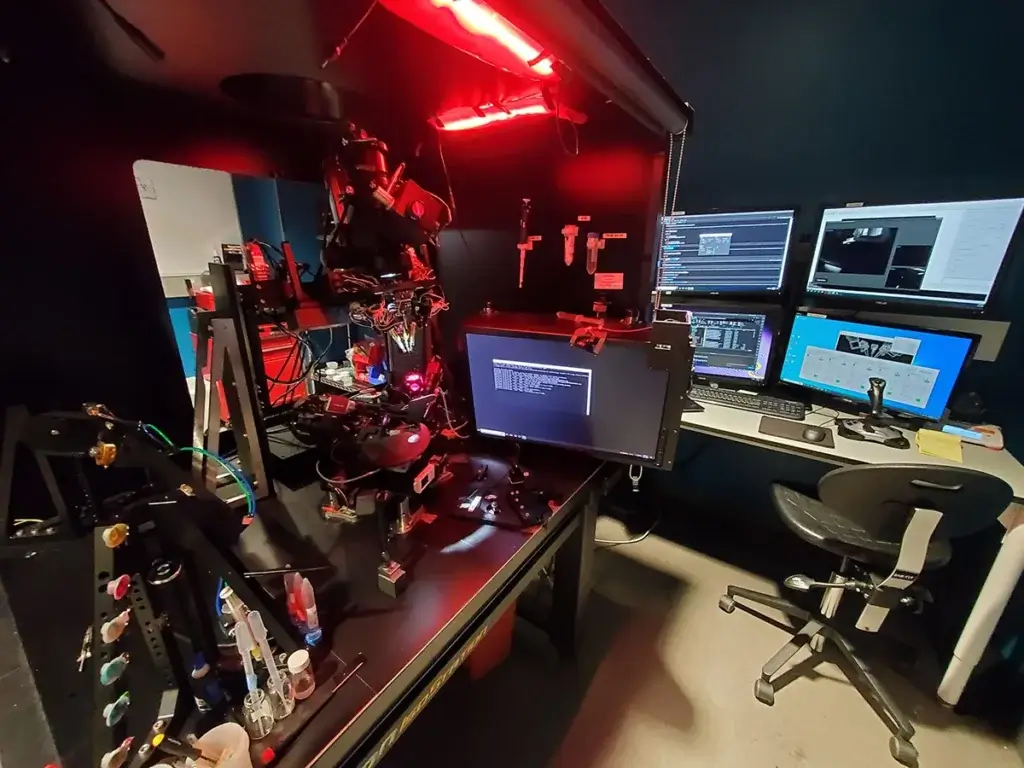
High-tech workspace with 3D printer under red lighting and multiple computer monitors displaying software interfaces.

Using the Allen Institute’s state-of-the-art OpenScope platform, a set of tools to record signals from large populations of neurons during behavior, researchers have designed experiments to test key brain functions related to predictive processing. The study aims to uncover the trade-offs that the brain makes in different contexts when predicting what comes next. For example, imagine you’re sitting on a train. If the train is moving, you naturally expect the scenery outside to flow continuously; and many brain areas are working together to predict what happens next in the long, uninterrupted sequence. But if the train is stopped and you only see a single person walking by, your brain taps into a more specialized process to anticipate that individual’s movement and uses a different set of computations.

Openscope: The World Observatory of the Mind
This experiment will bridge insights from previous studies and theoretical models to understand how the brain dynamically adjusts its predictive processes depending on the context.

A New Model for Neuroscience Research

The Allen Institute, supported by the Cognitive Computational Neuroscience conference, organized this first-of-its-kind international effort. A group of more than 50 scientists conducted extensive online collaboration, including more than 1,900 proposals and comments, to design the crowd-sourced study. This unprecedented level of cooperation will help the global scientific community better understand this important brain adaptation that is critical to survival.

“Despite nearly 3,000 scientific publications on the topic, current theories have often been criticized as too vague or difficult to validate experimentally. This disconnect has hampered progress in both understanding brain function and applying these insights to advances in machine learning and artificial intelligence,” noted Jérôme Lecoq, Ph.D., associate investigator at the Allen Institute for Neural Dynamics.  

This online, collaborative model represents a potential paradigm shift in how neuroscience research is conducted. By pooling expertise from scientists around the globe and engaging in transparent discussion and decision-making, the project successfully integrates theory with experiments. The findings are expected to not only deepen our understanding of predictive processing but also inspire future collaborative efforts in neuroscience.

Citations
No items found.

about the allen institute

The Allen Institute is an independent, 501(c)(3) nonprofit research organization founded by philanthropist and visionary, the late Paul G. Allen. The Allen Institute is dedicated to answering some of the biggest questions in bioscience and accelerating research worldwide. The Institute is a recognized leader in large-scale research with a commitment to an open science model. For more information, visit alleninstitute.org.
explore related stories

explore more stories
No articles for the category
we acceleratedevelopcatalyzeimpact

science done differently. shared with the world.

explore our accelerators

brain science

Mapping every cell, connection, and circuit in the brain—openly shared with the world.

cell science

Decoding how cells become tissues, then programming that knowledge into powerful new research tools.

neural dynamics

Revealing the brain's hidden algorithms that transform neural activity into real-world behavior.

immunology

Creating the deepest open reference for the healthy human immune system ever built.

synthetic biology

Engineering cells to record their own histories, transforming how we understand disease over time.

research

Big questions, open answers, and science built to be shared.

education

Inspiring the next generation of scientists through open science resources.

impact

Our science is empowering researchers and advancing health worldwide.
advancing science through open, collaborative research
Get the allen institute newsletter
Stay informed on the latest breakthroughs in neuroscience, bioscience, and AI-driven research.
allen institute
impactpeople & teamscareers & opportunitiesalumnihistory & founder
science resources
allencell.orgallenimmunology.orgallenneuraldynamics.orgbrain-bican.orgbrain-map.orgmicrons-explorer.org
research
brain sciencecell scienceneural dynamicsimmunologysynthetic biologypublications
education
science educationfield tripsprofessional developmenteducation resources
quick links
newseventsopen sciencepodcastscience resourceshuman brain donationvisit uscontact
follow us/

allen institute, 615 Westlake Ave North, Seattle, WA 98109 +12065487055

© 0000 allen institute. all rights reserved.
privacy policyterms of usecitation policyemployee portalpolicy & compliance