


impact
impact
open science
subheadline
careers and opportunities
subheadline
people & teams
people & teams
subheadline
allenites
subheadline
allen institute advisors
subheadline
board of directors
subheadline
shanahan foundation fellowship
subheadline
next generation leaders
subheadline
research
overview
our approach
subheadline
publications
subheadline
open science
subheadline
accelerator
brain science
subheadline
cell science
subheadline
neural dynamics
subheadline
immunology
subheadline
synthetic biology
subheadline
education
education
science education
subheadline
education resources
subheadline
field trips
subheadline
open science
subheadline
open science quest
subheadline
news
news
stories
subheadline
podcast
subheadline
sign up for our newsletter
subheadline
events
events
all events
subheadline
conferences
subheadline
event code of conduct
subheadline
events
open science quest
subheadline
summer workshop on the dynamic brain
subheadline
open science week
subheadline
brain fest
subheadline
science resources
science resources
allencell.org
subheadline
allenimmunology.org
subheadline
allenneuraldynamics.org
subheadline
brain-bican.org
subheadline
brain-map.org
subheadline
microns-explorer.org
subheadline
impact
back to menu
impact
open science
subheading
careers and opportunities
subheading
people & teams
people & teams
subheading
allen institute advisors
subheading
board of directors
subheading
shanahan foundation fellowship
subheading
next generation leaders
subheading
research
back to menu
impact
Label
subheading
Label
subheading
people & teams
education
back to menu
research
Label
subheading
Label
subheading
Heading
news
back to menu
research
Label
subheading
Label
subheading
Heading
events
back to menu
research
Label
subheading
Label
subheading
Heading
science resources
back to menu
science resources
allencell.org
subheading
allenimmunology.org
subheading
allenneuraldynamics.org
subheading
brain-bican.org
subheading
brain-map.org
subheading
microns-explorer.org
subheading
search
education

What is omics?

Explore the branch of research known as “omics“– including genomics, transcriptomics, and proteomics

resource type / 
Explainer
published / March 2, 2026
education level / 
General Public
Undergraduate
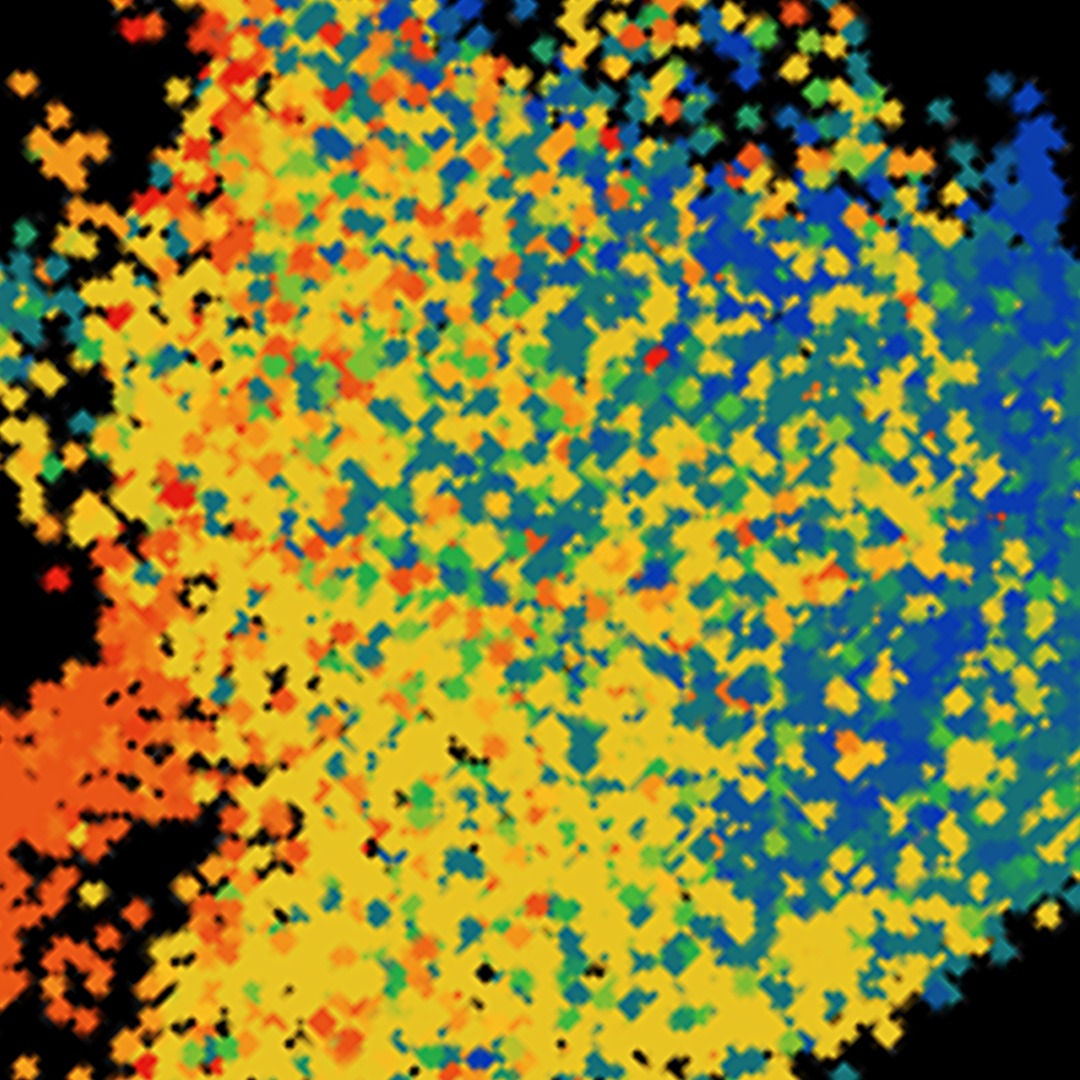
Colorful pixelated grid pattern with purple, yellow, black, and olive tones in mosaic layout
share/
This is some text inside of a div block.

in this lesson

table of contents will display on published page only
set h2 to populate the table of contents here
lesson

contributors

Madison Meuler
Education and Engagement Specialist II
Kaitlyn Casimo
Manager, Education & Engagement
Rachel Penton
Education and Engagement Supervisor

Explore a branch of research called “omics”

“Omics” refers to a branch of research in the biological sciences focused on studying all of a particular type of molecule found within a living system.

This research includes techniques that share the suffix of -omics:

  • Genomics: studying all of the genes within a genome
  • Transcriptomics: studying all of the RNA within a cell
  • Proteomics: studying all of the proteins within a cell
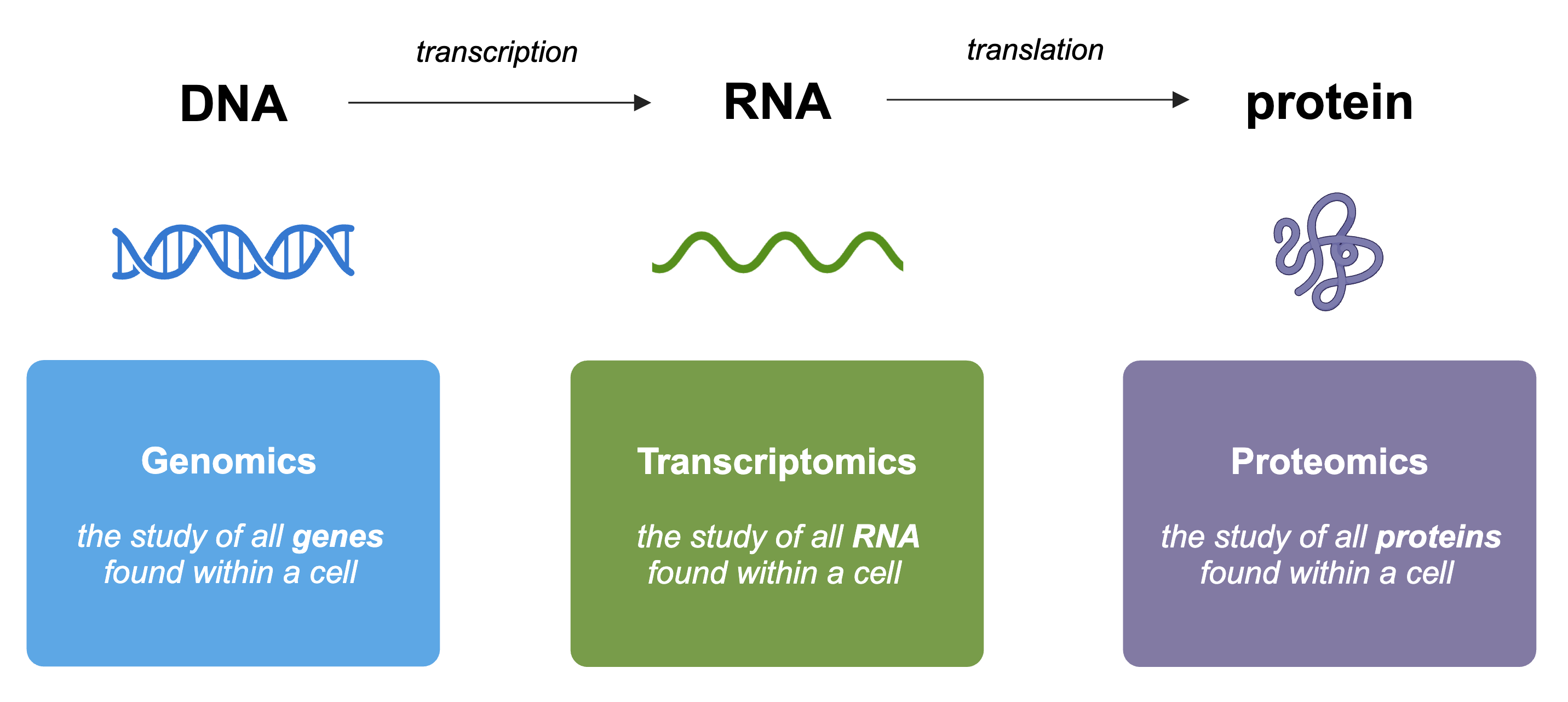
Flow chart of central dogma. A DNA molecule with an arrow to an RNA molecule with a label of "transcription," and then an arrow from the RNA molecule to a protein molecule with a label of "translation." Under DNA, there is a text box that reads "Genomics: the study of all genes found within a cell." Under RNA, there is a text box that reads "Transcriptomics: the study of all RNA found within a cell." Under protein, there is a text box that reads: "Proteomics: the study of all proteins found within a cell."
Image created in https://BioRender.com

‍

Types of Omics

What is genomics?

While genetics is the study of individual genes, genomics is the study of all of the genes found within a particular cell or organism (National Human Genome Research Institute). By studying all of the genes within a genome, we can gain a better understanding of the sequence of each of these genes, their relative locations within the genome, and what they code for within the cell.
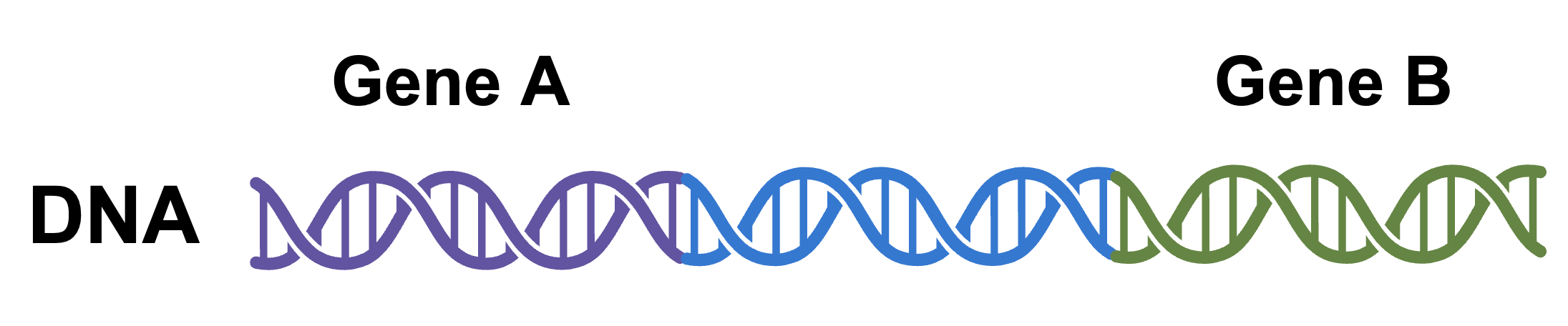
Double-stranded DNA with a region highlighted and titled "gene A," an unlabled region of DNA in the center, and another highlighted region titled "gene B."
Image created in https://BioRender.com

‍

Perhaps the most famous example of genomics research is the Human Genome Project where scientists successfully sequenced the entire human genome for the first time. Understanding the full sequence of a genome tells us valuable information about which genes a cell could express. However, not all genes in a cell’s genome are expressed all of the time. Instead, most genes are turned “on” and “off” at different points in a cell’s life cycle. Gene expression can not only vary across time but can also differ between different types of cells within the body. For example, the cells that make up your heart express different genes than the cells that make up your skin.  

While genomics allows us to study which genes a cell could express, we have to rely on other methods, such as transcriptomics or proteomics, to determine which genes a cell is actually expressing at a given point in time.

‍

What is transcriptomics?

Transcriptomics is the study of all of the RNA transcripts found within a cell at a given point in time. This includes measuring coding RNA, which is RNA that will be translated into a protein, and non-coding RNA, which carries out a separate function without necessarily being translated into a protein.
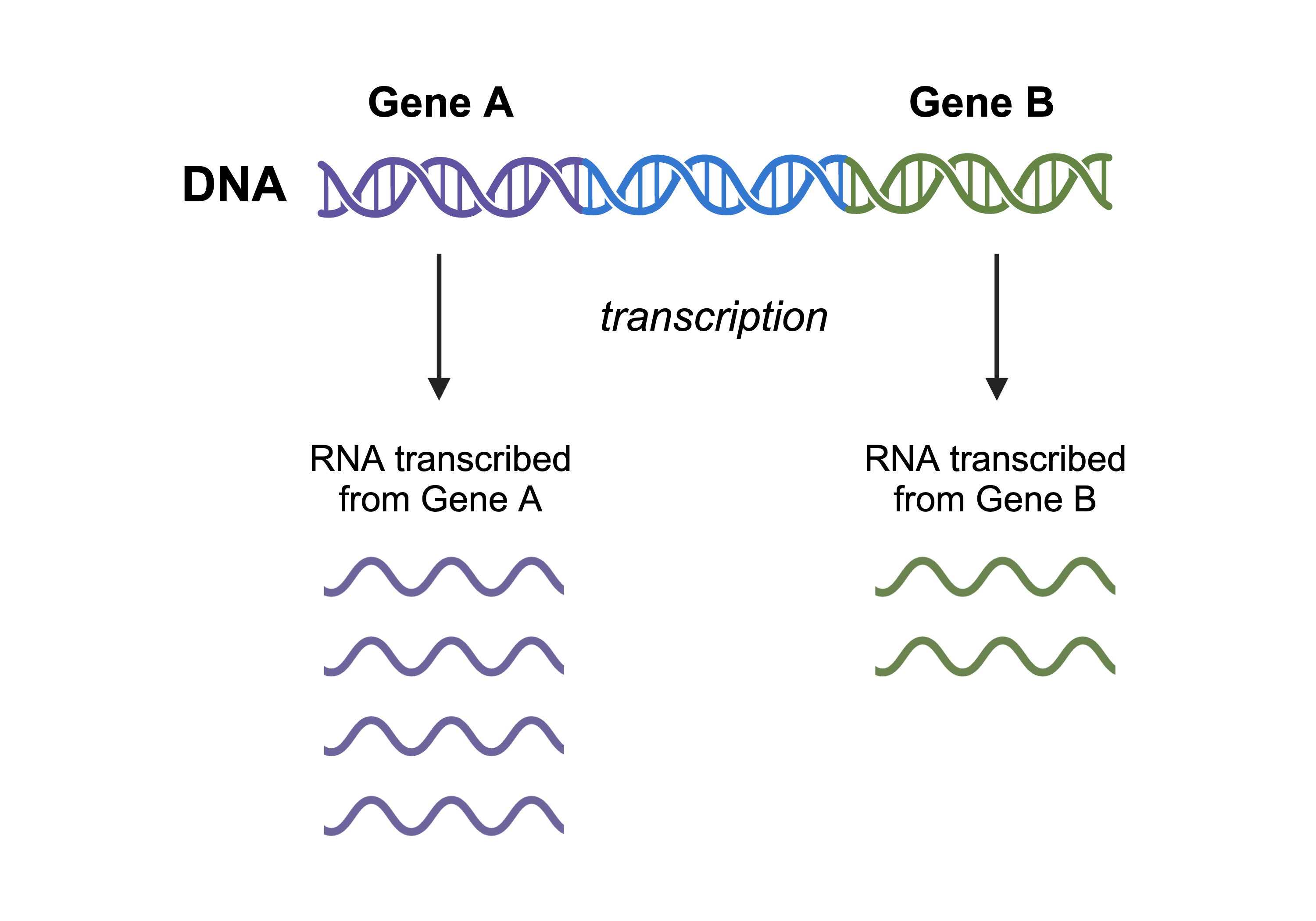
A long DNA molecule with three sections each with different colors. The first section is labeled "Gene A" with an arrow pointing down to 4 RNA molecules, labeled "RNA transcribed from Gene A." The last section of DNA is labeled "Gene B" with an arrow pointing down to 2 RNA molecules, labeled "RNA transcribed from Gene B."
Image created in https://BioRender.com

‍

By sequencing all of the RNA found within a cell, we can work “backwards” and determine which gene each molecule of RNA was transcribed from. Transcriptomics not only evaluates which RNA molecules are present/absent in a cell but also the quantity of the RNA molecules.  

For example, if we are measuring RNA transcripts within a hypothetical cell, we might find twice the amount of RNA transcripts from gene A compared to the RNA transcripts from gene B. This information allows us to infer that at the point in time when we measured the RNA within this cell, the cell was expressing gene A twice as much as gene B. If the functions of gene A and gene B are known, we can then use these data on their relative expression to infer what internal processes were taking place at the time when the cell was sampled.  

At the Allen Institute, we use transcriptomics for multiple lines of research—including our efforts to map the human brain and map the healthy human immune system.  

‍

What is proteomics?

Proteomics refers to the study of all of the proteins within a given cell and/or organism. A proteome refers to the entire list of proteins made by a cell.
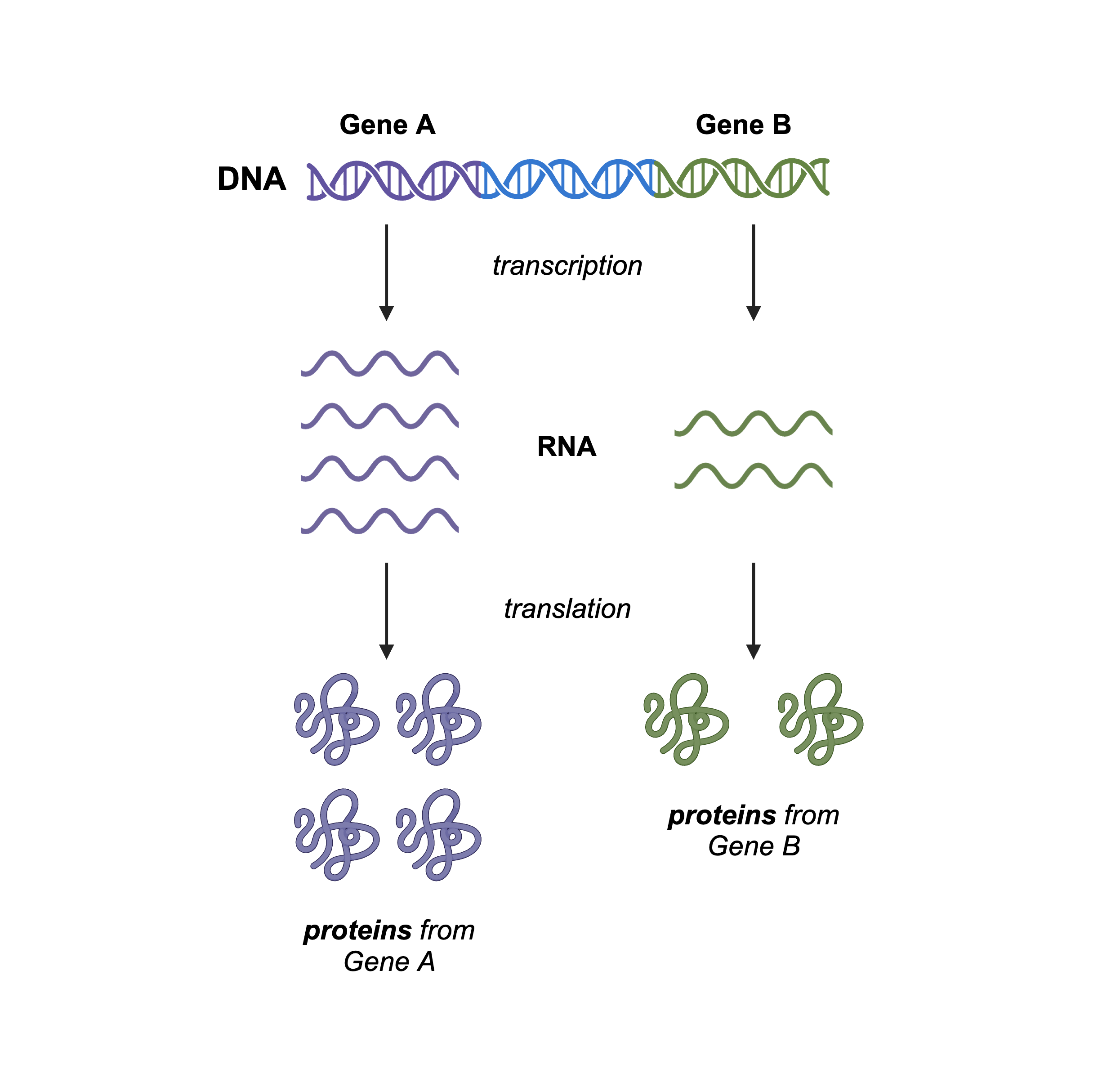
A diagram showing the central dogma. Gene A is being expressed at higher levels than Gene B as evidenced by the fact that there are twice as many protein A molecules as protein B molecules present.
Image created in https://BioRender.com

‍

Proteins carry out the majority of functions and activities that take place within a living system. For example, insulin, which helps regulate our blood sugar levels, hemoglobin, which helps carry oxygen within our blood, and antibodies, which help the immune system fight foreign pathogens, are all examples of proteins that perform vital functions for our health and wellbeing.  

Because proteins are responsible for so many vital functions within a given cell, system, and/or organism, studying proteomics helps us gain insight into the processes, mechanisms, and/or pathways that are critical to health and disease.  

Similarly to transcriptomics, proteomics not only evaluates which proteins are present/absent in a living system at a given point in time, but also how much of these proteins are present. If we measure proteins within a hypothetical cell, we might find twice as much of protein A compared to protein B. These data tell us that gene A, which is transcribed and then translated into protein A, is being expressed roughly twice as much as gene B.  

Knowing which proteins are more or less abundant within a cell and/or organism can be extremely helpful when studying health and disease. For example, our scientists have used proteomics in multiple lines of research, including our efforts to better understand long COVID.  

‍

Why Omics?

Performing Omics research has become increasingly popular in recent years due to its ability to provide a more in-depth, comprehensive look into biological systems. For example, by using proteomics to study all of the proteins within a cell rather than just a select few, scientists can gain a more holistic picture into the structure and function of individual cells.  

In addition to individual Omics projects like genomics, transcriptomics, or proteomics, multi-omic profiling has also emerged as an increasingly popular approach. This approach refers to the practice of collecting data for multiple Omics simultaneously—such as studying both the transcriptomic and proteomic profile of a given cell or system instead of just one or the other.  

Here, we overviewed three types of Omics research. However, the field of Omics includes a wide variety of other methods to gain a holistic picture of different molecules within a cell, including approaches like epigenomics and metabolomics.

Want to learn more?

If you want to learn more about the different types of Omics research, check out the following resources:  

  • Genomics: Genome, The Long and Winding Road
  • Transcriptomics: Releasing the Messengers
  • Proteomics: Proteins at Work

featured education resources
explore more resources
brain science
cell science
immunology
neural dynamics
synthetic biology
Early Career Scientists
Health Care Providers
Students
Doctors
Teachers
Postdocs
Scientists
Educators
General Public
Middle School
High School
Undergraduate
Graduate
Thank you! Your submission has been received!
Oops! Something went wrong while submitting the form.
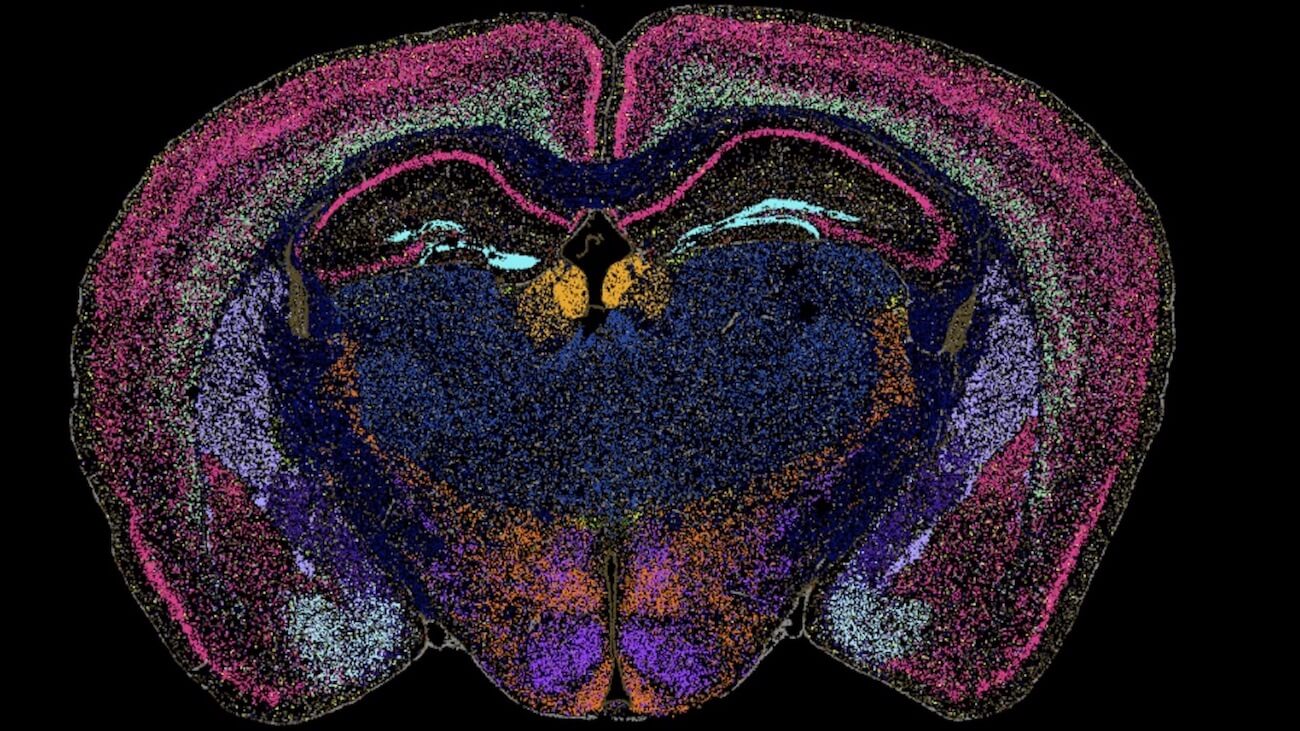
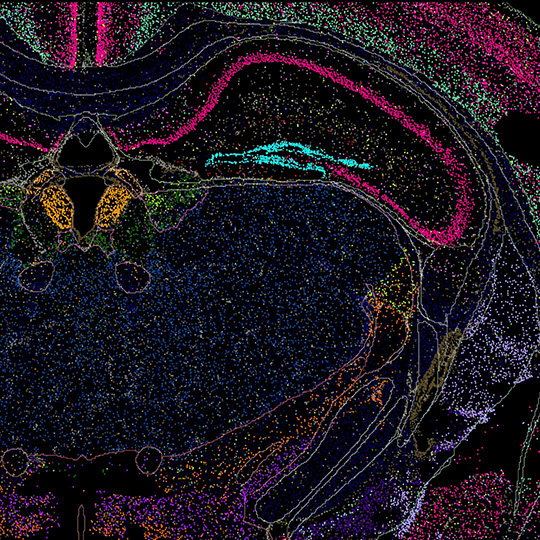
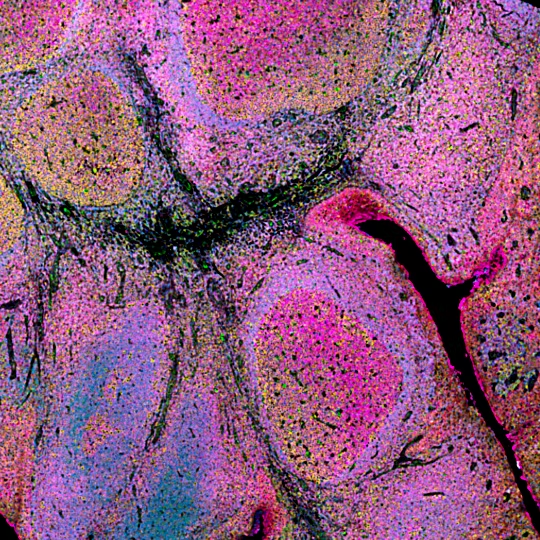
Colorful cross-section of a mouse brain showing neural tissue with pink, blue, and orange regions.
Database Guide 
Database Guide | Allen Brain Cell (ABC) Atlas
An in-depth guide on how to use the ABC Atlas to ask and evaluate research questions
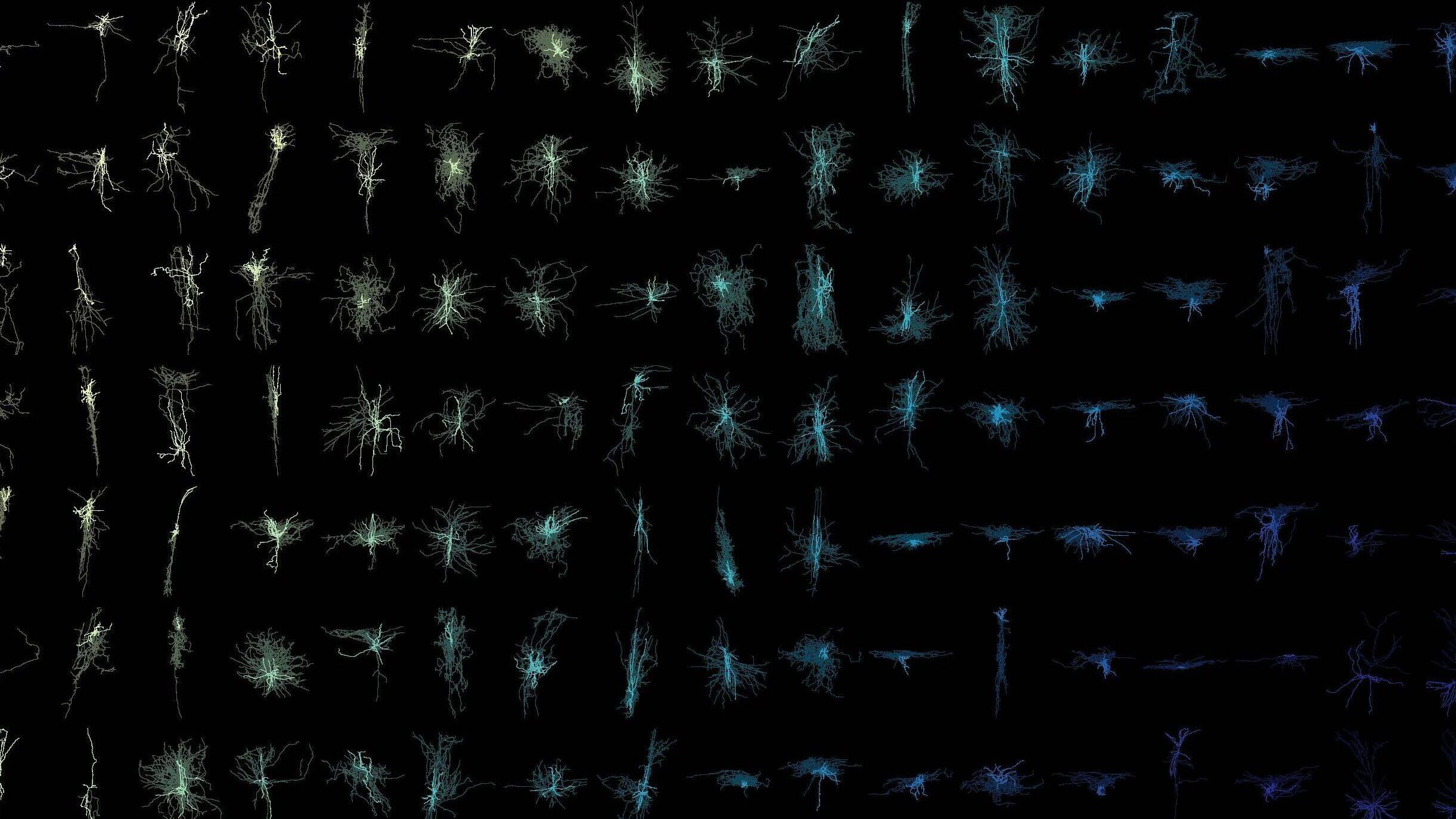
Grid of digitally generated neurons with branching dendrites in white, green, cyan, and blue colors
Lesson(s) 
Building realistic neurons with pipe cleaners
Create authentic models of neurons using low-cost craft materials
Laptop displaying code on desk with blurred people collaborating in background office setting.
Interactive Activity 
Teaching and learning with python
Explore resources to introduce undergraduate students in the life sciences to Python programming
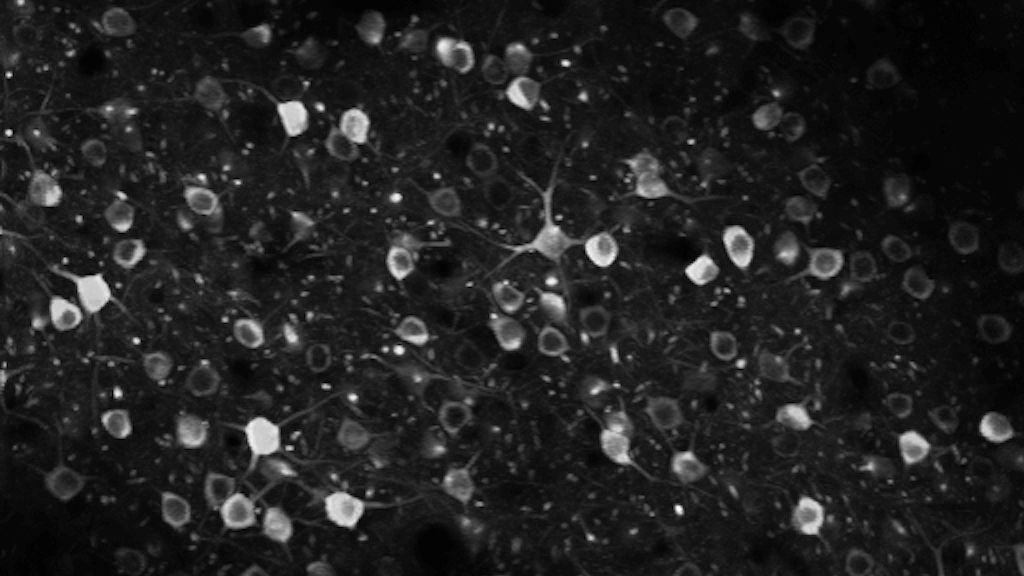
Black and white microscopic view of interconnected cells and particles in dark space
Video 
How scientists see neurons fire with 2-photon calcium imaging
Join our scientists in the lab to walk through the 2-photon calcium imaging pipeline
Colorful pixelated grid pattern with purple, yellow, black, and olive tones in mosaic layout
Explainer 
What is omics?
Explore the branch of research known as “omics“– including genomics, transcriptomics, and proteomics
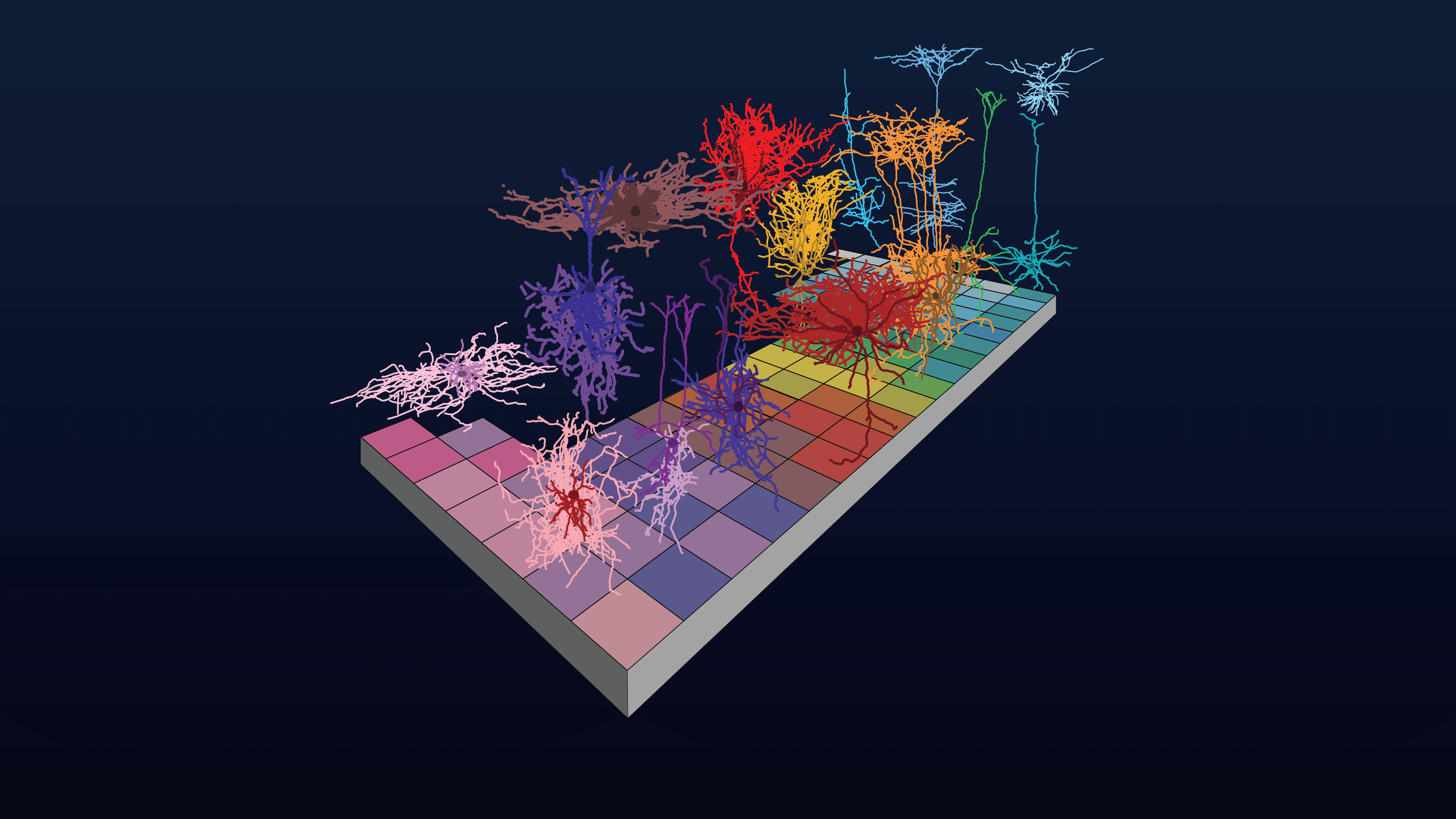
Colorful neural network visualization with branching patterns on gradient grid surface.
Lesson(s) 
Defining cell types using transcriptomics, morphology, and electrophysiology
Overview of how multi-modal data is gathered to define cell types in the brain
load more resources
1 / 5
we acceleratedevelopcatalyzeimpact

science done differently. shared with the world.

explore our accelerators

brain science

Mapping every cell, connection, and circuit in the brain—openly shared with the world.

cell science

Decoding how cells become tissues, then programming that knowledge into powerful new research tools.

neural dynamics

Revealing the brain's hidden algorithms that transform neural activity into real-world behavior.

immunology

Creating the deepest open reference for the healthy human immune system ever built.

synthetic biology

Engineering cells to record their own histories, transforming how we understand disease over time.

research

Big questions, open answers, and science built to be shared.

education

Inspiring the next generation of scientists through open science resources.

impact

Our science is empowering researchers and advancing health worldwide.
advancing science through open, collaborative research
Get the allen institute newsletter
Stay informed on the latest breakthroughs in neuroscience, bioscience, and AI-driven research.
allen institute
impactpeople & teamscareers & opportunitiesalumnihistory & founder
science resources
allencell.orgallenimmunology.orgallenneuraldynamics.orgbrain-bican.orgbrain-map.orgmicrons-explorer.org
research
brain sciencecell scienceneural dynamicsimmunologysynthetic biologypublications
education
science educationfield tripsprofessional developmenteducation resources
quick links
newseventsopen sciencepodcastscience resourceshuman brain donationvisit uscontact
follow us/

allen institute, 615 Westlake Ave North, Seattle, WA 98109 +12065487055

© 0000 allen institute. all rights reserved.
privacy policyterms of usecitation policyemployee portalpolicy & compliance