

about this event
Founded by Adrienne Fairhall and Christof Koch, the Summer Workshop on the Dynamic Brain is co-hosted by the Allen Institute and the Computational Neuroscience Center at the University of Washington. It is directed by Drs. Michael A. Buice, Saskia de Vries, Adrienne Fairhall, Shawn Olsen, and Eric Shea-Brown.
The workshop is geared towards Ph.D. students and postdoctoral fellows in neuroscience, biology, physics, engineering, and computer science as well as other early-career researchers at the equivalent level. Ideal candidates have a planned or established research agenda related to the course topics such as neuroanatomy and neurophysiology; neuronal cell types; connectomics; optical and electrophysiological methods for measuring and analyzing cell populations; theories and modeling of neocortex and associated structures; big data approaches; and perceptual and behavioral neuroscience with a focus on the visual system.
students will
- Develop skills in large-scale neural data analysis and computational methods.
- Work in an interdisciplinary collaborative environment and modern tools.
- Explore data and software from the Allen Institute.
- Interact with leading computational and experimental neuroscientists.
- Complete a collaborative project with other workshop students.
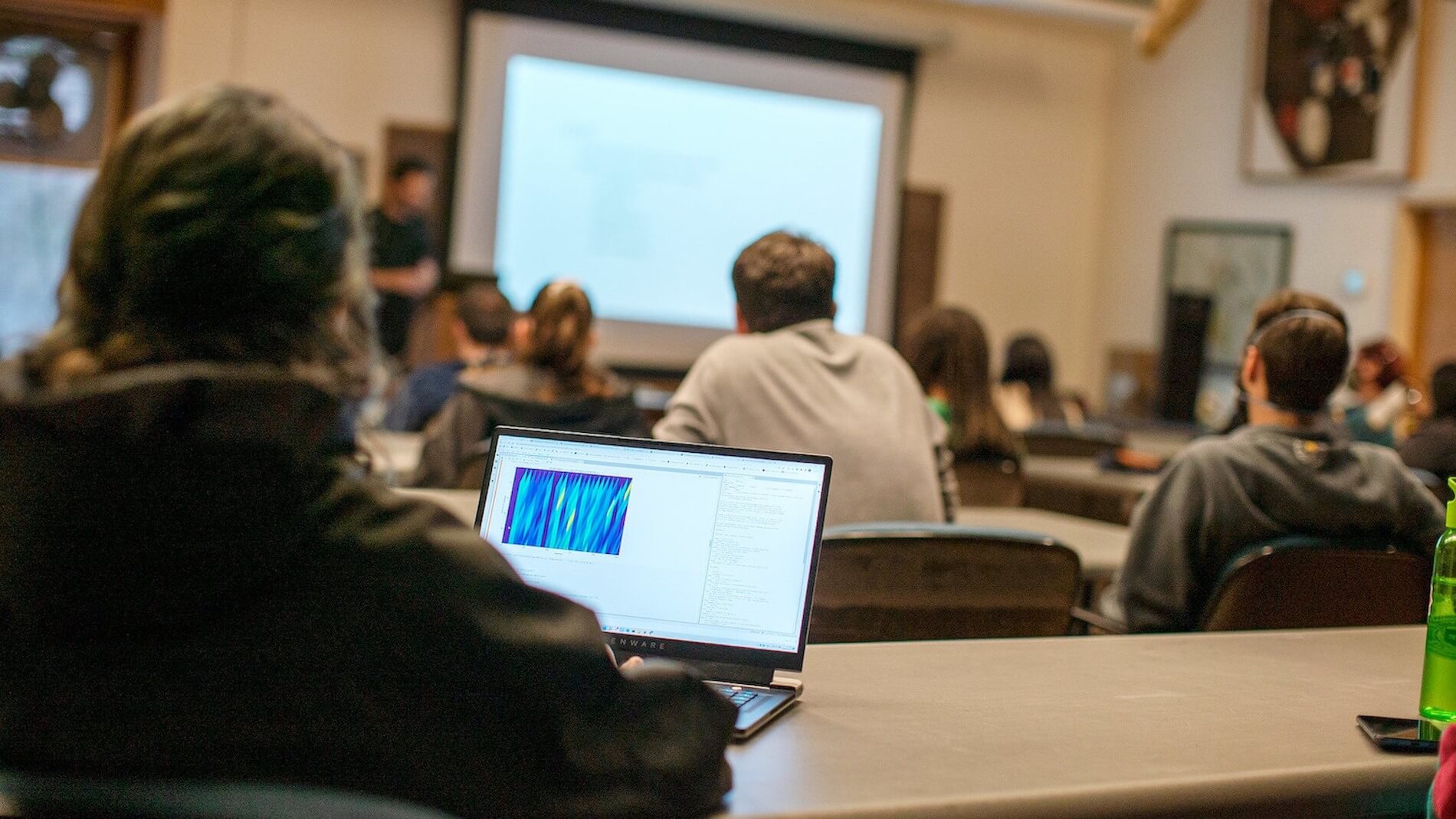
All tutorials and software packages in the course use the Python programming language. The workshop includes an optional Python bootcamp and ongoing software tutorials in modeling, data analysis, and computational methods. While previous experience with Python is not required or expected, it is highly recommended that students have some previous coding experience.
Students will have the opportunity to receive training with featured large-scale datasets generated by the Allen Institute. Examples from past workshops include the Allen Brain Observatory Visual Coding and Neuropixels datasets. Other Allen Institute resources are available also for students to explore.
A core component of the workshop curriculum is the completion of short research projects. With faculty guidance, students collaborate in teams to develop and carry out a project that explores the featured open data sets. Student teams present their project proposals at the end of the first week of the course and the outcome of their work at the conclusion of the workshop to faculty and fellow participants. Previous projects from this course have been developed into publications and presented at scientific conferences.
more information
faculty
Previous faculty and guest instructors:
- Blaise Aguera y Arcas, Google
- Michael Buice, Allen Institute
- Anne Churchland, Cold Spring Harbor Laboratory
- Saskia de Vries, Allen Institute
- Adrienne Fairhall, University of Washington
- Christof Koch, Allen Institute
- Scott Linderman, Stanford University
- David McCormick, University of Oregon
- Shawn Olsen, Allen Institute
- Kanaka Rajan, Mt. Sinai School of Medicine
- Rajesh Rao, University of Washington
- Pamela Reinagel, University of California, San Diego
- Eric Shea-Brown, University of Washington
- Nick Steinmetz, University of Washington
- Karel Svoboda, Allen Institute for Neural Dynamics
- Edgar Walker, University of Washington
- Daniela Witten, University of Washington
- Hongkui Zeng, Allen Institute for Brain Science
Students will have the opportunity to carry out computational neuroscience and data science research projects with the guidance of faculty, and will present their project to faculty and fellow participants at the conclusion of the workshop.
Time
N/A
datasets & code
Students will learn analysis and computational tools by exploring open datasets from the Allen Institute. These data also form the basis for the course projects that students will develop over the second week of the course. Every year we select a few recent datasets from the Allen Institute to showcase including large scale physiology, behavior, and anatomy. These are likely to include recordings of neural activity collected using 2-photon calcium imaging or dense electrophysiology using Neuropixels probes, such as the Allen Brain Observatory datasets. These datasets, focused on the mouse visual cortex, contain recordings from large populations of neurons across many brain regions, both in passive and active behavioral conditions. Connectomic electron microscopy (EM) data from the MiCRONS program, or similar Allen Institute EM or high resolution light sheet data, will also be used to explore neuronal morphology, ultrastructure, and connectivity.
Python boot camp
The Python boot camp is held in Seattle all day on Saturday and the morning on Sunday, before all workshop participants depart for Friday Harbor, WA. Students who wish to get a start on the Python boot camp can work through the boot camp material and resources from previous years, complete introduction to Python exercises by Code Academy or Google, or see documentation from Python.
Code repositories
Code repositories from past workshops reflect materials and projects included in the workshop curriculum.
Time
N/A
Facilities
Seattle, WA – University of Washington and Allen Institute
The Python boot camp is held Saturday all day and Sunday morning before the full workshop group departs for Friday Harbor on Sunday afternoon. On Saturday, students will visit the University of Washington. Breakfast and lunch will be provided. Optional welcome dinner for all SWDB participants.
Accommodations are available at the University of Washington on Friday and Saturday night for students participating in the boot camp, and on Saturday night for students not participating in the boot camp.
Friday Harbor, WA – Friday Harbor Labs
The main workshop is held at Friday Harbor Labs, a University of Washington facility in Friday Harbor, WA, around 80 miles drive followed by an hour-long ferry ride from Seattle. The facility is primarily used for teaching and research in marine biology, oceanography, and fisheries.
Students and course staff are accommodated on site at the labs and have access to a classroom, dining hall/lounge space, and expansive outdoor spaces. Most students stay in double rooms in the FHL dormitories. The FHL campus is about a mile from the town center of Friday Harbor.
For more information, please visit the FHL website.
Expenses
Students are responsible for travel expenses to and from Seattle and incidental expenses in Friday Harbor, such as snacks. The Allen Institute provides accommodations and meals at Friday Harbor.
Time
N/A
Course impact
Research and technical skills impact
- The Summer Workshop on the Dynamic Brain taught me Python and expanded the range of my computational skills. I probably wouldn’t be a data scientist right now if it weren’t for the workshop. (Participant, 2016)
- Attending the Summer Workshop on the Dynamic Brain gave me my first introduction to Python, which is now my primary coding language. It taught me about open science and the magnitude of possibility with datasets such as those provided by the Allen Institute. I’m now using all of these skills. (Participant, 2014)
- It was an enriching first experience to collaborate with scientists working on different disciplines for a computational neuroscience project. Our project… included three neurophysiologists, a computer scientist, and a statistician (myself). I believe such a practice helps build the ability to accommodate different perspectives to build something greater… I learned about different topics in neuroscience and experimentation, and about Allen Institute datasets, which bettered my understanding of the field. (Participant, 2018)
Career development and collaboration
- I really learned the value of open and reproducible science. I have implemented a policy of open science and data sharing in my lab – including making all data and code available. (Participant, 2017)
- The sheer access to talent and resources is hard to match. I owe a lot of what I do now to the Summer Workshop on the Dynamic Brain, particularly with serving as a strong introduction to modern computational neuroscience and giving me the much needed courage to pursue a doctorate degree in a much more computational lab than in my Master’s. (Federico Bolanos, 2017)
- How to work efficiently in groups. You meet complete strangers and at the end of 2 weeks have had to formulate, work on, and present a project together. That’s a pretty unique skill. (Stephanie Seeman, 2015)
- I think this workshop was one of the handful of factors that made me want to understand what questions were important for neuroscience, not just for neuro-theory. After this experience, I spent several years in an experimental lab for my postdoc, and my career trajectory totally changed as a result. (Participant, 2014)
Professional networks and community
- I found my postdoctoral mentor at Summer Workshop on the Dynamic Brain! I also have longstanding friends/collaborators from the course. (Participant, 2014)
- I found my current post-doc through a connection I made at the course. I’ve also stayed in touch with a few of the students and we continue to support each other in various ways, e.g. going through the job market process. I’ve also continued to interact with a few of the faculty on teaching computational neuroscience. (Madineh Sedigh-Sarvestani, 2016)
- It functioned as a great in depth overview of currently highly active research fields within neuroscience, beyond the ones I knew about off the top of my head. This was great for understanding what work I might want to pursue next in my career. (Emily Gelfand, 2019)
Time
N/A
event agenda
Please note that students are required to attend the full two weeks of the course, including the middle weekend.
Python Bootcamp | University of Washington
- Saturday before workshop – 9am – 5pm
- Sunday before workshop – 9am -12pm
Travel to workshop | Anacortes
- Bus to Anacortes
- Ferry from Anacortes to Friday Harbor
Week 1 | Friday Harbor
- Morning Lectures
- Afternoon dataset explorations
- Meal breaks and social activities throughout
Week 2 | Friday Harbor
- Morning Lectures
- Afternoon work time
- Meal breaks and social activities throughout
Time
N/A
This program is intended for researchers at the graduate and postdoctoral level with an interest in developing the intersection of their scientific knowledge and their computational skills.