impact
about
our story
explore our impact
careers and opportunities
join us
open science
sharing science to speed discovery
open science week
celebrating open science
team science
people & teams
discovery is a team effort
allenites
the people who make our work possible
advisors
their input shapes our science
board of directors
they help us fulfill our mission
shanahan foundation fellowship
at the interface of data and neuroscience
next generation leaders
fostering emerging leaders in bioscience
research
overview
our approach
science at the scale of greatest impact
publications
explore our publications
open science
sharing science to speed discovery
science accelerators
brain science
building a blueprint of the brain
cell science
understanding how cells become organs
neural dynamics
revealing the brain’s hidden algorithms
immunology
creating the ultimate immune system reference
synthetic biology
seattle hub for synthetic biology
education
overview
science education
science is for everyone
open science
sharing science speeds discovery
engagement
education resources
real science. real skills.
field trips
experience science where it happens
educator development
empowering educators
news
overview
all news
explore the latest news
podcast
the human stories behind discovery
sign up for our newsletter
stay connected to our science
events
overview
all events
public engagement, workshops, seminars and more
conferences
connect with us
science resources
science resources
allencell.org
allenimmunology.org
allenneuraldynamics.org
brain-bican.org
brain-map.org
microns-explorer.org
impact
back to menu
team science
our story
explore our impact
careers and opportunities
join us
open science
sharing science to speed discovery
open science week
celebrating open science
team science
people & teams
discovery is a team effort
allenites
the people who make our work possible
advisors
their input shapes our science
board of directors
they help us fulfill our mission
shanahan foundation fellowship
at the interface of data and neuroscience
next generation leaders
fostering emerging leaders in bioscience
research
back to menu
overview
our approach
science at the scale of greatest impact
publications
explore our publications
open science
sharing science to speed discovery
science accelerators
brain science
building a blueprint of the brain
cell science
understanding how cells become organs
neural dynamics
revealing the brain’s hidden algorithms
immunology
creating the ultimate immune system reference
synthetic biology
seattle hub for synthetic biology
education
back to menu
overview
science education
science is for everyone
open science
sharing science speeds discovery
engagement
education resources
real science. real skills.
field trips
experience science where it happens
educator development
empowering educators
news
back to menu
overview
all news
explore the latest news
podcast
the human stories behind discovery
newsletter
stay connected to our science
events
back to menu
overview
all events
public engagement, workshops, seminars and more
conferences
connect with us
science resources
back to menu
science resources
allencell.org
allenimmunology.org
allenneuraldynamics.org
brain-bican.org
brain-map.org
microns-explorer.org
search
news

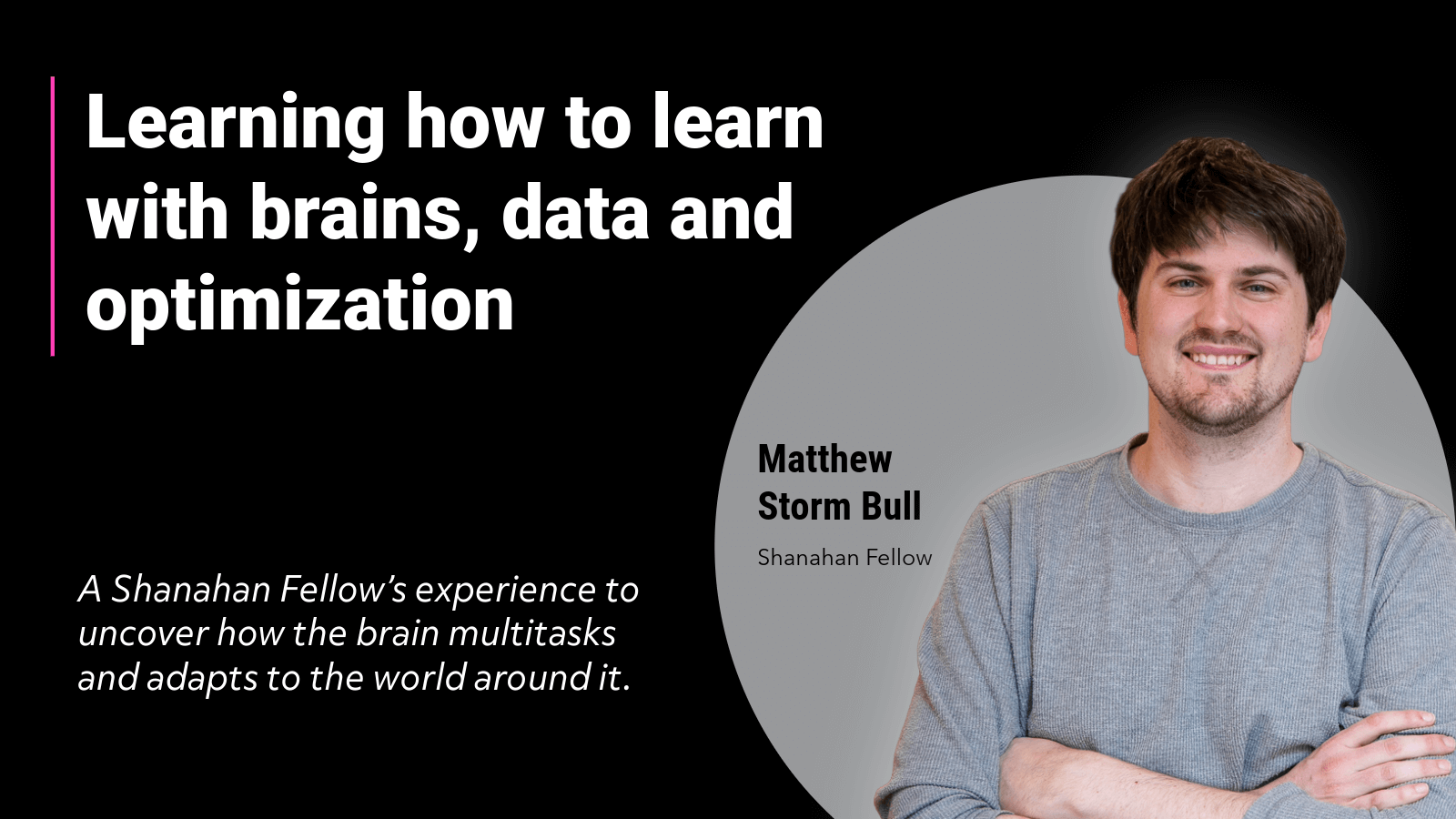
Learning how to learn with brains, data and optimization

A Shanahan Fellow’s experience to uncover how the brain multitasks and adapts to the world around it.

August 5, 2025
 min read
share/
Matthew Storm Bull, a Shanahan Fellow, explores how the brain multitasks and adapts to the world around it.
Thank you! Your submission has been received!
Oops! Something went wrong while submitting the form.

in this article

table of contents will display on published page only
set h2 to populate the table of contents here

When Matthew Storm Bull first saw an advertisement for the Shanahan Fellowship opportunity, he didn’t hesitate. “I immediately shared the listing with my partner,” he recalls. “I knew it was a unique opportunity that celebrated diverse perspectives in neuroscience.”

His instinct was right. As a Shanahan Fellow at the Allen Institute, Bull took a deep dive into work that pushes the boundaries of neuroscience, combining machine learning, systems theory, and biological data to study how the brain learns many timescale temporal sequences, or how events occur over time, particularly when that order is significant to understanding relationships and patterns.
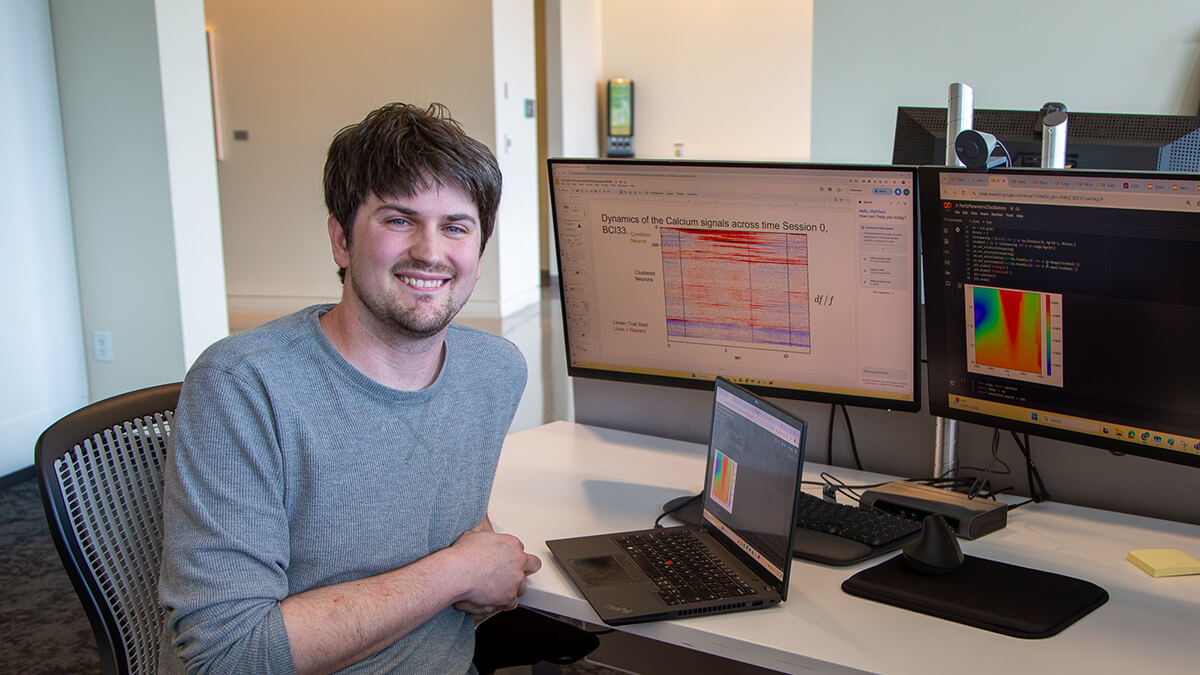
Man smiling at desk with multiple computer monitors displaying scientific data visualizations
Matthew Bull, reviews research data and code at the Allen Institute.
My research is about learning how brains multitask, adapt and manage competing needs, I’d love to help piece together the community-wide puzzle of how the brain actually works with the predictions coming from the math of optimization.

He spends about half his time immersed in neural data, searching for “experimental fingerprints” that could help confirm or reject different mechanistic hypotheses for how the brain assigns credit through local learning rules. A mechanistic hypothesis is a proposed explanation of the factors that cause an observable phenomenon. It goes beyond simply describing an observation to explain the causal chain of events.

“These optimization techniques are powerful, but intuition in high dimensional problems can be misleading,” he says. “That’s why we always go back to the data.”

Bull’s interest lies not just in the how of learning, but the why. He’s especially drawn to the question of why brains multitask at all, exploring how organisms maintain physiological balance “setpoints” through ongoing perception and action, all while navigating a constantly changing and sometimes unpredictable world.

His work spans three main areas of neuroscience and artificial intelligence. He studied how neural networks learn to handle multiple tasks simultaneously and apply learned skills to new situations, collaborating on research that uses novel brain-inspired computational models. In another project, he developed analysis tools and trained simulated mice to understand a new all-optical brain-computer interface being pioneered at the Allen Institute to understand how mice learn motor skills, using light-based techniques to monitor and simulate activity in real-time. He also focused on research looking at the parts of the brain that control feelings of fullness and satiety, analyzing large-scale data to understand how multiple brain regions work together to regulate thirst. The work was presented across four conferences and resulted in three manuscripts.

The freedom to explore questions like these, he says, is one of the most valuable parts of the Shanahan Fellowship along with the expert support to make lofty ambitions into concrete actions.

“We’re entrusted with the faith and support that, given the time and resources, we can make contributions to the neuroscientific community,” Bull says. “Along with that comes real support across disciplinary and institutional divides.”

One of the most rewarding aspects of the fellowship was the chance to mentor a research associate. “Helping someone find their scientific voice has been incredibly fulfilling,” he says. His experience at the Allen Institute has been equally positive, shaped by a long list of generous and invested mentors. “My time here has been punctuated by welcoming and empowering support from many members of the community,” Bull says. That same sense of support extends beyond the lab. Living in Seattle, he and his family have embraced the Pacific Northwest. “We especially love the Seattle summers: late evening adventures and outdoor meals.” But he has advice for any aspiring Seattleite: “You might want to get some rain pants for your morning commute!”

During the fellowship, Bull says he’s grown in three key ways: developing a clearer sense of what satisfying questions look like, learning to think strategically about what should be done in research (not just what can be done), and deepening his fluency in machine learning as it applies to biological systems.

“I’ve been able to advance my science toward a personally satisfying north star: bridging normative theory and messy reality of diverse neuromodulatory dynamics,” he said; in other words, making sense of how the brain should work (in theory) compared to the complicated way it does work, looking beyond synapses for understanding of neural computation in the soup of brain chemicals.

Since leaving the fellowship, Bull is currently working as a Senior Research Scientist, guiding a team at a startup called Softmax, developing artificial intelligence systems where multiple agents can work together and learn from each other. The company is creating tools to help the AI research community build systems that cooperate with people and understand what humans want to learn and achieve.

“I will forever be grateful to the Shanahan Family, the Allen Institute and the University of Washington for building a community of generous and wonderful scientists who have helped shape my trajectory every step of the way. What a rewarding ride!”

‍

Citations
No items found.

about the allen institute

The Allen Institute is an independent, 501(c)(3) nonprofit research organization founded by philanthropist and visionary, the late Paul G. Allen. The Allen Institute is dedicated to answering some of the biggest questions in bioscience and accelerating research worldwide. The Institute is a recognized leader in large-scale research with a commitment to an open science model. For more information, visit alleninstitute.org.
related news

all news
news
Making connections
How Yiliu Wang's found her place in neuroscience during the Shanahan Fellowship.
news
Sink or Swim: Navigating the deep waters of neuroscience research
Charting a course to understand brain function and neurodegenerative disease through the Shanahan Fellowship.
news
Serendipity and Synapses: How a part-time job unlocked a passion for brain-mapping
For Sven Dorkenwald, Ph.D., mapping the brain's connections was more than a job; it became a passion sparked by a simple twist of fate.
we acceleratedevelopcatalyzeimpact

science done differently. shared with the world.

explore our accelerators

brain science

Mapping every cell, connection, and circuit in the brain—openly shared with the world.

cell science

Decoding how cells become tissues, then programming that knowledge into powerful new research tools.

neural dynamics

Revealing the brain's hidden algorithms that transform neural activity into real-world behavior.

immunology

Creating the deepest open reference for the healthy human immune system ever built.

synthetic biology

Engineering cells to record their own histories, transforming how we understand disease over time.

research

Big questions, open answers, and science built to be shared.

education

Inspiring the next generation of scientists through open science resources.

impact

Our science is empowering researchers and advancing health worldwide.
advancing science through open, collaborative research
Get the allen institute newsletter
Stay informed on the latest breakthroughs in neuroscience, bioscience, and AI-driven research.
allen institute
impactpeople & teamscareers & opportunitiesalumnihistory & founder
science resources
allencell.orgallenimmunology.orgallenneuraldynamics.orgbrain-bican.orgbrain-map.orgmicrons-explorer.org
research
brain sciencecell scienceneural dynamicsimmunologysynthetic biologypublications
education
science educationfield tripsprofessional developmenteducation resources
quick links
newseventsopen sciencepodcastscience resourceshuman brain donationvisit uscontact
follow us/

allen institute, 615 Westlake Ave North, Seattle, WA 98109 +12065487055

© 0000 allen institute. all rights reserved.
privacy policyterms of usecitation policyemployee portalpolicy & compliance