
Researchers at the Allen Institute for Immunology have been busy.
Since the division of the Allen Institute launched in late 2018, the 60-person team of immunologists, molecular and computational biologists, engineers and other staff have been setting up a new way of doing research to handle a massive trove of data that’s now wending its way through experiments and analysis: long-term studies of how the immune system changes, responds or fails to respond in the course of a healthy human life or during immune-related diseases.
Now, the division has built a new online portal for all to explore the details of their work and, eventually, the health and disease-related human data as well.
Launched today, the Human Immune System Explorer is the Allen Institute for Immunology’s data-sharing portal to the broader community. Built using de-identified and anonymized data, the site allows scientists to delve into the methods and resources the immunology team is using to analyze and manage their studies on human immunology. As the team’s long-term studies of immune health and diseases are completed, those data will be deposited on the public portal as well. The researchers hope that by making their data available to the public, others in the scientific community will comb through the data to make their own insights about human immunology that could eventually lead to better, more precise therapies for immune-related diseases.
As the immunology team established a specialized process, also called a research pipeline, to carry out multi-year studies of human immune health and disease, including studies of the immune system in COVID-19, cancer, and autoimmune disease, they realized they needed to develop new methods to study the immune system and analyze the resulting data. As they are continuing to follow healthy and patient volunteers for two or more years, the first public release on the open-access platform contains data and tools related to these newly developed methods. Data from the long-term studies themselves will be released on the public portal in the years to come.
The first public release includes:
- Protocols describing the team’s research pipeline, which captures and integrates five different kinds of molecular data about the human immune system from the same person over time, in addition to clinical data
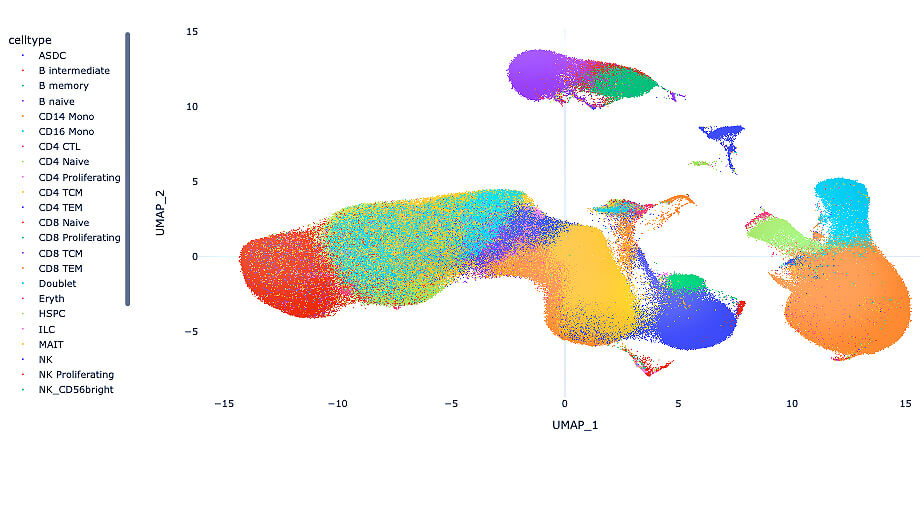
- A new method and accompanying data visualization app called TEA-seq, which captures three types of data simultaneously from individual human immune cells: proteins present on the cells’ surfaces; the set of genes switched on or expressed in each cell; and the cell’s “epigenetic” landscape, which gives clues as to how its genes are regulated
- Data and an accompanying interactive visualization of the team’s findings that delays in processing human blood samples changes certain molecular properties of the immune cells (this finding led the team and their external collaborators to standardize rapid processing of blood samples after they’re taken from study volunteers)
- A new method and accompanying data visualization app dubbed PALMO (Platform for Analyzing Longitudinal Multi-Omics data) to analyze longitudinal, multi-omics data — meaning data that captures multiple kinds of information, such as genome-wide gene activity or whole-cell protein levels, from thousands or more single cells, in samples gathered from patients over several points in time.
- A package of computational methods, known as BarWare, that tracks the original source of individual cells mixed together in the same experiment, and unmixes them for analysis.
“Since day one of the Allen Institute for Immunology, we always had a plan to share our research data openly, but perhaps more importantly, how we derive that data,” said Tom Bumol, Ph.D., Executive Vice President and Director of the Allen Institute for Immunology. “This first access to the Human Immune System Explorer is really a window into what we’re building. Right now, it illustrates some of the techniques and computational environment we’re using to tackle this big, difficult problem of understanding human immunology.”
Collaboration in the cloud
The public-facing portal is the final step in an experimental and computational pipeline that includes a custom-built collaboration and data analysis space for Allen Institute for Immunology researchers and their external clinical collaborators to work together in the cloud on research projects. This environment, also part of the Human Immune System Explorer, was created by engineers at the Allen Institute for Immunology in collaboration with Google Cloud.
“Finding insights from complex biomedical research requires powerful tools,” said Joe Miles, managing director, Healthcare & Life Sciences Industry Solutions for Google Cloud. “The Allen Institute’s biomedical platform provides a secure and collaborative environment for scientists with the leading AI platform combined with the computational power to answer the world’s most complex health questions and accelerate the scientific breakthroughs that benefit us all.”
This secure platform ensures patient privacy and data integrity, said Paul Meijer, Ph.D., Director of Software Development, Database and Pipelines at the Allen Institute for Immunology, allowing the researchers to work together seamlessly in preparing the data for publication in a scientific journal and for release on the public portal. All patient data are de-identified and anonymized before they are uploaded to the closed, secure platform; certain data and other resources will then be released to the public, open-access part of the website.
Meijer and the other engineers on the team had to think carefully not only about patient privacy, but about how to govern such huge amounts of different kinds of scientific data spanning multiple years in a single study. They want their results to be useful and interpretable for many years to come, which means careful annotation and tracking needed to be built into the computational environment from the beginning.
“The Human Immune System Explorer is not just our contribution to open science,” Meijer said. “It is also built on the conviction that science is a collaborative activity that involves careful cooperation amongst a team of multidisciplinary scientists.”
For more information on the Allen Institute’s private collaboration space for immunologists, check out the Google Cloud blog by Paul Meijer, Ph.D.
Citations
about the allen institute
The Allen Institute is an independent, 501(c)(3) nonprofit research organization founded by philanthropist and visionary, the late Paul G. Allen. The Allen Institute is dedicated to answering some of the biggest questions in bioscience and accelerating research worldwide. The Institute is a recognized leader in large-scale research with a commitment to an open science model. For more information, visit alleninstitute.org.