in this article
The Allen Institute for Immunology today announced the release of its first Human Immune Health Atlas, a comprehensive single-cell reference dataset that offers unprecedented insight into the landscape of healthy human immune cells from childhood through adulthood.
This comprehensive single-cell resource will be invaluable for immunology research, helping us better understand how the immune system evolves with age and advancing research into immune-related diseases.
Ananda Goldrath, Ph.D., Executive Vice President and Director of the Allen Institute for Immunology
The atlas provides detailed profiles of 71 distinct immune cell subsets, based on the analysis of 1.8 million cells taken from over 100 healthy volunteers. This high-resolution view addresses a critical need in immunology research for a resource that accurately reflects the immune system’s complexity and diversity.
“Building the Immune Health Atlas was truly a labor of love for our team,” said Ananda Goldrath, Ph.D., executive vice president and director of the Allen Institute for Immunology. “We meticulously studied millions of individual cells from more than 100 people aged 11 to 65. This comprehensive single-cell resource will be invaluable for immunology research, helping us better understand how the immune system evolves with age and advancing research into immune-related diseases.”

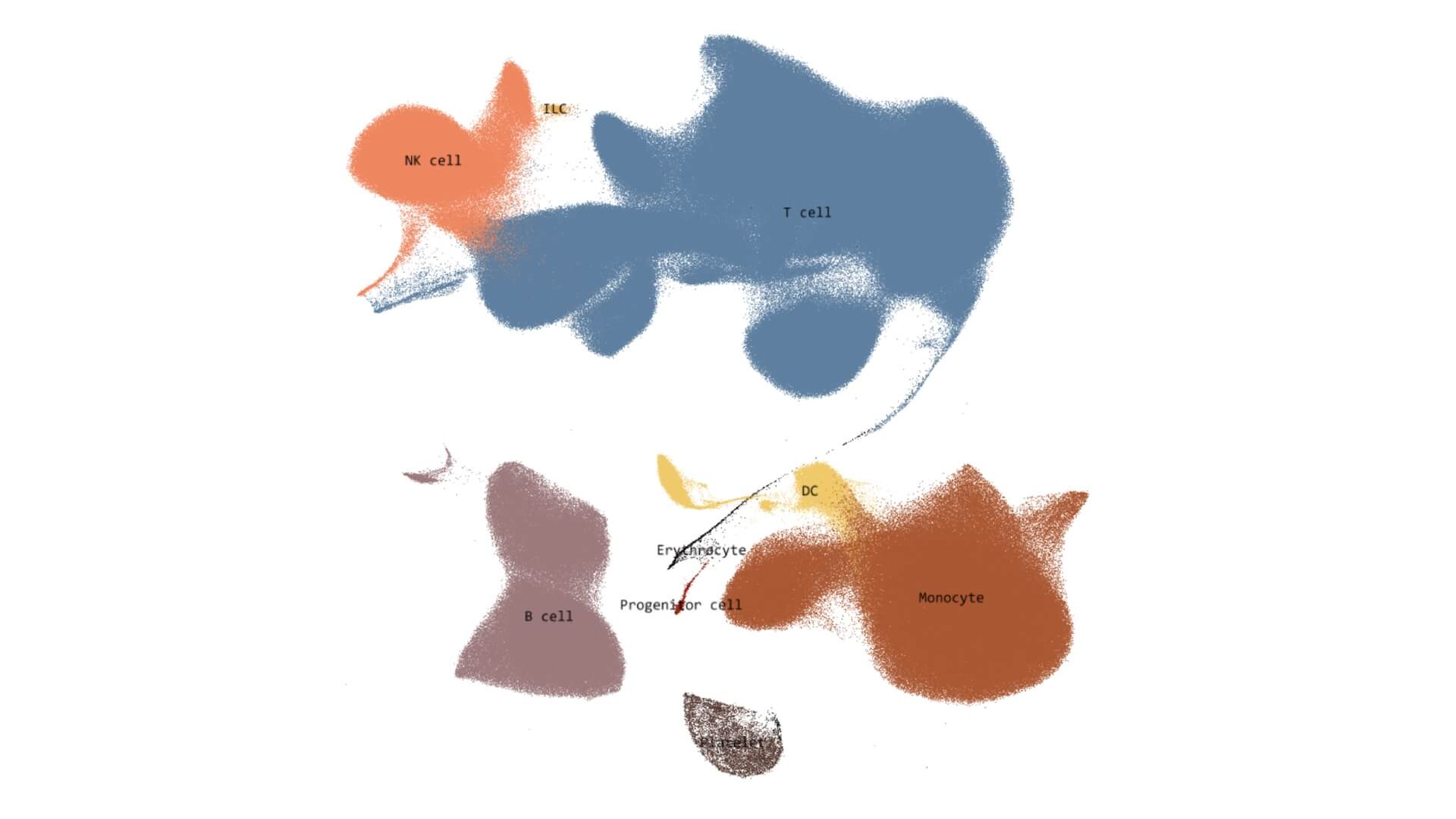
This visualization, called a UMAP, shows human immune cells from the dataset organized and color-coded based on cell type determined by their gene expression.
The full dataset and a suite of interactive visualization tools are freely available online. These tools include:
- A UMAP viewer for 2D visualization of cell relationships and gene expression
- An expression reference tool for exploring gene expression across cell types and age groups
- A clinical data explorer for basic health parameters
The Atlas was developed through collaborations with the Benaroya Research Institute (BRI) and the University of Pennsylvania. These clinical partners collected blood samples from healthy volunteers spanning three age groups: 11-13, 25-35, and 55-65. The Allen Institute then conducted deep single-cell RNA sequencing analysis on these samples, using advanced computational tools to define an unprecedented level of immune cell diversity and age-related dynamics.
Dive deeper into the Immune Health Atlas
“Creating a picture of what a healthy immune system looks like is fundamental to advancing the science around diseases of the immune system and part of our mission at BRI,” says Jane Buckner, M.D., president of Benaroya Research Institute. “Using our expertise in biorepositories and clinical trial recruitment to create the atlas is something we are proud to have contributed to and are excited to see the advancements that will come from it.”
”Claire Gustafson, Ph.D., an assistant investigator at the Allen Institute for Immunology, emphasized the atlas’s potential impact: “Our Atlas provides a full picture of the (peripheral) immune system’s complexity. By making this resource widely available, we’re enabling new discoveries that could lead to transformative advances in immunology and medicine.”
Building on this resource, Allen Institute scientists are now examining how immune cells change over time to uncover detailed mechanisms of immune system aging. This ongoing research, combined with the Immune Health Atlas, could pave the way for more targeted treatments and preventative strategies in the future, Gustafson said.

Citations
about the allen institute
The Allen Institute is an independent, 501(c)(3) nonprofit research organization founded by philanthropist and visionary, the late Paul G. Allen. The Allen Institute is dedicated to answering some of the biggest questions in bioscience and accelerating research worldwide. The Institute is a recognized leader in large-scale research with a commitment to an open science model. For more information, visit alleninstitute.org.