
Harnessing the muscle of one of the world’s fastest supercomputers, researchers have built one of the largest and most detailed biophysically realistic brain simulations of an animal ever. This virtual copy of a whole mouse cortex allows researchers to study the brain in a new way: simulating diseases like Alzheimer’s or epilepsy in the virtual world to watch in detail how damage spreads throughout neural networks or understanding cognition and consciousness. It simulates both form and function, with almost ten million neurons, 26 billion synapses, and 86 interconnected brain regions.
This spectacular achievement is the product of Fugaku, the Japanese flagship supercomputer that can crunch data faster than we can blink, with quadrillions of calculations per second. Scientists at the Allen Institute and Tadashi Yamazaki, Ph.D., from Japan’s University of Electro-Communications led the project in collaboration with researchers from the Research Organization for Information Science and Technology (RIST), Yamaguchi University, and RIKEN Center for Computational Science (R-CCS). An upcoming paper will unveil the accomplishment at SC25, the world’s premier supercomputing conference taking place in mid-November.
The research and work was supported by the National Institutes of Health’s Brain Research Through Advancing Innovative Neurotechnologies® Initiative, or The BRAIN Initiative®.
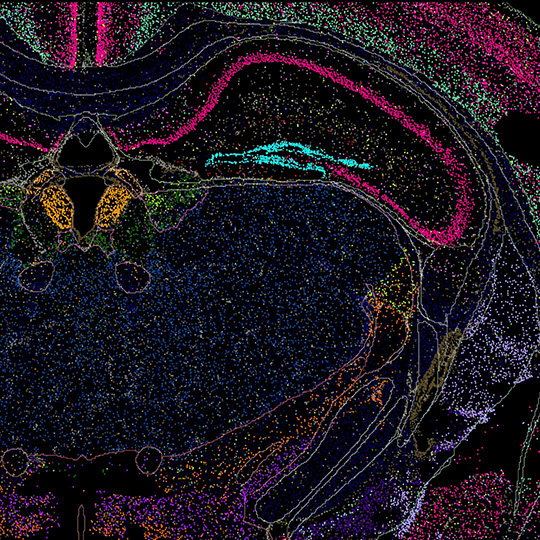
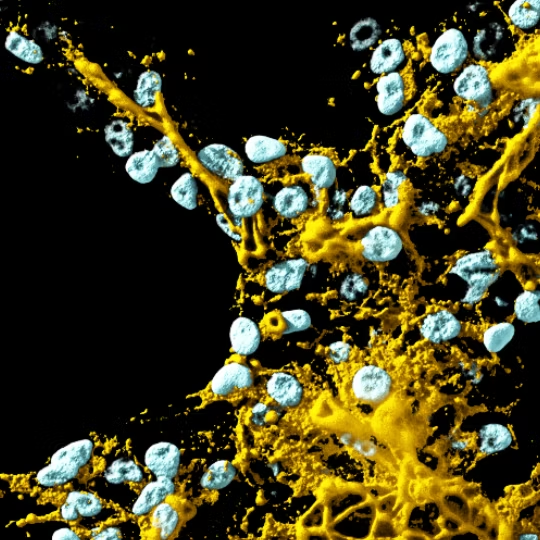
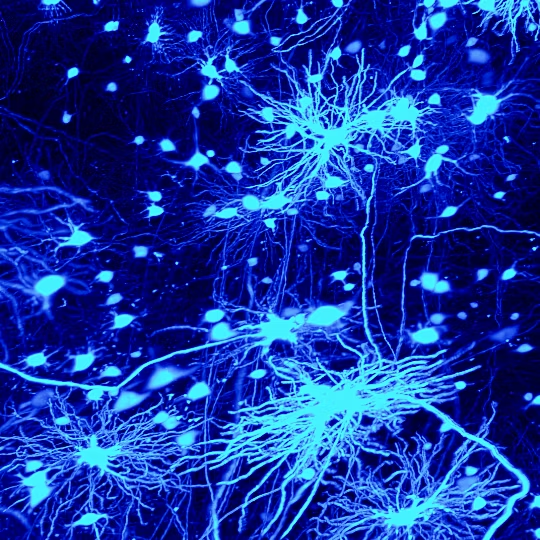
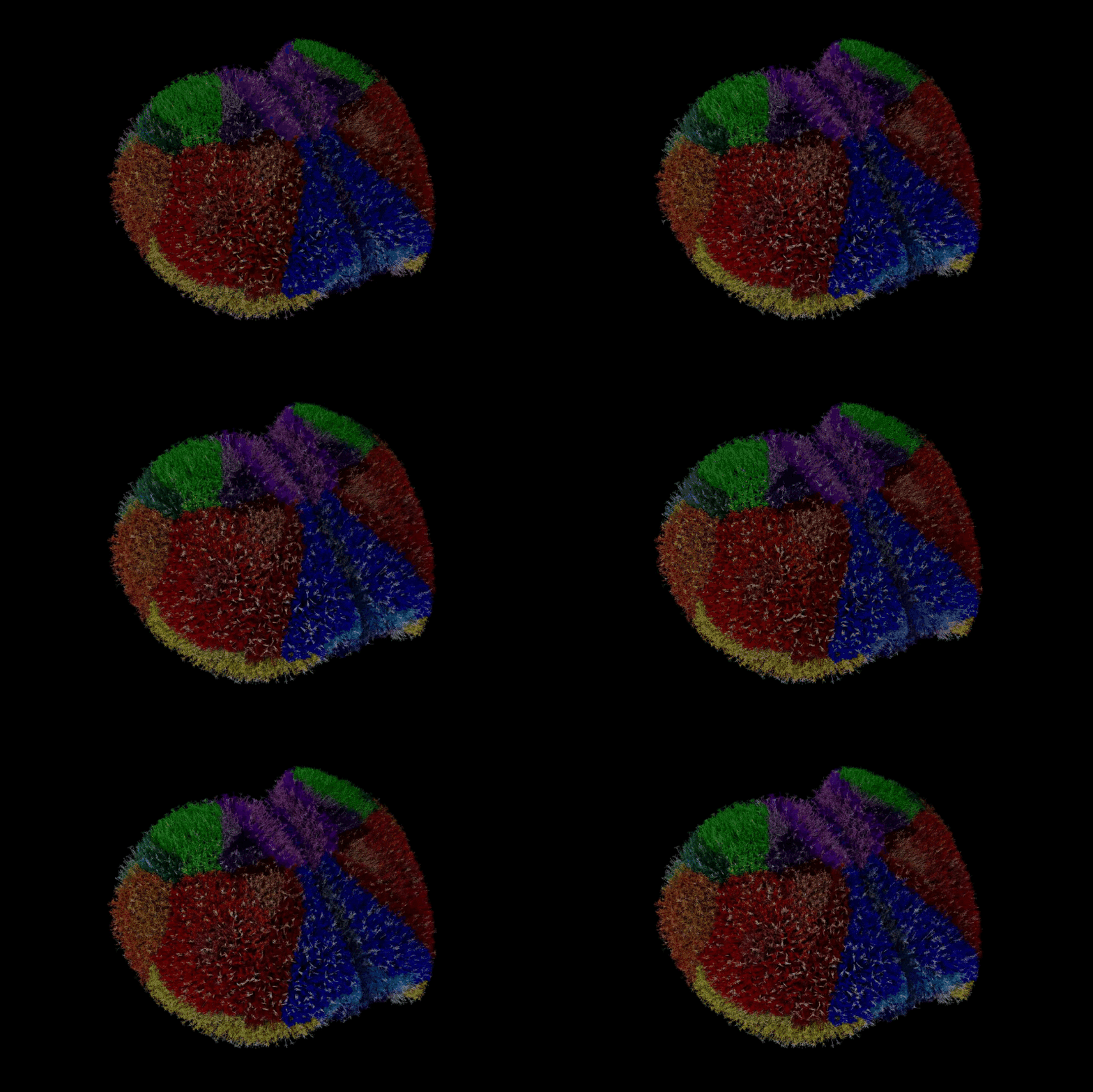
Biophysically detailed simulation of whole mouse cortex neuron by neuron, while in resting state, with sub-cellular resolution. The simulation captures ion flows and fluctuations of membrane voltage within many compartments that the tree-like neuronal morphologies consist of. Neurons are colored by cortical area and marked with a light flash when active. Only 1% of neurons are shown for clarity. (Credit: Barry Isralewitz , University of Illinois at Urbana-Champaign; with contributions by Kaaya Akira-Tamura, University of Electro-Communications; Kael Dai, Laura Green, Beatriz Herrera, Allen Institute; Tadashi Yamazaki, University of Electro-Communications; and Anton Arkhipov, Allen Institute) using the simulation from the paper: Kuriyama et al., ‘Microscopic-Level Mouse Whole Cortex Simulation Composed of 9 Million Biophysical Neurons and 26 Billion Synapses on the Supercomputer Fugaku’
Scientists can use this mouse cortex model to ask detailed questions about what happens in a disease, how brain waves shape focus, or how seizures spread in the brain, and then test their hypotheses. Before this, these questions could only be asked using real brain tissue one experiment at a time. Now, researchers can test hypotheses virtually. These simulations may help find answers for brain disorders, revealing how problems begin before symptoms appear, and allow researchers to test new treatments or therapies safely in a digital environment.
“This shows the door is open. We can run these kinds of brain simulations effectively with enough computing power,” said Anton Arkhipov, Ph.D., an investigator at the Allen Institute who worked on the project. “It’s a technical milestone giving us confidence that much larger models are not only possible, but achievable with precision and scale.”
This global collaboration merges human neuroscience expertise with the remarkable computing power of a machine. Allen Institute supplied the virtual brain’s blueprint and biophysical properties through real data from the Allen Cell Types Database and the Allen Connectivity Atlas and Japan’s Supercomputer Fugaku brought the data to life.
How researchers created the whole cortex simulation
Supercomputer Fugaku, jointly developed by RIKEN and Fujitsu, is one of the world’s fastest supercomputers capable of more than 400 quadrillion operations per second. To put that into perspective, if you started counting right now, one by one per second, it would take over 12.7 billion years to reach that number (approximately the age of the universe: 13.8 billion years). “Fugaku” comes from Mount Fuji, and just like the mountain’s high peak and broad base, it was chosen to symbolize its power and wide reach.
“Fugaku is used for research in a wide range of computational science fields, such as astronomy, meteorology, and drug discovery, contributing to the resolution of many societal problems,” said Yamazaki. “On this occasion, we utilized Fugaku for a neural circuit simulation.”
The supercomputer is made up of thousands of small parts called nodes, which are grouped together in layers like boards, shelves, and racks. Together, these components add up to a total of 158,976 nodes, allowing Fugaku to manage a massive volume of data and computations.
Using the Allen Institute’s Brain Modeling ToolKit, the team translated data into the working digital simulation of the cortex. A neuron simulator, Neulite, turned equations into neurons that spike, signal, and chatter just like their living counterparts.
Watching a simulated mouse cortex is like watching biology in real time. It captures the actual structure and behavior of brain cells, down to the branches coming from neurons, the activations of synapses—the tiny contacts conveying messages from upstream neurons to the branches of downstream neurons—and the ebb and flow of electrical signals across membranes. “It’s a technical feat, but it’s only the first step,” said Yamazaki. “God is in the details, so in the biophysically detailed models, I believe.”
“Our long-term goal is to build whole-brain models, eventually even human models, using all the biological details our Institute is uncovering,” said Arkhipov. “We’re now moving from modeling single brain areas to simulating the entire brain of the mouse.” With this kind of computational power, the goal of a full, biophysically accurate brain model isn’t just science fiction anymore. Scientists are in a new frontier where understanding the brain means, quite literally, being able to build one.
This cutting-edge research was made possible by an international team including Laura Green, Ph.D.; Beatriz Herrera, Ph.D.; Kael Dai, B.Sc.; Rin Kuriyama, M.Sc.; and Kaaya Akira, Ph.D.
Citations
about the allen institute
The Allen Institute is an independent, 501(c)(3) nonprofit research organization founded by philanthropist and visionary, the late Paul G. Allen. The Allen Institute is dedicated to answering some of the biggest questions in bioscience and accelerating research worldwide. The Institute is a recognized leader in large-scale research with a commitment to an open science model. For more information, visit alleninstitute.org.