impact
.nav--link
research
research
impact
open science
subheadline
careers and opportunities
subheadline
people & teams
people & teams
subheadline
allen institute advisors
subheadline
board of directors
subheadline
shanahan foundation fellowship
subheadline
next generation leaders
subheadline
research
overview
our approach
subheadline
publications
subheadline
open science
subheadline
accelerator
brain science
subheadline
cell science
subheadline
neural dynamics
subheadline
immunology
subheadline
synthetic biology
subheadline
education
education
science education
subheadline
teaching resources
subheadline
field trips
subheadline
open science
subheadline
open science quest
subheadline
news
news
stories
subheadline
podcast
subheadline
sign up for our newsletter
subheadline
events
events
all events
subheadline
conferences
subheadline
event code of conduct
subheadline
events
open science quest
subheadline
summer workshop on the dynamic brain
subheadline
open science week
subheadline
brain fest
subheadline
science resources
science resources
allencell.org
subheadline
allenimmunology.org
subheadline
allenneuraldynamics.org
subheadline
brain-bican.org
subheadline
brain-map.org
subheadline
microns-explorer.org
subheadline
impact
back to menu
impact
open science
subheading
careers and opportunities
subheading
people & teams
people & teams
subheading
allen institute advisors
subheading
board of directors
subheading
shanahan foundation fellowship
subheading
next generation leaders
subheading
research
back to menu
impact
Label
subheading
Label
subheading
people & teams
education
back to menu
research
Label
subheading
Label
subheading
Heading
news
back to menu
research
Label
subheading
Label
subheading
Heading
events
back to menu
research
Label
subheading
Label
subheading
Heading
science resources
back to menu
science resources
allencell.org
subheading
allenimmunology.org
subheading
allenneuraldynamics.org
subheading
brain-bican.org
subheading
brain-map.org
subheading
microns-explorer.org
subheading
search
stories
news

“Computational crystal ball” helps predict cell behavior

New technology could lead to better treatments for cancer by allowing scientists to perform virtual experiments

March 31, 2026
3 min read
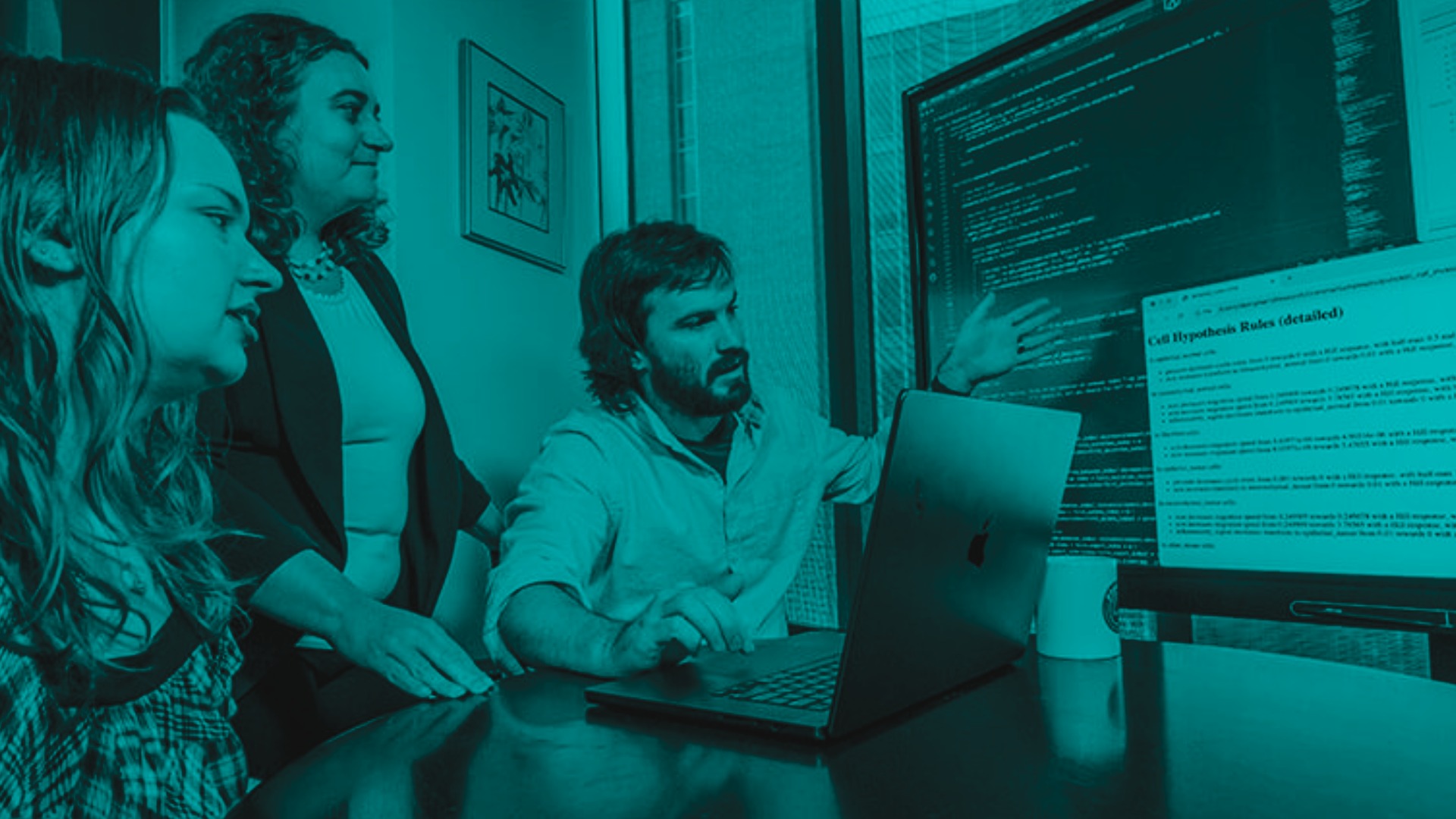
Drs. Jeanette Johnson, Elana J. Fertig, and Daniel Bergman review mathematical models and genomic data to simulate cancer cell growth. Credit: University of Maryland School of Medicine
share/
Drs. Jeanette Johnson, Elana J. Fertig, and Daniel Bergman review mathematical models and genomic data to simulate cancer cell growth.
Thank you! Your submission has been received!
Oops! Something went wrong while submitting the form.

in this article

table of contents will display on published page only
set h2 to populate the table of contents here

authors

Ed Muir

The power of prediction is everywhere in our lives: we try to forecast the weather, swings in the stock market, technological advancements, and much more. That’s also true in science.

In biology, it’s hard enough to understand how cells interact with each other. It’s even more complex to predict how these cells will change over time as they do. New technology can measure genes and proteins in individual cells, but these methods provide just a snapshot, leaving unanswered questions like how cells eventually become cancerous or immune-resistant. Meanwhile, mathematical and computer models can simulate how cells evolve, but they’re hard to build and require advanced programming skills. However, a new study combining biological research and computational modeling could democratize this field, helping scientists forecast how cells change, with ramifications for cancer research, immunology, and other areas.

A team of scientists from the University of Maryland and Johns Hopkins University developed an understandable modeling language that allows researchers to describe, in words and sentences, how cells behave and respond to their environment. This cell behavior grammar enables them to plug intuitive statements into the program, such as “oxygen decreases cell death”, and run virtual experiments on tissues such as tumors.
Professional businesswoman with long dark hair wearing navy blazer and white shirt
We can take these snapshots and put them into this virtual cell laboratory and basically hit ‘play’. Then we watch the movie unfold and make predictions on the hypothesis based off what we see.

- Genevieve Stein-O’Brien, Ph.D., assistant professor of Neuroscience and Neurology at Johns Hopkins School of Medicine

One important finding involved simulations of pancreatic cancer using genomic data from human patients. The models predicted that signals from immune cells promote invasion primarily by increasing cancer cell movement—known as motility—rather than cell division, which they later confirmed with further experiments. In the future, they hope to study other cancers.

“We’re trying now to extend this modeling framework to see if we can predict the development of pancreatic cancer and learn which lesions will grow and which ones won’t,” said Elana Fertig, Ph.D, Director of the Institute for Genome Sciences and Dean Albert E Reece Endowed Professor of Medicine and Epidemiology at the University of Maryland School of Medicine.

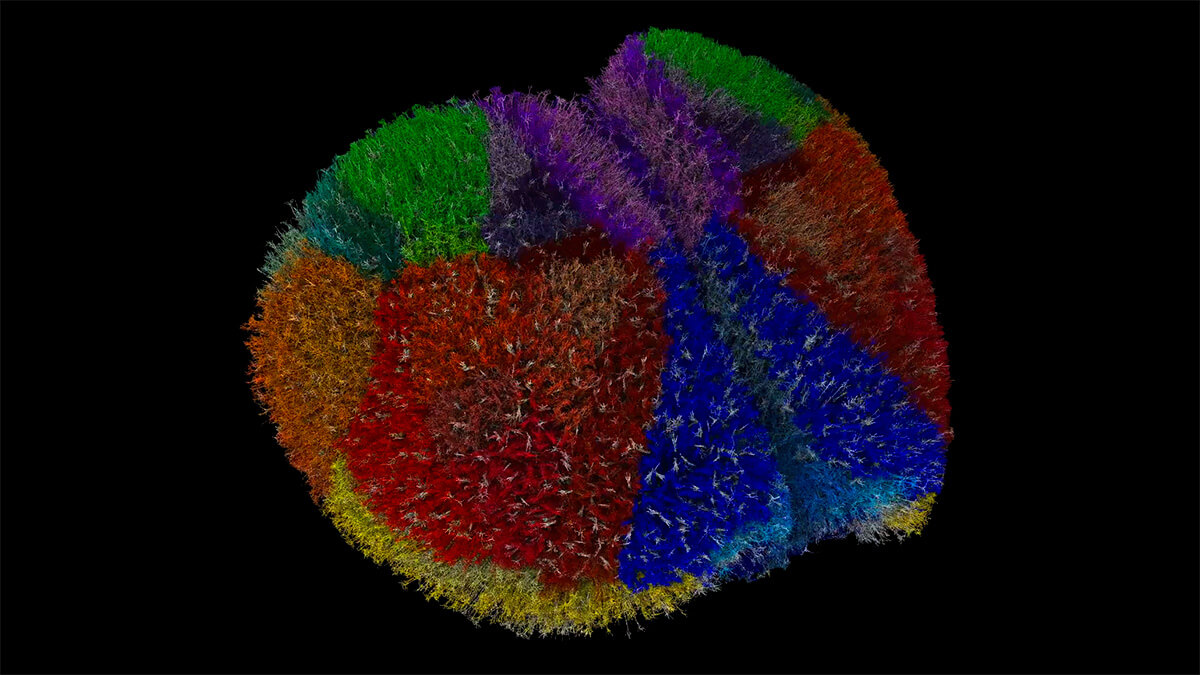
To test the model and show how broadly it could be applied, researchers used the Allen Institute’s Mouse Brain Atlas to simulate cell layer formation during brain development particularly in the cortex.

“The ability to load a whole brain of agents that are potentially connected and interacting with each other is extremely powerful,” said Stein-O’Brien.

“Agent-based modeling is a type of mathematical modeling that needs a lot of data support because we want to represent individual cells as discrete software agents that interact with one another and with their environment,” said Daniel Bergman, Ph.D., assistant professor at the Institute for Genome Sciences at University of Maryland School of Medicine and assistant professor of Pharmacology and Physiology. “So I like to think of it as the truest digitalization of how we can see cells in biology.”

The software is open source, so other scientists can access it for their research without requiring a deep understanding of computer programming. This work could eventually lead to computer programs that help treat cancer patients by creating a “digital twin” of the patient, which could help predict the best course of treatment. Scientists hope this technology will provide a bridge to a predictive future that largely hasn’t existed before in such an accessible way.

Citations
No items found.

about the allen institute

The Allen Institute is an independent, 501(c)(3) nonprofit research organization founded by philanthropist and visionary, the late Paul G. Allen. The Allen Institute is dedicated to answering some of the biggest questions in bioscience and accelerating research worldwide. The Institute is a recognized leader in large-scale research with a commitment to an open science model. For more information, visit alleninstitute.org.
explore related stories

explore more stories
news 
Designing better weapons to fight prostate cancer
New study unlocks key insights that could help develop next-generation immunotherapies
news 
Neuropixels Opto sheds new light into deepest regions of the brain
A single tool measures and manipulates brain cell communication and democratizes advanced neuroscience
news 
Mind trip: How psilocybin changes the brain
New research may help improve psychedelic therapy for neuropsychiatric disorders
news 
Computer model predicts aspects of cognitive performance
The Allen Human Brain Atlas helped researchers design a model that looked at “intrinsic neural timescales”
Allen Impact 2025
Technology and innovation are fueling discovery in science like never before we’re proud to be leading the way. 2025 was a year of tremendous impact...
news 
One of world’s most detailed virtual brain simulations is changing how we study the brain
Scientists use supercomputer that can process quadrillions of calculations per second to simulate mouse cortex for “virtual experiments”
we acceleratedevelopcatalyzeimpact

science done differently. shared with the world.

explore our accelerators

brain science

Mapping every cell, connection, and circuit in the brain—openly shared with the world.

cell science

Decoding how cells become tissues, then programming that knowledge into powerful new research tools.

neural dynamics

Revealing the brain's hidden algorithms that transform neural activity into real-world behavior.

immunology

Creating the deepest open reference for the healthy human immune system ever built.

synthetic biology

Engineering cells to record their own histories, transforming how we understand disease over time.

research

Big questions, open answers, and science built to be shared.

education

Inspiring the next generation of scientists through open science resources.

impact

Our science is empowering researchers and advancing health worldwide.
advancing science through open, collaborative research
Get the allen institute newsletter
Stay informed on the latest breakthroughs in neuroscience, bioscience, and AI-driven research.
allen institute
impactpeople & teamscareers & opportunitiesalumnihistory & founder
science resources
allencell.orgallenimmunology.orgallenneuraldynamics.orgbrain-bican.orgbrain-map.orgmicrons-explorer.org
research
brain sciencecell scienceneural dynamicsimmunologysynthetic biologypublications
education
science educationfield tripsprofessional developmentteaching resources
quick links
newseventsopen sciencepodcastscience resourceshuman brain donationvisit uscontact
follow us/

allen institute, 615 Westlake Ave North, Seattle, WA 98109 +12065487055

© 0000 allen institute. all rights reserved.
privacy policyterms of usecitation policyemployee portalpolicy & compliance