impact
impact
open science
subheadline
careers and opportunities
subheadline
people & teams
people & teams
subheadline
allenites
subheadline
allen institute advisors
subheadline
board of directors
subheadline
shanahan foundation fellowship
subheadline
next generation leaders
subheadline
research
overview
our approach
subheadline
publications
subheadline
open science
subheadline
accelerator
brain science
subheadline
cell science
subheadline
neural dynamics
subheadline
immunology
subheadline
synthetic biology
subheadline
education
education
science education
subheadline
education resources
subheadline
field trips
subheadline
open science
subheadline
open science quest
subheadline
news
news
stories
subheadline
podcast
subheadline
sign up for our newsletter
subheadline
events
events
all events
subheadline
conferences
subheadline
event code of conduct
subheadline
events
open science quest
subheadline
summer workshop on the dynamic brain
subheadline
open science week
subheadline
brain fest
subheadline
science resources
science resources
allencell.org
subheadline
allenimmunology.org
subheadline
allenneuraldynamics.org
subheadline
brain-bican.org
subheadline
brain-map.org
subheadline
microns-explorer.org
subheadline
impact
back to menu
impact
open science
subheading
careers and opportunities
subheading
people & teams
people & teams
subheading
allen institute advisors
subheading
board of directors
subheading
shanahan foundation fellowship
subheading
next generation leaders
subheading
research
back to menu
impact
Label
subheading
Label
subheading
people & teams
education
back to menu
research
Label
subheading
Label
subheading
Heading
news
back to menu
research
Label
subheading
Label
subheading
Heading
events
back to menu
research
Label
subheading
Label
subheading
Heading
science resources
back to menu
science resources
allencell.org
subheading
allenimmunology.org
subheading
allenneuraldynamics.org
subheading
brain-bican.org
subheading
brain-map.org
subheading
microns-explorer.org
subheading
search
stories
news

Q&A: A former experimental psychologist with a passion for data governance

Scientists everywhere are struggling with data. Paul Meijer, Ph.D., Director of Software Development at the newly launched Allen Institute for...

May 3, 2019
 min read
share/
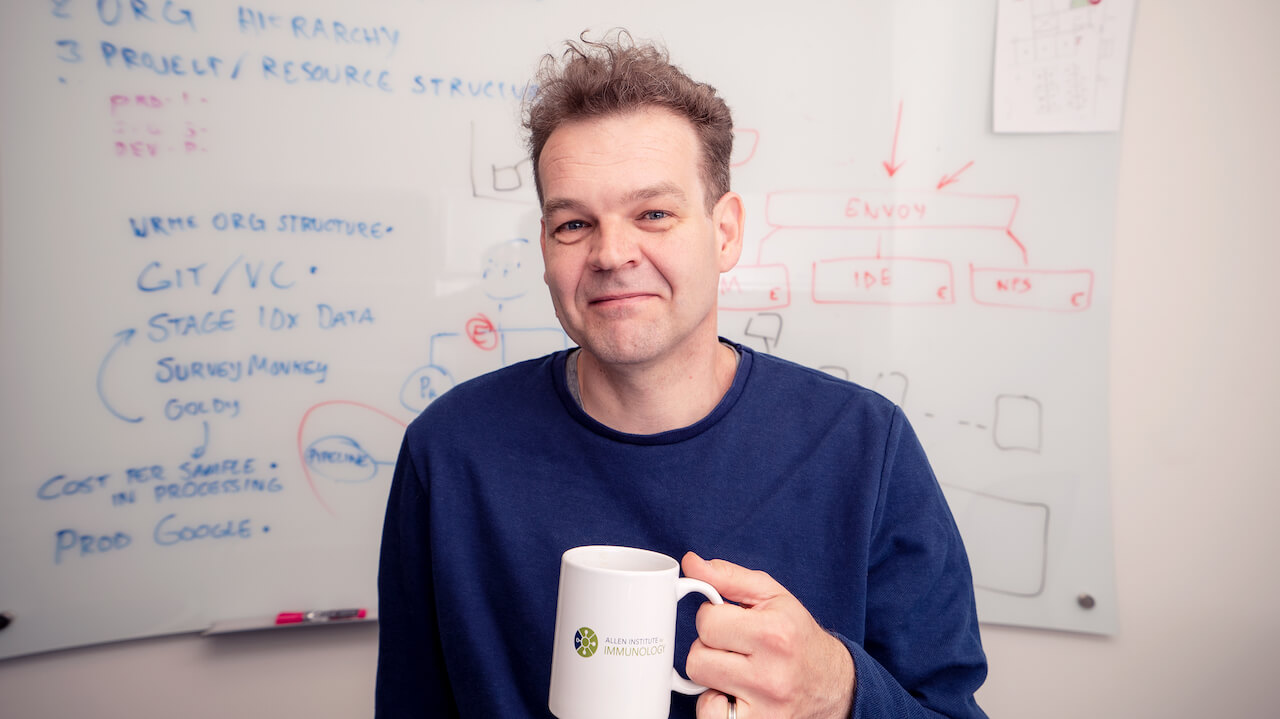
Paul Meijer, Ph.D., Director of Software Development at the newly launched Allen Institute for Immunology.
Scientists everywhere are struggling with data. Paul Meijer, Ph.D., Director of Software Development at the newly launched Allen Institute for...
Thank you! Your submission has been received!
Oops! Something went wrong while submitting the form.

in this article

table of contents will display on published page only
set h2 to populate the table of contents here

As more and more new technologies come on the scene, researchers’ ability to generate and store massive datasets is on the rise. But doing something with that data is a different question.

It’s a massive engineering challenge to package, store and present biological data so that other scientists can use it to glean new insights.

Paul Meijer, Ph.D., Director of Software Development at the newly launched Allen Institute for Immunology, is up for that challenge. Beyond the standard “data governance issues” that modern biology presents, the Allen Institute for Immunology has some formidable data challenges of its own. Meijer and his team will need to coordinate anonymized data from hundreds of different patients and healthy volunteers gathered by the Institute’s five different research partner organizations, allowing the partners and the broader scientific community to understand, access — and ultimately analyze — all that data.

We sat down with Meijer, who started out his career as a research psychologist before moving to software development, to find out more about what brought him to the Allen Institute, his vision for his team, and why he’s so excited about the mountains of immunology data that are soon headed his way. The conversation has been lightly edited for length and clarity.

What do you do in your role?
My goal — and my team’s goal — is to develop any and all tools so that the data we generate can be collected, analyzed and shared among our research partners, and with the broader scientific community, and in some ways even with the general public.

You used to be a psychology researcher. What led you to software development?
My background is in experimental and cognitive psychology. I studied speech production patterns in people and using the computer to model human processes was a natural next step. This was around the time when people were starting to do deep learning models and timely computational analysis became a reality for many researchers. It was natural for me to start learning some programming languages to see if we could model the results of our experiments with human subjects. So I had the background in both, and at some point I decided to just make the switch to pure software development.

What brought you to the Allen Institute for Immunology?
It’s definitely satisfying to come into a role that combines software development and research. It’s kind of the best of both worlds. Many other jobs in software limit you to solving problems that are commercially viable. There are very few jobs where you have the opportunity to identify and solve real needs without having to worry first about a licensing model. That’s incredibly liberating.

But it’s also really great to be part of something new. We’re only a few months old now and it’s really exciting to get to step in and build new tools from scratch, many of which we don’t even know yet what they will be.

And being part of a translational institute that will have a clinical impact in people’s lives, that’s very motivating. Of course, we still have to find out if we will be successful – but I think we will be.

What makes the Allen Institute for Immunology unique?
I will first start with the caveat that I’m by no means an immunology expert, so my perspective is maybe more in line with that of the general public, with a bit of a research background. But I think the longitudinal aspect (following patients over long periods of time) is very interesting. That’s not commonly done in immunology, as those studies are difficult and costly.

From a technology perspective, scientific organizations everywhere are grappling with an effective data governance model and it’s only getting worse as data sets become larger and larger. Too often articles are published and datasets are made publicly available with minimal guidance on how to work with this data, making it next to impossible for other scientists to pick up that data and understand how to analyze and verify it. This problem is not unique to immunology, but our field produces a huge amount of data. As a scientific discipline we could do a lot better. That’s a technological problem that I’m really interested in working on.

What’s your vision for your team? Where do you see yourselves two years down the road?
In terms of development, our main focus will be on making sure that everyone in the Institute here and our research partners are able to easily share data, and that any pipelines to analyze these data are in place. We will also be focused on developing a lot of visualization tools for our scientists to explore the data.

Beyond just the products, I would also love to help bring some visibility into the great engineering happening across the Allen Institute, not just in the immunology group. I have been very impressed with some of the cool scientific computing tools built at collaborating organizations right here in South Lake Union in Seattle and across the world, and we should similarly highlight and share what we have built to the greater community. I think the tools the engineers at the Allen Institute build could be useful to a lot of different audiences, and not just in our direct scientific areas.

Citations
No items found.

about the allen institute

The Allen Institute is an independent, 501(c)(3) nonprofit research organization founded by philanthropist and visionary, the late Paul G. Allen. The Allen Institute is dedicated to answering some of the biggest questions in bioscience and accelerating research worldwide. The Institute is a recognized leader in large-scale research with a commitment to an open science model. For more information, visit alleninstitute.org.
explore related stories

explore more stories
news 
Designing better weapons to fight prostate cancer
New study unlocks key insights that could help develop next-generation immunotherapies
news 
SciShots: Nervous and immune systems team up to take on parasites
Pain-sensing neurons in the intestine give marching orders to the immune system to kick off an attack against parasites
Allen Impact 2025
Technology and innovation are fueling discovery in science like never before we’re proud to be leading the way. 2025 was a year of tremendous impact...
news 
How age affects vaccine responses and how to make them better
Age-related shifts in T cells weaken vaccine response in older adults, but new findings pave the way for next generation of vaccines.
news 
Susan Kaech, Ph.D., named next leader of Allen Institute’s Immunology accelerator
Leader in immunology to advance the Institute’s next frontier in understanding the immune system’s role across health and disease
news 
New study reveals rheumatoid arthritis begins long before symptoms, opening door to prevention
The seven-year study reveals early-warning signs that could help doctors catch the disease before it starts, potentially saving patients years of pain and disability.
we acceleratedevelopcatalyzeimpact

science done differently. shared with the world.

explore our accelerators

brain science

Mapping every cell, connection, and circuit in the brain—openly shared with the world.

cell science

Decoding how cells become tissues, then programming that knowledge into powerful new research tools.

neural dynamics

Revealing the brain's hidden algorithms that transform neural activity into real-world behavior.

immunology

Creating the deepest open reference for the healthy human immune system ever built.

synthetic biology

Engineering cells to record their own histories, transforming how we understand disease over time.

research

Big questions, open answers, and science built to be shared.

education

Inspiring the next generation of scientists through open science resources.

impact

Our science is empowering researchers and advancing health worldwide.
advancing science through open, collaborative research
Get the allen institute newsletter
Stay informed on the latest breakthroughs in neuroscience, bioscience, and AI-driven research.
allen institute
impactpeople & teamscareers & opportunitiesalumnihistory & founder
science resources
allencell.orgallenimmunology.orgallenneuraldynamics.orgbrain-bican.orgbrain-map.orgmicrons-explorer.org
research
brain sciencecell scienceneural dynamicsimmunologysynthetic biologypublications
education
science educationfield tripsprofessional developmenteducation resources
quick links
newseventsopen sciencepodcastscience resourceshuman brain donationvisit uscontact
follow us/

allen institute, 615 Westlake Ave North, Seattle, WA 98109 +12065487055

© 0000 allen institute. all rights reserved.
privacy policyterms of usecitation policyemployee portalpolicy & compliance