impact
impact
open science
subheadline
careers and opportunities
subheadline
people & teams
people & teams
subheadline
allenites
subheadline
allen institute advisors
subheadline
board of directors
subheadline
shanahan foundation fellowship
subheadline
next generation leaders
subheadline
research
overview
our approach
subheadline
publications
subheadline
open science
subheadline
accelerator
brain science
subheadline
cell science
subheadline
neural dynamics
subheadline
immunology
subheadline
synthetic biology
subheadline
education
education
science education
subheadline
education resources
subheadline
field trips
subheadline
open science
subheadline
open science quest
subheadline
news
news
stories
subheadline
podcast
subheadline
sign up for our newsletter
subheadline
events
events
all events
subheadline
conferences
subheadline
event code of conduct
subheadline
events
open science quest
subheadline
summer workshop on the dynamic brain
subheadline
open science week
subheadline
brain fest
subheadline
science resources
science resources
allencell.org
subheadline
allenimmunology.org
subheadline
allenneuraldynamics.org
subheadline
brain-bican.org
subheadline
brain-map.org
subheadline
microns-explorer.org
subheadline
impact
back to menu
impact
open science
subheading
careers and opportunities
subheading
people & teams
people & teams
subheading
allen institute advisors
subheading
board of directors
subheading
shanahan foundation fellowship
subheading
next generation leaders
subheading
research
back to menu
impact
Label
subheading
Label
subheading
people & teams
education
back to menu
research
Label
subheading
Label
subheading
Heading
news
back to menu
research
Label
subheading
Label
subheading
Heading
events
back to menu
research
Label
subheading
Label
subheading
Heading
science resources
back to menu
science resources
allencell.org
subheading
allenimmunology.org
subheading
allenneuraldynamics.org
subheading
brain-bican.org
subheading
brain-map.org
subheading
microns-explorer.org
subheading
search
stories
news

Quantum mechanics and the puzzle of human consciousness

Exploring how quantum processes in the brain might shape our experiences.

May 30, 2024
 min read
share/
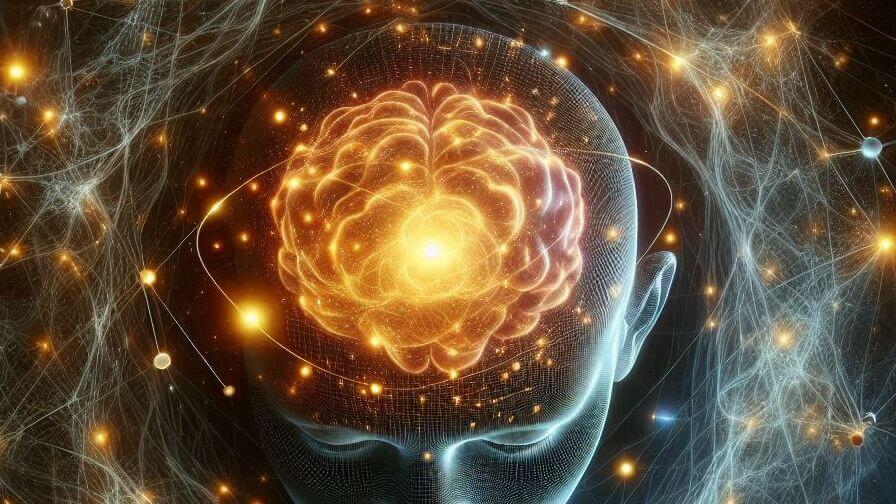
Lead image created by AI using Image Creator from Microsoft Designer.
Scientists at the Allen Institute and Google Quantum AI are exploring the role quantum mechanics might play in shaping consciousness.
Thank you! Your submission has been received!
Oops! Something went wrong while submitting the form.

in this article

table of contents will display on published page only
set h2 to populate the table of contents here

authors

Jake Siegel

Deep down, your brain is an ensemble of the smallest bits of matter in the universe.

These subatomic particles don’t play by the rules of the everyday world. They obey quantum physics—the mind-bending theory that posits objects can exist in multiple states at once and entangled atoms can instantaneously interact across vast distances.

Some scientists speculate that the strange happenings in this microscopic realm may hold the key to understanding consciousness. But scant evidence has left the majority skeptical.

That includes Christof Koch, Ph.D., meritorious investigator at the Allen Institute. As he wrote in his recent book, Then I am myself the world, “the brain is wet and warm, hardly conducive to subtle quantum interactions.”

But despite his skepticism, Koch is collaborating with scientists at Google Quantum AI and universities worldwide to explore the role quantum mechanics might play in shaping consciousness. A paper published in Entropy offers their novel theory on the links between quantum mechanics and consciousness and details a series of experiments to test it.

Some of those experiments—like linking a human brain to a quantum processor—are currently impossible. But other studies are actively pursuing signs of quantum activity within the brain, with results expected within the next few years.

Koch, who has spent decades studying the link between the physical matter in our brains and our conscious minds, remains open to unexpected discoveries.

“Anything that isn’t ruled out by the laws of physics can be exploited by evolution,” Koch said. “Evolution is very clever and has had the entire planet to play with for 4.5 billion years, so it’s possible.”

Clues of quantum minds?

Various theories have tried to explain how quantum physics might play a role in consciousness. Most hinge on the idea of superposition, where particles like electrons, photons, or maybe even the cat of the physicist Erwin Schrödinger, of the eponymous equation, can be in two or more states or positions at the same time. When observed, the state or position of these particle “collapses” and the system is in one definite state or location.
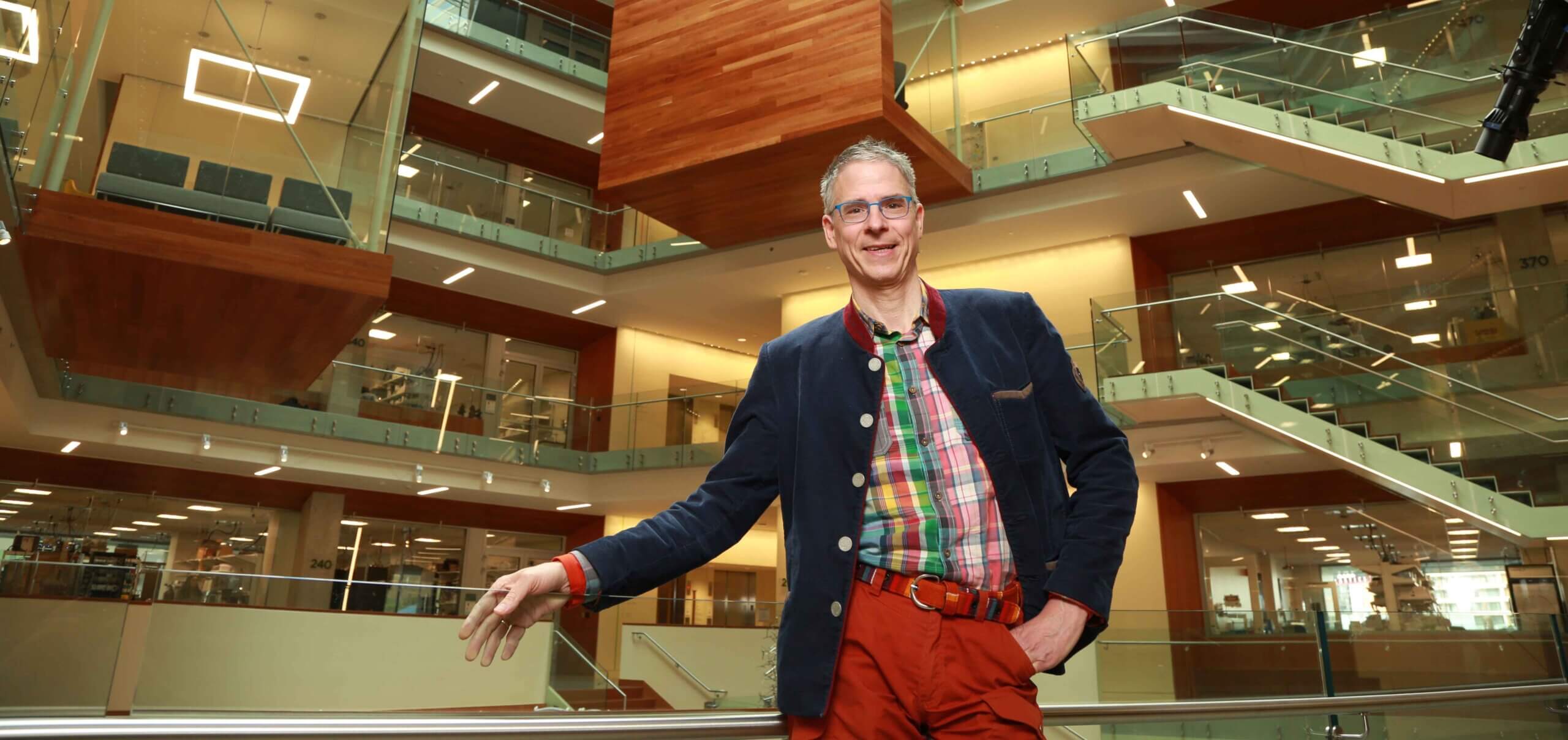
Man in navy blazer and red pants stands in modern multi-story atrium with glass railings.
Despite his skepticism, Koch is collaborating with scientists at Google Quantum AI and universities worldwide to explore the role quantum mechanics might play in shaping consciousness. Photo by Erik Dinnel / Allen Institute

Roger Penrose, a Nobel Prize winning cosmologist, has suggested that each collapse of a quantum superposition creates a moment of “proto-conscious.” Penrose, together with the anesthesiologist Stuart Hameroff, posit that small structures in our neurons (and other cells), called microtubules, might weave these moments together into full consciousness.

Koch and team drew upon Penrose’s theory but propose the opposite—that conscious experience arises whenever a quantum superposition forms. That avoids the possibility of faster-than-light travel implied in the original theory, Koch said.

It also implies a graded model of consciousness, where the complexity of consciousness correlates with the number of potential states in a superposition. Which isn’t surprising, Koch said; we’ve all observed the development of consciousness from infancy to adulthood. What is perhaps more surprising is that this also implies that at least simple forms of consciousness are far more widespread than conventionally assumed.

Other consequences are even harder to digest.

“It’s total science fiction right now, but if you could couple your brain with a quantum computer, achieving entanglement between the brain and the computer, you could expand your consciousness,” Koch said.

What makes science uniquely powerful is that you can have strongly held opinions, but you can test things by asking Nature a question.

-Christof Koch, Ph.D., Meritorious Investigator

That experiment is on the team’s proposed to-do list, though Koch says it’s unlikely in his lifetime. Instead, they are starting a bit smaller.

In a 2018 study, researchers in China explored how four forms of xenon, a noble gas with known anesthetic properties, affected consciousness. These forms or isotopes of xenon, were chemically identical but differed in their “spin,” a quantum property tied to particle momentum.

Intriguingly, the researchers observed different anesthetic effects in mice. The finding suggested a link between quantum processes and the modulation of consciousness.

Koch and his collaborators hypothesize that the xenon form with a larger “spin” value might create larger superpositions, correlating with more complex conscious experiences. This could counteract anesthetic effects, explaining the observed differences. They are now trying to replicate the 2018 results in flies and lab-grown human brain cells. If they do, the results just might shatter Koch’s skepticism.

Those are big ifs. Koch notes the profound differences between the frigid conditions necessary for today’s quantum computers—colder than the vacuum of outer space—and the brain’s warm, wet environment. Many believe that setting simply can’t sustain quantum processes, let alone those related to consciousness.

Still, he says, “what makes science uniquely powerful is that you can have strongly held opinions, but you can test things by asking Nature a question.”

Citations
No items found.

about the allen institute

The Allen Institute is an independent, 501(c)(3) nonprofit research organization founded by philanthropist and visionary, the late Paul G. Allen. The Allen Institute is dedicated to answering some of the biggest questions in bioscience and accelerating research worldwide. The Institute is a recognized leader in large-scale research with a commitment to an open science model. For more information, visit alleninstitute.org.

explore related stories

explore more stories
video 
What extreme experience can teach us about consciousness
Christof Koch speaks to a global audience about psychedelics, unresponsive patients, and the unsolved mystery of conscious experience
video 
The new lab partner: AI and future scientific discovery
Allen Institute scientists and tech experts took the international stage to explore how human-machine partnerships are pushing the boundaries of science.
news 
Mind trip: How psilocybin changes the brain
New research may help improve psychedelic therapy for neuropsychiatric disorders
news 
Partnering with Anthropic to supercharge research and help cure disease
From months to hours, autonomous AI agents will accelerate research in the quest for cures.
news 
Zapping the right brain cells: The path to improved stimulation
New findings could help scientists develop better ways to treat brain disorders with electrical stimulation.
we acceleratedevelopcatalyzeimpact

science done differently. shared with the world.

explore our accelerators

brain science

Mapping every cell, connection, and circuit in the brain—openly shared with the world.

cell science

Decoding how cells become tissues, then programming that knowledge into powerful new research tools.

neural dynamics

Revealing the brain's hidden algorithms that transform neural activity into real-world behavior.

immunology

Creating the deepest open reference for the healthy human immune system ever built.

synthetic biology

Engineering cells to record their own histories, transforming how we understand disease over time.

research

Big questions, open answers, and science built to be shared.

education

Inspiring the next generation of scientists through open science resources.

impact

Our science is empowering researchers and advancing health worldwide.
advancing science through open, collaborative research
Get the allen institute newsletter
Stay informed on the latest breakthroughs in neuroscience, bioscience, and AI-driven research.
allen institute
impactpeople & teamscareers & opportunitiesalumnihistory & founder
science resources
allencell.orgallenimmunology.orgallenneuraldynamics.orgbrain-bican.orgbrain-map.orgmicrons-explorer.org
research
brain sciencecell scienceneural dynamicsimmunologysynthetic biologypublications
education
science educationfield tripsprofessional developmenteducation resources
quick links
newseventsopen sciencepodcastscience resourceshuman brain donationvisit uscontact
follow us/

allen institute, 615 Westlake Ave North, Seattle, WA 98109 +12065487055

© 0000 allen institute. all rights reserved.
privacy policyterms of usecitation policyemployee portalpolicy & compliance