impact
impact
open science
subheadline
careers and opportunities
subheadline
people & teams
people & teams
subheadline
allenites
subheadline
allen institute advisors
subheadline
board of directors
subheadline
shanahan foundation fellowship
subheadline
next generation leaders
subheadline
research
overview
our approach
subheadline
publications
subheadline
open science
subheadline
accelerator
brain science
subheadline
cell science
subheadline
neural dynamics
subheadline
immunology
subheadline
synthetic biology
subheadline
education
education
science education
subheadline
education resources
subheadline
field trips
subheadline
open science
subheadline
open science quest
subheadline
news
news
stories
subheadline
podcast
subheadline
sign up for our newsletter
subheadline
events
events
all events
subheadline
conferences
subheadline
event code of conduct
subheadline
events
open science quest
subheadline
summer workshop on the dynamic brain
subheadline
open science week
subheadline
brain fest
subheadline
science resources
science resources
allencell.org
subheadline
allenimmunology.org
subheadline
allenneuraldynamics.org
subheadline
brain-bican.org
subheadline
brain-map.org
subheadline
microns-explorer.org
subheadline
impact
back to menu
impact
open science
subheading
careers and opportunities
subheading
people & teams
people & teams
subheading
allen institute advisors
subheading
board of directors
subheading
shanahan foundation fellowship
subheading
next generation leaders
subheading
research
back to menu
impact
Label
subheading
Label
subheading
people & teams
education
back to menu
research
Label
subheading
Label
subheading
Heading
news
back to menu
research
Label
subheading
Label
subheading
Heading
events
back to menu
research
Label
subheading
Label
subheading
Heading
science resources
back to menu
science resources
allencell.org
subheading
allenimmunology.org
subheading
allenneuraldynamics.org
subheading
brain-bican.org
subheading
brain-map.org
subheading
microns-explorer.org
subheading
search
stories
news

Zapping the right brain cells: The path to improved stimulation

New findings could help scientists develop better ways to treat brain disorders with electrical stimulation.

June 4, 2024
 min read
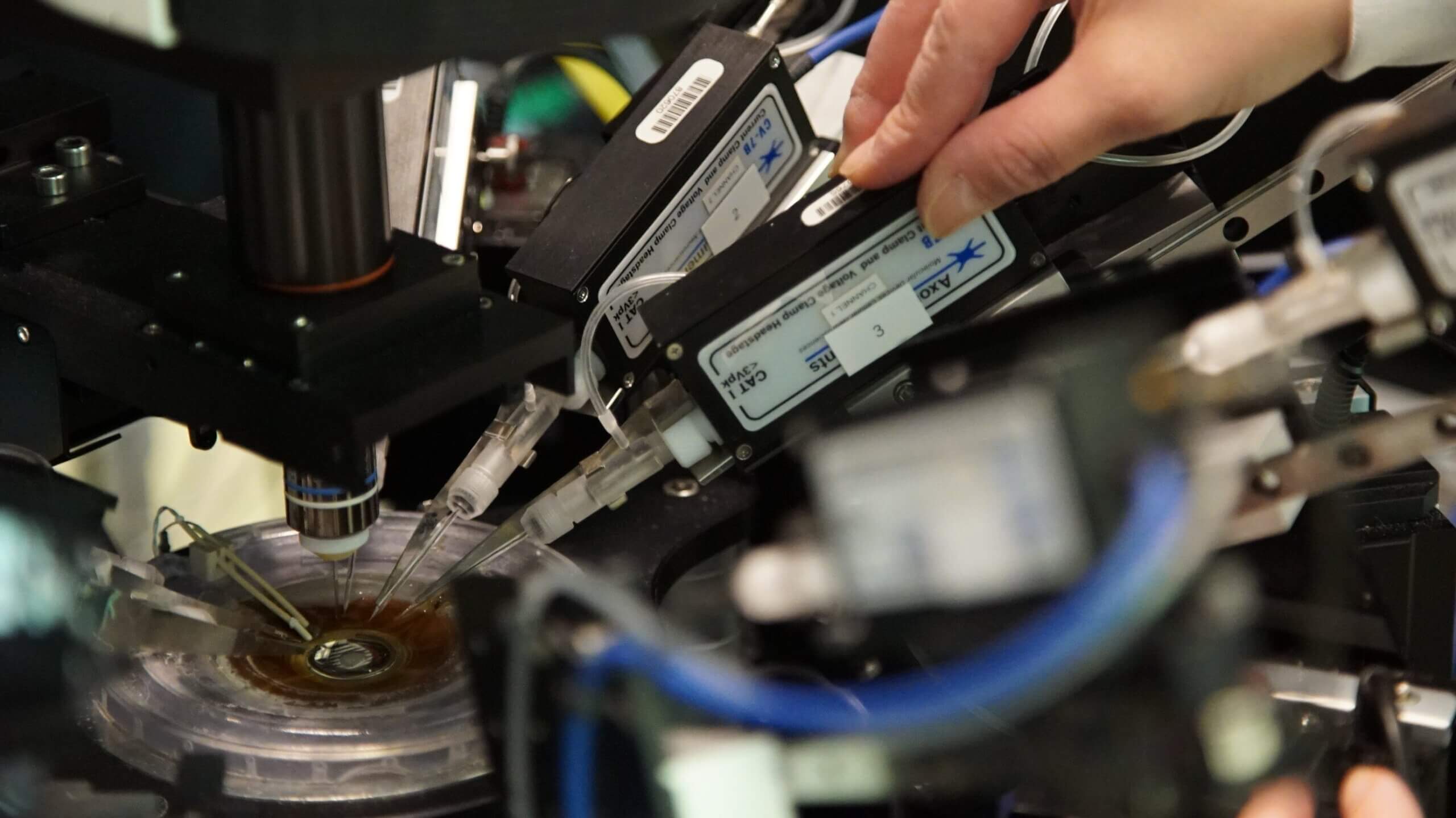
Multipatch electrophysiology rig at Allen Institute
share/
Multipatch electrophysiology rig at Allen Institute used for experimentation
New findings could help scientists develop better ways to treat brain disorders with electrical stimulation.
Thank you! Your submission has been received!
Oops! Something went wrong while submitting the form.

in this article

table of contents will display on published page only
set h2 to populate the table of contents here

authors

Jake Siegel

Sending electrical currents into the brain is an established treatment for neurological conditions like epilepsy and Parkinson’s. But how electric stimulation (ES) affects individual brain cells remains unclear.

New research by scientists at the Allen Institute’s Brain and Consciousness group and Cedars-Sinai offers an unprecedented look at how neurons respond to ES. Far from being uniform, different types of neurons showed distinct patterns of ‘syncing up’ with electrical fields. These patterns varied depending on the rate at which the ES was delivered.

The newfound understanding of these underlying mechanisms could transform our approach to treating complex brain disorders.

- Soo Yeun Lee, Ph.D., Senior Scientist at the Allen Institute

The findings, published today in Neuron, could help doctors fine-tune where, when, and how to apply ES to the brain, said Soo Yeun Lee, Ph.D., the paper’s first author and a Senior Scientist at the Allen Institute.

“With this study, we now have a much better idea of what types of stimulation work for specific cell classes,” she said. “We can use that knowledge to develop more efficient ways of using electrical stimulation to treat disorders.”

Using tissue samples from mice and humans, the research team delivered oscillating waves of ES within tens of micrometers of individual neurons. This extraordinary precision enabled an unprecedented look at electrical stimulation’s impact at a single-cell level. They observed strong, cell-class-specific responses. Excitatory neurons synchronized firing with both slow and fast stimulation frequencies, while inhibitory neurons primarily responded to fast frequencies.

These class-specific responses are significant, Lee said, because they reveal that adjusting the stimulation frequency allows for the selective targeting of different neurons. That discovery could lead to more precise therapies to modulate neural activity.

For example, inhibitory neurons that express a protein called parvalbumin are implicated in epilepsy and in cognitive dysfunctions, she noted. This study shows that these cell classes are most responsive to certain frequencies. Future treatments could tailor ES to the most effective frequency, potentially improving outcomes and limiting side effects.
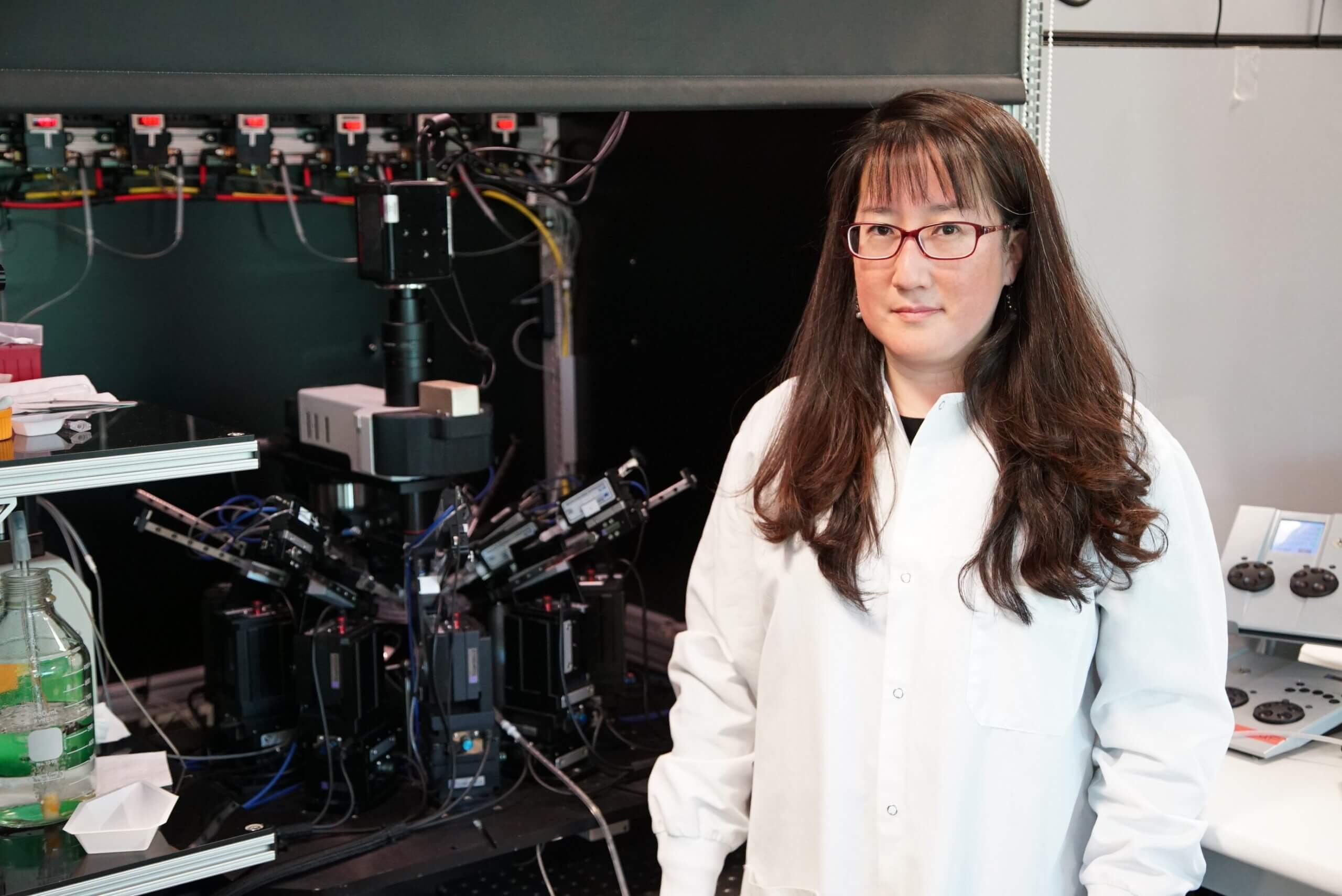
Photo of a woman in a white lab coat standing next to a large electrophysiology rig
The new findings could help doctors fine tune when, where and how to apply electrical stimulation to the brain, said Soo Yeun Lee, a Senior Scientist at the Allen Institute. Photo by Steven Hurd / Allen Institute.

Beyond its clinical implications, the study also revealed a universal truth about how neurons function, Lee added. Regardless of cell class, cortical areas, or species, neurons exhibit a remarkable ability to synchronize with an external electric field.

This general property is superimposed on the brain’s dazzling cellular diversity, Lee said—and the newfound understanding of these underlying mechanisms could transform our approach to treating complex brain disorders.

Research described in this article was supported by award numbers R01NS120300 and R01NS130126 from the National Institute of Neurological Disorders and Stroke of the National Institutes of Health. The content is solely the responsibility of the authors and does not necessarily represent the official views of NIH and its subsidiary institutes. ‍

Citations
No items found.

about the allen institute

The Allen Institute is an independent, 501(c)(3) nonprofit research organization founded by philanthropist and visionary, the late Paul G. Allen. The Allen Institute is dedicated to answering some of the biggest questions in bioscience and accelerating research worldwide. The Institute is a recognized leader in large-scale research with a commitment to an open science model. For more information, visit alleninstitute.org.

explore related stories

explore more stories
video 
What extreme experience can teach us about consciousness
Christof Koch speaks to a global audience about psychedelics, unresponsive patients, and the unsolved mystery of conscious experience
news 
Mind trip: How psilocybin changes the brain
New research may help improve psychedelic therapy for neuropsychiatric disorders
news 
Quantum mechanics and the puzzle of human consciousness
Exploring how quantum processes in the brain might shape our experiences.
we acceleratedevelopcatalyzeimpact

science done differently. shared with the world.

explore our accelerators

brain science

Mapping every cell, connection, and circuit in the brain—openly shared with the world.

cell science

Decoding how cells become tissues, then programming that knowledge into powerful new research tools.

neural dynamics

Revealing the brain's hidden algorithms that transform neural activity into real-world behavior.

immunology

Creating the deepest open reference for the healthy human immune system ever built.

synthetic biology

Engineering cells to record their own histories, transforming how we understand disease over time.

research

Big questions, open answers, and science built to be shared.

education

Inspiring the next generation of scientists through open science resources.

impact

Our science is empowering researchers and advancing health worldwide.
advancing science through open, collaborative research
Get the allen institute newsletter
Stay informed on the latest breakthroughs in neuroscience, bioscience, and AI-driven research.
allen institute
impactpeople & teamscareers & opportunitiesalumnihistory & founder
science resources
allencell.orgallenimmunology.orgallenneuraldynamics.orgbrain-bican.orgbrain-map.orgmicrons-explorer.org
research
brain sciencecell scienceneural dynamicsimmunologysynthetic biologypublications
education
science educationfield tripsprofessional developmenteducation resources
quick links
newseventsopen sciencepodcastscience resourceshuman brain donationvisit uscontact
follow us/

allen institute, 615 Westlake Ave North, Seattle, WA 98109 +12065487055

© 0000 allen institute. all rights reserved.
privacy policyterms of usecitation policyemployee portalpolicy & compliance