in this article
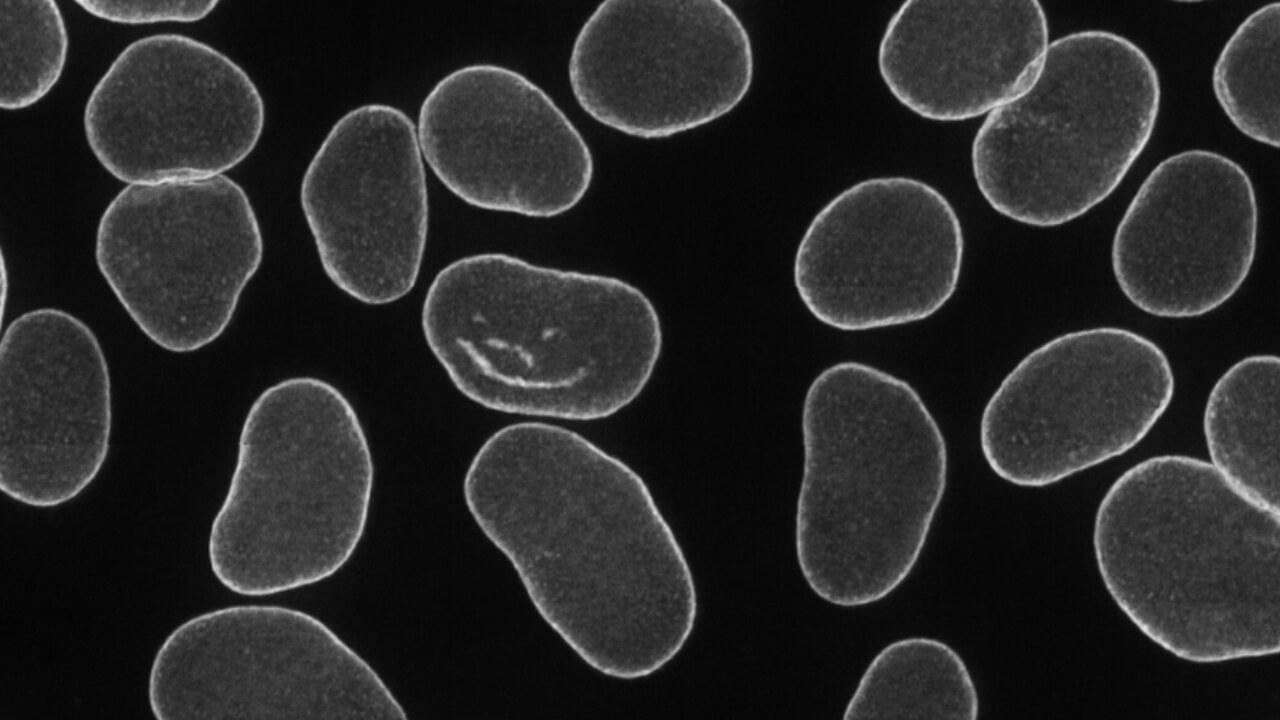
Allen Institute for Cell Science researchers photograph thousands and thousands of different cells under the microscope. Sometimes, one of those photos captures something unusual. The cells these scientists work with are human stem cells, derived from an adult donor’s skin cells and engineered to revert to a more “naive” state. Biologists at the Allen Institute have further engineered these stem cells to tag certain proteins or cellular structures with glowing fluorescent labels. These cells, in an image captured by scientist Chris Frick, Ph.D., are engineered with a label that marks the nuclear envelope, the thin membrane that surrounds the cell’s nucleus. Each of our cells houses all its chromosomes inside the nucleus, as well as many specialized proteins that regulate how our genes switch on or off. The protein labeled in these cells, known as lamin B1, is a key part of the nuclear envelope. In most stem cells, the nuclear envelope is smooth, but wrinkles can occasionally form in its thin surface — sometimes taking on unexpected shapes. — Rachel Tompa, Ph.D.
Microscopic viewpoints, computer-generated models, intricate tracings and more — see a new side of science with SciShots.
Get in touch at press@alleninstitute.org.
Citations
about the allen institute
The Allen Institute is an independent, 501(c)(3) nonprofit research organization founded by philanthropist and visionary, the late Paul G. Allen. The Allen Institute is dedicated to answering some of the biggest questions in bioscience and accelerating research worldwide. The Institute is a recognized leader in large-scale research with a commitment to an open science model. For more information, visit alleninstitute.org.