impact
about
our story
explore our impact
careers and opportunities
join us
open science
sharing science to speed discovery
open science week
celebrating open science
team science
people & teams
discovery is a team effort
allenites
the people who make our work possible
advisors
their input shapes our science
board of directors
they help us fulfill our mission
shanahan foundation fellowship
at the interface of data and neuroscience
next generation leaders
fostering emerging leaders in bioscience
research
overview
our approach
science at the scale of greatest impact
publications
explore our publications
open science
sharing science to speed discovery
science accelerators
brain science
building a blueprint of the brain
cell science
understanding how cells become organs
neural dynamics
revealing the brain’s hidden algorithms
immunology
creating the ultimate immune system reference
synthetic biology
seattle hub for synthetic biology
education
overview
science education
science is for everyone
open science
sharing science speeds discovery
engagement
education resources
real science. real skills.
field trips
experience science where it happens
educator development
empowering educators
news
overview
all news
explore the latest news
podcast
the human stories behind discovery
sign up for our newsletter
stay connected to our science
events
overview
all events
public engagement, workshops, seminars and more
conferences
connect with us
science resources
science resources
allencell.org
allenimmunology.org
allenneuraldynamics.org
brain-bican.org
brain-map.org
microns-explorer.org
impact
back to menu
team science
our story
explore our impact
careers and opportunities
join us
open science
sharing science to speed discovery
open science week
celebrating open science
team science
people & teams
discovery is a team effort
allenites
the people who make our work possible
advisors
their input shapes our science
board of directors
they help us fulfill our mission
shanahan foundation fellowship
at the interface of data and neuroscience
next generation leaders
fostering emerging leaders in bioscience
research
back to menu
overview
our approach
science at the scale of greatest impact
publications
explore our publications
open science
sharing science to speed discovery
science accelerators
brain science
building a blueprint of the brain
cell science
understanding how cells become organs
neural dynamics
revealing the brain’s hidden algorithms
immunology
creating the ultimate immune system reference
synthetic biology
seattle hub for synthetic biology
education
back to menu
overview
science education
science is for everyone
open science
sharing science speeds discovery
engagement
education resources
real science. real skills.
field trips
experience science where it happens
educator development
empowering educators
news
back to menu
overview
all news
explore the latest news
podcast
the human stories behind discovery
newsletter
stay connected to our science
events
back to menu
overview
all events
public engagement, workshops, seminars and more
conferences
connect with us
science resources
back to menu
science resources
allencell.org
allenimmunology.org
allenneuraldynamics.org
brain-bican.org
brain-map.org
microns-explorer.org
search
news

Brain expansion brings bigger brains and clearer images, with the help of a diaper chemical

Clear, jelly-like mouse brains are the new gamechangers in neuroscience

August 3, 2023
 min read
share/
Clear, jelly-like mouse brains are the new gamechangers in neuroscience.
Thank you! Your submission has been received!
Oops! Something went wrong while submitting the form.

in this article

table of contents will display on published page only
set h2 to populate the table of contents here

authors

Haylee Jarrett

There is something extraordinary about the mouse brain. This small, half-a-cubic centimeter, corn chip-shaped organ holds nearly 85 million neurons — and the potential to better understand our own brains.

Despite its size, scientists unveil the secrets within this tiny structure daily. A team of researchers at the Allen Institute for Neural Dynamics, a division of the Allen Institute, is taking a closer look at these mini marvels by employing expansion microscopy, a technique that makes the brain three times bigger and see-through with the unlikely assistance of a chemical commonly found in disposable diapers.  
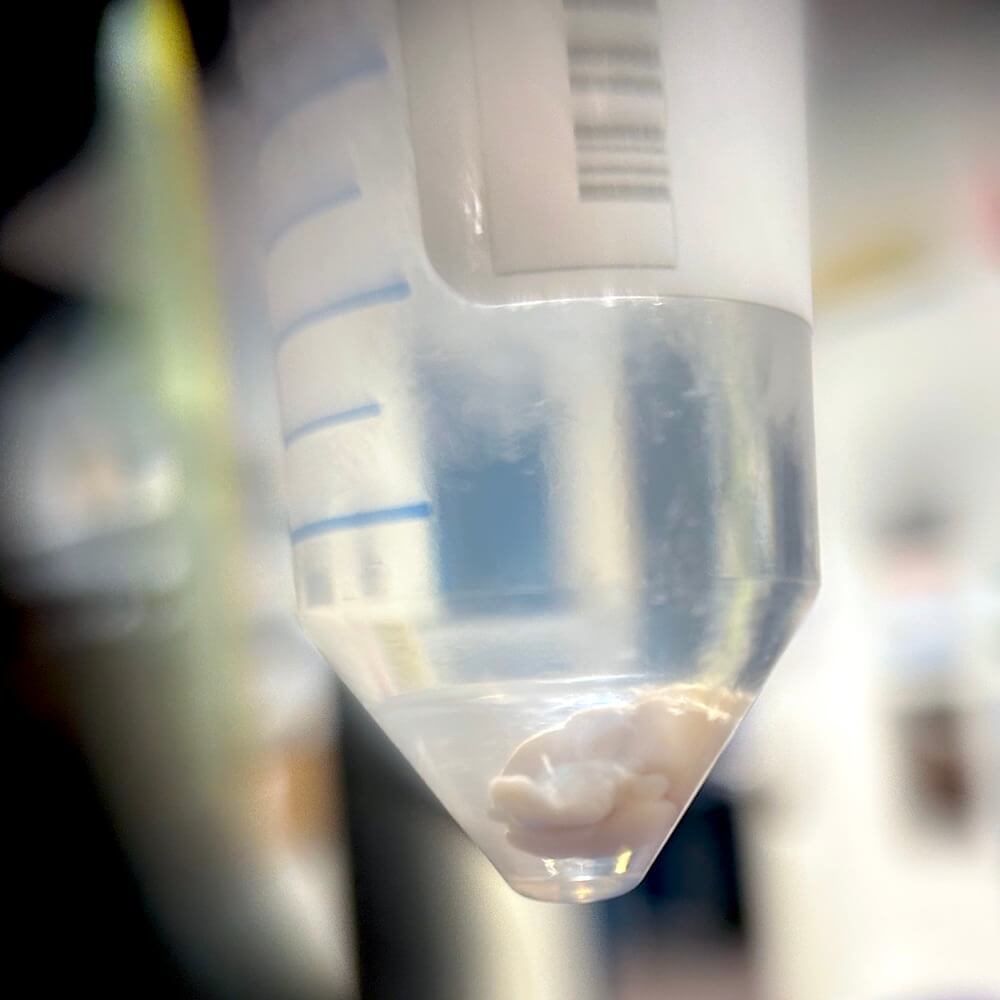
Clear plastic bottle held in hand with liquid and blue measurement markings visible
A whole (non-expanded) mouse brain in the lab at the Allen Institute for Neural Dynamics. Photo by Madeline Burchard / Allen Institute.

Scientists at the Massachusetts Institute of Technology first used the water absorbing chemical, known as sodium polyacrylate, to expand cells and slices of tissue. The Allen Institute team is now using such technology to expand entire mouse brains in a first-of-its-kind approach. By expanding whole mouse brains before capturing images of them, the scientists can see individual axons, the long signal-sending branches of neurons, at a much higher resolution. This is especially important for the types of neurons the Allen Institute team wants to study, which have branches that can stretch multiple centimeters in the brain but are a thousand times thinner than a human hair.  

“There are really fine structures in the brain that are normally really difficult to image,” said senior research associate Naveen Ouellette. “We’ve gotten to the point where we’re now able to see these fine structures and we’re able to see them brightly labeled, which is all very difficult to do.”

In 2015, neuroscientist Ed Boyden, Ph.D., and his team at MIT shook the scientific community by using a swellable polymer to expand brain slices from a mouse to more than four times their original size. The compound contains sodium polyacrylate, which attracts moisture and expands when introduced to water. Making tissues or entire organs physically larger means scientists can capture higher levels of detail using existing microscopes. Expansion microscopy has since been used in projects ranging from neurological disorders to breast cancer biopsy analysis.

The nitty gritty of brain expansion

To preserve the brain’s fine spatial relationships, the Allen Institute scientists first add a molecular anchor that links the brain’s structures in proportion to each other as the whole organ is expanded. It’s akin to drawing a smiley face on a balloon before it’s blown up — the face gets bigger but maintains its same shape. In order to see the neurons they want to study, the scientists must also label specific cells with a fluorescent marker and clear the brain — rendering the organs see-through.  

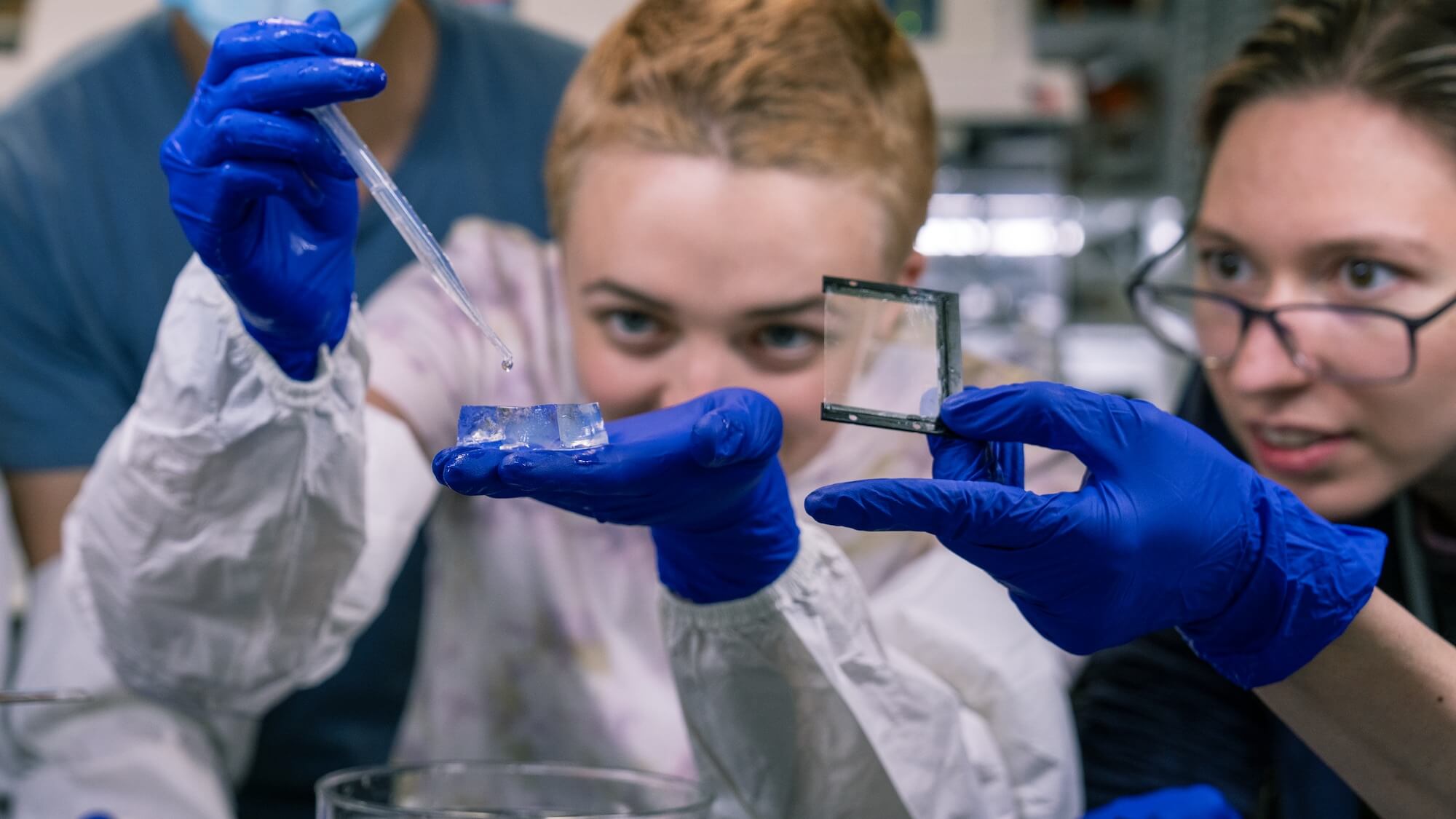
Person in blue gloves pouring clear liquid into glass beaker in laboratory setting
Scientists adding a (non-expanded) mouse brain to a solution next to an expanded, cleared mouse brain (tinted pink for visibility in the photo) in the lab. Photo by Erik Dinnel / Allen Institute

To get from opaque to transparent, scientists must first remove any fat in the way. These fats, or lipids, play a key role in supporting brain function. However, they block closer examination of neurons. That’s where delipidation comes in, otherwise known as de-fatting. This process uses a chemical similar to paint stripper to remove most of the fats. For that chemical to work, the scientists must first dehydrate the whole brain, which makes it even smaller. After the fats are stripped out, the brain is rehydrated and goes through a second delipidation step that includes alcohol and soap — a far more respectable choice than your typical Trader Joe’s peony foam hand soap. The entire process, including neuron labeling, delipidation, and “gelation,” can take up to two months to complete.  
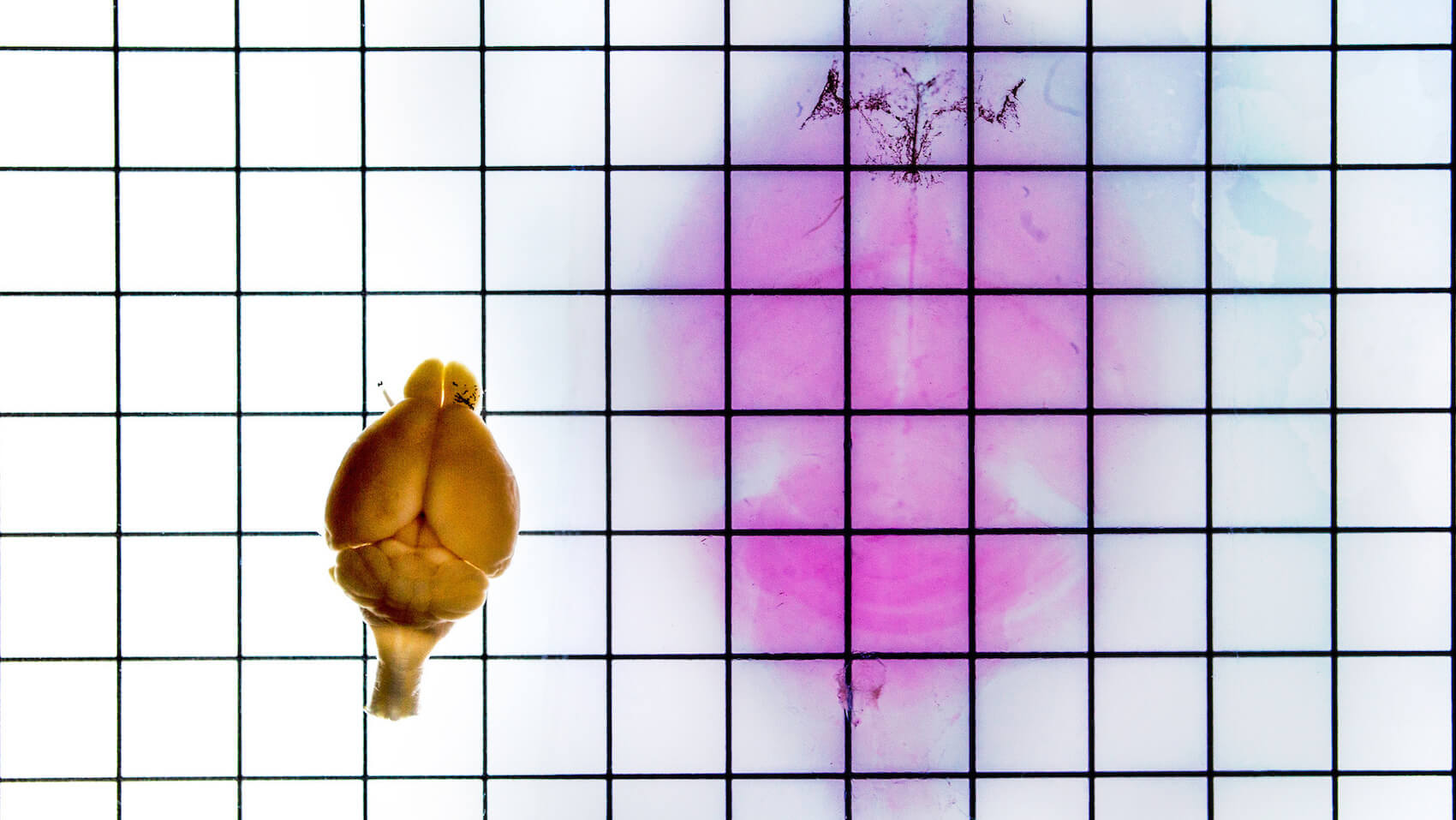
Golden flower bud against grid background with purple and pink gradient watercolor
Normal mouse brain (left) and transparent expanded mouse brain (right). Photo by Erik Dinnel / Allen Institute

Getting to that point seems taxing, but creating transparent brains makes whole brain microscopy possible, allowing scientists to see the big picture of the brain at the finest detail, all at once.  

“We want to image the whole brain at high resolution and a limitation that comes from traditional imaging techniques is that you can only see parts of it at a time,” said senior scientist Jayaram Chandrashekar, Ph.D. “The clarity provided by whole brain expansion overcomes this limitation. To track these individual axons, we need to be able to image the entire brain without losing any data.”  

Woman scientist wearing mask and gloves conducts laboratory experiment at workbench.
Naveen Ouellette in the lab at the Allen Institute for Neural Dynamics working to expand brain tissue. Photo by Erik Dinnel / Allen Institute

But why strive to do this anyway? It’s about understanding the anatomy of the brain at super resolution, one class of neuron at a time. Kevin Cao, another neuroscientist on the Neural Dynamics team, said: “Imagine we’re trying to map the human skeleton for the first time. This technique is like taking away all the parts of your body that aren’t your bones, and then fixing your bones to a grid and stretching them out four times bigger. They’d be in the same location relative to each other, just much bigger and their features unobstructed by tendons and muscle. In the context of the brain, we’re trying to understand how different parts of it interact with one another by mapping it in this way.”  

With microscopic features, maintaining precision while increasing size is crucial. “Whole brain expansion is important because it enables us to study brain-wide connectivity at the nanoscale level,” Cao said.

Most microscopes are designed to image thin slices of a brain or other tissue; these machines provide essential information, but they can’t always capture the full breadth of neurons in the entire brain. The Neural Dynamics team also recently unveiled a new kind of microscope known as ExA-SPIM, which is purpose-built to image these giant gummy brains. Together, the equipment and the expansion technique led to an in-depth exploration of individual neurons and axons.  

With the naked eye, it takes a certain skill level to see an expanded, cleared brain, because it is so translucent.  

“It’s like a clear Jell-O shot, basically,” Ouellette said. “There’s almost like a ghost image of the brain.”

Things need to line up perfectly to even catch a glimpse. The calculated position of the wrist. The right choice of background. A subtle tilt of the neck and then an outline can be detected. It is elusive, like a black cat in the night. Thinking of the time, the effort, the possibilities, in a see-thru jelly vessel, is unexpectedly moving.

Citations
No items found.

about the allen institute

The Allen Institute is an independent, 501(c)(3) nonprofit research organization founded by philanthropist and visionary, the late Paul G. Allen. The Allen Institute is dedicated to answering some of the biggest questions in bioscience and accelerating research worldwide. The Institute is a recognized leader in large-scale research with a commitment to an open science model. For more information, visit alleninstitute.org.

related news

all news
news
“Computational crystal ball” helps predict cell behavior
New technology could lead to better treatments for cancer by allowing scientists to perform virtual experiments
news
Mind trip: How psilocybin changes the brain
New research may help improve psychedelic therapy for neuropsychiatric disorders
news
Computer model predicts aspects of cognitive performance
The Allen Human Brain Atlas helped researchers design a model that looked at “intrinsic neural timescales”
news
Scientists unveil the world's most comprehensive AI-powered tool for neuroscience: Brain Knowledge Platform
Massive, first-of-its-kind data resource aims to accelerate medical breakthroughs in brain diseases like Alzheimer’s and Parkinson's
news
Scientists shoot lasers into brain cells to uncover how illusions work
Supported by the Allen Institute's OpenScope program, the findings could help us better understand neuropsychiatric disorders like schizophrenia and...
news
Collaboration Expands Research Tool to Help Crack the Code on Parkinson’s and Other Neurodegenerative Diseases
A new view of Parkinson's Disease
we acceleratedevelopcatalyzeimpact

science done differently. shared with the world.

explore our accelerators

brain science

Mapping every cell, connection, and circuit in the brain—openly shared with the world.

cell science

Decoding how cells become tissues, then programming that knowledge into powerful new research tools.

neural dynamics

Revealing the brain's hidden algorithms that transform neural activity into real-world behavior.

immunology

Creating the deepest open reference for the healthy human immune system ever built.

synthetic biology

Engineering cells to record their own histories, transforming how we understand disease over time.

research

Big questions, open answers, and science built to be shared.

education

Inspiring the next generation of scientists through open science resources.

impact

Our science is empowering researchers and advancing health worldwide.
advancing science through open, collaborative research
Get the allen institute newsletter
Stay informed on the latest breakthroughs in neuroscience, bioscience, and AI-driven research.
allen institute
impactpeople & teamscareers & opportunitiesalumnihistory & founder
science resources
allencell.orgallenimmunology.orgallenneuraldynamics.orgbrain-bican.orgbrain-map.orgmicrons-explorer.org
research
brain sciencecell scienceneural dynamicsimmunologysynthetic biologypublications
education
science educationfield tripsprofessional developmenteducation resources
quick links
newseventsopen sciencepodcastscience resourceshuman brain donationvisit uscontact
follow us/

allen institute, 615 Westlake Ave North, Seattle, WA 98109 +12065487055

© 0000 allen institute. all rights reserved.
privacy policyterms of usecitation policyemployee portalpolicy & compliance