







summary
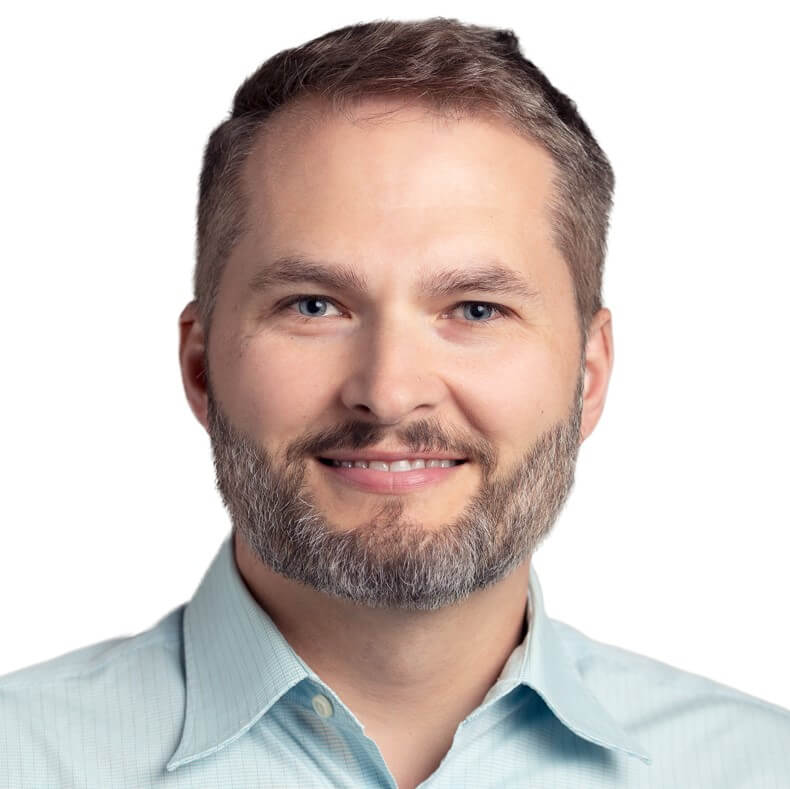
Aldan Beaubien was in high school when a smorgasbord of bagels, cream cheese and apple juice left him in agony. Months later, doctors diagnosed him with Crohn’s disease. Now an IT engineer at a research institute studying the disease, Aldan has new hope for better treatments or even a cure.
podcast transcript
show full transcript
Aldan Beaubien
I spent a lot of my life in front of computers…
Rob Piercy
Like a lot of kids growing up in the ‘90s, Aldan Beaubien spent hours and hours basking in the warm glow of his computer monitor.
Aldan Beaubien
At first it was video games, you have a computer in front of you that can run any video game you like. That’s what you do. I gravitated towards modding projects, projects that would pull apart code.
Rachel Tompa
Those projects led to a network security degree, a career in information technology and — eventually — a job at a research institute that happens to be working on the disease Aldan has lived with for half of his life.
Aldan Beaubien
I felt like maybe food poisoning or something, but it never really went away. It just grew and grew.
Rachel Tompa
I’m Rachel Tompa
Rob Piercy
I’m Rob Piercy and this is Lab Notes
Rachel Tompa
What do you like about computers?
Aldan Beaubien
I think everything about it is very precise, there is a definite answer to questions. I feel like your imagination is the limit with computing. And you can really make some things that can blow minds.
Rachel Tompa
Aldan Beaubien is a Senior DevOps/SecOps engineer. He’s in charge of building out, securing and tuning the IT infrastructure at the Allen Institute for Immunology in Seattle. Founded in 2018, the Institute is working to understand the human immune system, how it senses friend from foe and what goes wrong when we’re ill.
Rob Piercy
The Institute is doing this by studying healthy volunteers, as well as patient volunteers living with immune-related diseases. With the help of collaborators across the country, researchers are gathering huge amounts of data on how the immune systems of these volunteers change over time, and respond to things like therapies and vaccines. Processing all these data requires what’s called high-performance computing.
Aldan Beaubien
You break out the data into a number of small chunks, and you give one to each server. And it goes through the steps of processing and computing. And then when it has this output, it sends it back to the master computer. And the master computer then just assembles us all again, it’s enabled us to do some really amazing things that wouldn’t be achievable 20 years ago.
Rachel Tompa
When immunologists talk about the immune system, many describe it as the body’s largest and most complex organ. It’s always in a state of motion, carrying out a behind-the-scenes balancing act to keep us healthy. But for many immune-related diseases, we still don’t understand what goes wrong with our immune cells. Understanding the ins and outs of the healthy immune system – and what changes in disease – could eventually lead to better treatments.
Rob Piercy
One of the types of diseases the Allen Institute is studying is called inflammatory bowel disease, or IBD. That’s a class of disorders that includes ulcerative colitis and Crohn’s disease.
Aldan Beaubien
I personally have Crohn’s and when Crohn’s comes up in some of our meetings, my ears perk up a bit.
Rob Piercy
Aldan has been living with Crohn’s since he was teenager. It’s a disease in which it’s believed the immune system mistakenly attacks the lining of the gut, triggering inflammation. Symptoms can include severe pain, diarrhea, fatigue, weight loss, and even an increased risk of colon cancer. Scientists still don’t fully understand it.
Adam Savage
We just don’t know enough there about what normal healthy immunity in the intestine is…
Rob Piercy
That’s Adam Savage – an experimental immunologist and Aldan’s colleague at the Allen Institute.
Adam Savage
At its simplest, Crohn’s is an inflammation in the intestine, where the immune system actually becomes destructive, and injures the tissue, causing lesions and local sites of damage in the intestine. And this, of course, impairs that the ability of the intestine to do its job, but is also incredibly painful and disruptive to people’s lives.
Rachel Tompa
So, what were your first inklings that there was something going on? Like, what were your symptoms like?
Aldan Beaubien
I was going to school and they usually set up a smorgasbord of bagels, cream cheese and apple juice. This particular day, I had some and it pained my gut, I felt like maybe food poisoning or something, but it never really went away. It just grew and grew and it’s, it’s a very dull but pronounced pain in my in my gut. And then for other people with Crohn’s disease, this may be in other places of the gut or in the esophagus, it is generally an inflammation and scarring of a tissue. But for me, it was very pronounced on the left side of my gut, I, I had trouble keeping down food, I had trouble eating at certain points.
Rachel Tompa
This was near the end of high school. Shortly after graduation, Aldan’s health deteriorated to the point he couldn’t even get off the couch.
Aldan Beaubien
I could not get up I could not move around. It was just constant pain. I remember being couch locked and trying to convince my mom to let me to go to college, and I had to force myself to get out to show her that I could be normal. And then this included, you know, hiding some of the pain forcing myself to go for a jog to show that you know, I could have energy. And it really was an uphill battle.
Rob Piercy
An uphill battle that sent his health spiraling downward. His 6’2” 180-pound frame began to wither.
Aldan Beaubien
You get to the point where you just food is revolting. You don’t want to eat you don’t want to drink is it only brings pain? No, it only brings pain. Your body just doesn’t want you to eat anymore because while your intestines are blocked, and then you know, passing anything isn’t is an absolute chore.
Rob Piercy
So, when you were at your worst, and you were losing weight, you were 6’2” and down to nearly 100 pounds.
Aldan Beaubien
105 was my absolute worst.
Rob Piercy
Aldan’s doctors first tried treating his Crohn’s with steroids and basic immuno-suppressants.
Aldan Beaubien
And prednisone would work. I mean, it reduced inflammation. But it had its side effects. I ballooned in water-weight and I had mood swings.
Rob Piercy
Then doctors switched him to the injectible biologic drug Humira. It’s an immuno-suppressant that blocks a protein that causes inflammation. It can cost tens of thousands of dollars a year for treatment. But for many people it’s a “wonder drug.”
Aldan Beaubien
At the instant I was on Humira it was maybe a month or two before I started feeling normal again, before I could start to move around again. I remembered achieving something like remission in my freshman year of college and on to sophomore year. But around sophomore to junior year, it dipped back I was off my parent’s insurance and I went back to being bedridden.
Rachel Tompa
He could no longer afford Humira. If he one day walked around and was active…
Aldan Beaubien
…the next day I’d have to walk with a cane. The day after that I could barely make it halfway to one of my classes. I would have my cane with me. And if I push myself too hard beyond just hobbling along, I would get hit with pain. Yeah, I would have to just stop where I was at times, whether it’s you know, along the sidewalk or on the stairs, and I would just have to wait for the paint to go and i’d i clutched that cane really hard. And this wait for it to pass, it became impossible to go anywhere. I wouldn’t be lying if I said there were a few times where there was an absolute delirium. I remember waking up and just not being in the right state of mind and not being in my own mind. Being in that, that starved but very much unable to eat state and it played a lot with the mind.
Rachel Tompa
After a couple months of this — Aldan finally got a glimmer of hope.
Aldan Beubien
I remember being bedridden and hearing that Abbott Labs had something of an assistance program. I wasn’t on insurance, so I sent into the assistance program, hoping for something and to put into perspective, at the time, I think each dose of Humira was something to the tune of $1800 to $2,000. Not something you could readily afford without insurance. And within a few months, I got a letter back saying that they were going to cover a full year of Humira at no cost to me. I remember just screaming at the top of my lungs with happiness that, you know, I got this. And I remember a few my roommates ran up thinking that I was dying or something.
Rachel Tompa
Instead — he was excited to start living again.
Aldan Beubien
When it got to us fall semester, I think I was at a state where I could walk again, I remember, I was extremely excited, I was able to not walk but run up the stairs again, we had a student center that had a rather large set of stairs, maybe 20-30 steps, and you know, and I picked up my cane and I just went for it. And I felt amazing after you know, being stuck in a place where you have absolutely no energy are in constant pain to you know, starting to feel normal again.
Rob Piercy
He started to look normal again too.
Aldan Beaubien
There’s a picture of me at Thanksgiving going from you know, 105, 110 to maybe 140 or 150. Still my cheeks are very much sunken. But you can see that I’m putting on weight and I’m happy and I’m up.
Rachel Tompa
In time, Aldan realized he had “trigger-foods” that would cause flare-ups of his Crohn’s. Peppers — like bell peppers — were at the top of the list. He learned to read food labels closely and ask at restaurants.
Aldan Beaubien
I was off of all medications for I’d say four years, and I had bad food at a restaurant and I was right back to being in pain, not being able to handle foods.
Rachel Tompa
When you talk about having a flare up of your disease, what is that like and how do you know when it’s coming on?
Aldan Beaubien
Well, you know, I’m not always certain. So I’ll still get my stomach aches. After a day or two or three, it goes away and you know I wipe the sweat off my forehead and I continue but you know that when that continues on onward for a week, and I have to you know call my doctor immediately. I know that you know the storm is coming and I have to bear it.
Aldan Beaubien
Very recently, after we you know, we tried Humira again and saw that the efficacy was just you know, bottoming out. We had to have another option. And so, I switched over to something called Stelara, which is what I’m on today and is keeping me remission.
Rachel Tompa
That’s the trouble with biologics in treating Crohn’s. One day — they can just stop working.
Adam Savage
One of the huge gaps is this fact that therapeutics don’t help everyone. And for those that help, that help can sometimes be limited that can cease to work. What would really be ideal is to help underpin a therapeutic that will work in the vast majority of people with Crohn’s disease, that can allow people to get back to normal.
Rob Piercy
To do this, the Allen Institute has partnered with the University of Pennsylvania on a multi-year study of Crohn’s patients. Study volunteers will submit multiple blood and tissue biopsy samples for analysis.
Adam Savage
There’s a lot of complexity here. And one of the challenges is how do we make understanding out of that complexity? What positions as well to do this is our focus on longitudinal studies. That is, we are studying individuals at multiple time points over the course of two to three years, as their disease develops, peaks and wanes as they go on therapy. The other thing that really positions as well in this is we have the data generation pipeline to study patient samples, that is extremely deep in the amount of data that we can collect and also very broad, which is vastly superior to a single snapshot, because a single snapshot of anything won’t tell you the whole story. By studying their immune system with that detail over time, we are positioned to see things that people typically have not been able to see.
Adam Savage
So, we both need to have a better understanding of what causes the disease. So we can ideally interrupt that process, but also then, additional therapeutics that are more effective, and also are effective for longer.
Rob Piercy
Aldan Beaubien and millions of other IBD patients like him… are waiting.
Aldan Beaubien
Understanding the type of work that we’re doing here, it seems like we can make a difference. And it’s only a matter of time.
Rachel Tompa
A little more than a year ago, Aldan was reminded of the urgency of the work he and his colleagues are doing.
Aldan Beaubien
I actually had just finished from the gym. I was you know feeling really healthy, but going up the steps to cross over to my apartment. I just felt really off and quickly from you know, just feeling completely normal at day to breaking out to 105 degrees, rush myself to the hospital. And the doctors had told me that if I didn’t go to the hospital that day that I would have suffered permanent brain damage. I had sepsis.
Aldan Beaubien
Very recently, I’ve been talking with my doctor about removing part of my intestines, and that scares me that’s, that’s huge. That scar will mean something to me, it’ll mean that, you know, my body has failed somewhere.
Rachel Tompa
How do you feel about your future kind of when you look into what’s coming for you in the years ahead?
Aldan Beaubien
So, to put this in terms with computers, computer science, we’ve seen an exponential increase in the amount of power computers are able to put out and the amount of processing and we can handle doubling from year to year, it’s absolutely mind boggling. And that translates over fairly well to us processing in the dry lab, the type of work that we do. I think the future looks pretty bright. Even with, you know, having surgery weighing over my head, I can’t remember the last time I had to pull out my cane from storage at at the very least, I’m very thankful for that.
Rachel Tompa
I’m Rachel Tompa.
Rob Piercy
I’m Rob Piercy. For more Lab Notes episodes and research news, visit our website, alleninstitute.org.
Rachel Tompa
Thanks for listening.
###
behind every science headline, there is a human story
The 21st century is the century of biology. Discoveries made in the lab today will shape the cures of tomorrow. Hear about the advancements in neuroscience, cell biology, immunology the frontiers of science with Lab Notes: A podcast from the Allen Institute. Streaming everywhere.

.jpeg)