impact
impact
open science
subheadline
careers and opportunities
subheadline
people & teams
people & teams
subheadline
allenites
subheadline
allen institute advisors
subheadline
board of directors
subheadline
shanahan foundation fellowship
subheadline
next generation leaders
subheadline
research
overview
our approach
subheadline
publications
subheadline
open science
subheadline
accelerator
brain science
subheadline
cell science
subheadline
neural dynamics
subheadline
immunology
subheadline
synthetic biology
subheadline
education
education
science education
subheadline
education resources
subheadline
field trips
subheadline
open science
subheadline
open science quest
subheadline
news
news
stories
subheadline
podcast
subheadline
sign up for our newsletter
subheadline
events
events
all events
subheadline
conferences
subheadline
event code of conduct
subheadline
events
open science quest
subheadline
summer workshop on the dynamic brain
subheadline
open science week
subheadline
brain fest
subheadline
science resources
science resources
allencell.org
subheadline
allenimmunology.org
subheadline
allenneuraldynamics.org
subheadline
brain-bican.org
subheadline
brain-map.org
subheadline
microns-explorer.org
subheadline
impact
back to menu
impact
open science
subheading
careers and opportunities
subheading
people & teams
people & teams
subheading
allen institute advisors
subheading
board of directors
subheading
shanahan foundation fellowship
subheading
next generation leaders
subheading
research
back to menu
impact
Label
subheading
Label
subheading
people & teams
education
back to menu
research
Label
subheading
Label
subheading
Heading
news
back to menu
research
Label
subheading
Label
subheading
Heading
events
back to menu
research
Label
subheading
Label
subheading
Heading
science resources
back to menu
science resources
allencell.org
subheading
allenimmunology.org
subheading
allenneuraldynamics.org
subheading
brain-bican.org
subheading
brain-map.org
subheading
microns-explorer.org
subheading
search
stories
news

A new high-resolution, 3D map of the whole mouse brain

The reference atlas, years in the making, offers common ground to put neuroscience findings in context

May 7, 2020
 min read
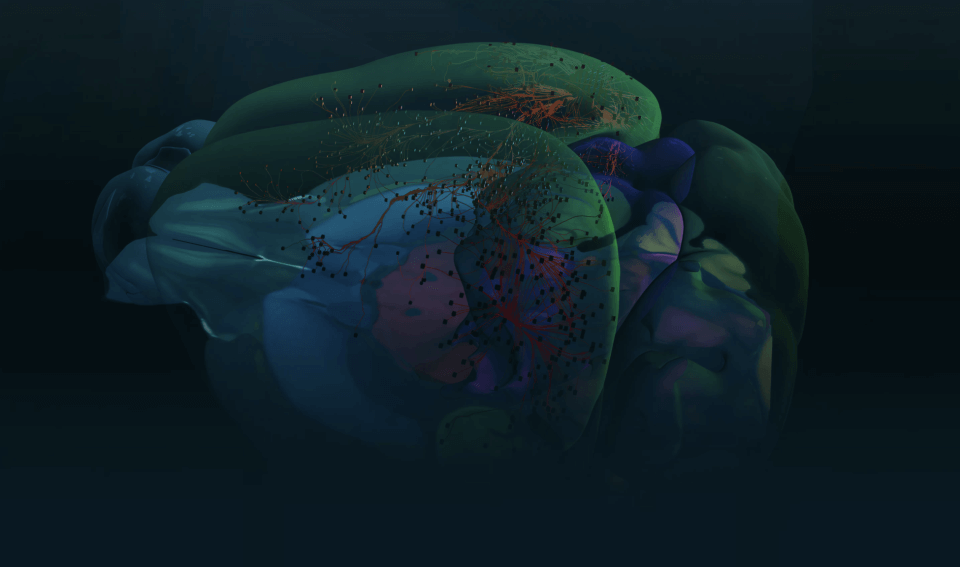
Artistic representation of a mouse brain
share/
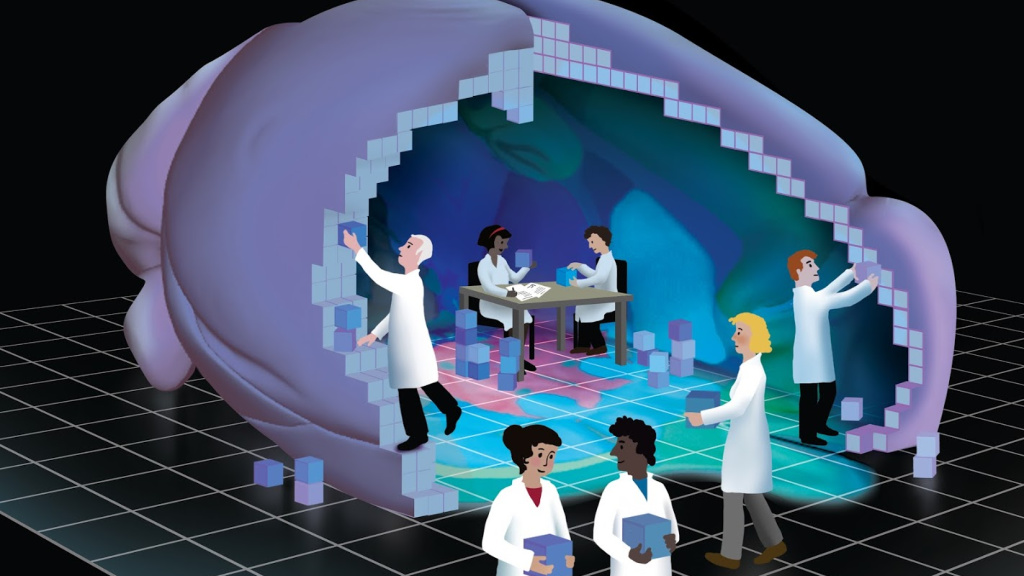
Researchers at the Allen Institute built a detailed map of the mouse brain from tiny virtual 3D blocks, or voxels. Illustration by Benedicte Rossi
The reference atlas, years in the making, offers common ground to put neuroscience findings in context
Thank you! Your submission has been received!
Oops! Something went wrong while submitting the form.

in this article

table of contents will display on published page only
set h2 to populate the table of contents here

After three years of intensive data-gathering and careful drawing, the mapmakers’ work was complete.

The complex terrain they charted, with all its peaks, valleys and borders, is only about half an inch long and weighs less than a jellybean: the brain of the laboratory mouse.

In a paper published today in the journal Cell, the Allen Institute mapmakers describe this cartographical feat — the third iteration of the Allen Mouse Brain Common Coordinate Framework, or CCFv3, a complete, high-resolution 3D atlas of the mouse brain.

The framework is meant to be a reference point for the neuroscience community, its creators said. Mice are widely used in biomedical research. Their brains contain approximately 100 million cells each across hundreds of different regions. As neuroscience datasets grow larger and more complex, a common spatial map of the brain becomes more critical, as does the ability to precisely co-register many different kinds of data into a common 3D space to compare and correlate.

The video moves through an average mouse brain (gray) from front to back, which served as the basis of the Allen Common Coordinate Framework (CCFv3) version 3, a new high resolution 3D reference atlas.

Think of it as the neuroscience equivalent of your phone’s GPS. Instead of manually searching for your location on a paper map based on what you see around you, the GPS (and the new brain atlas) tells you where you are. With datasets in the thousands or millions of different pieces of information, that common set of coordinates — and pinpointing the corresponding brain landmarks for those coordinates — is crucial.

“In the old days, people would define different regions of the brain by eye. As we get more and more data, that manual curation doesn’t scale anymore,” said Lydia Ng, Ph.D., Senior Director of Technology at the Allen Institute for Brain Science, a division of the Allen Institute, and one of the senior authors on the atlas paper along with Julie Harris, Ph.D., Associate Director of Neuroanatomy at the Allen Institute for Brain Science. “Just as we have a reference genome sequence, you need a reference anatomy.”

Enabling whole-brain studies
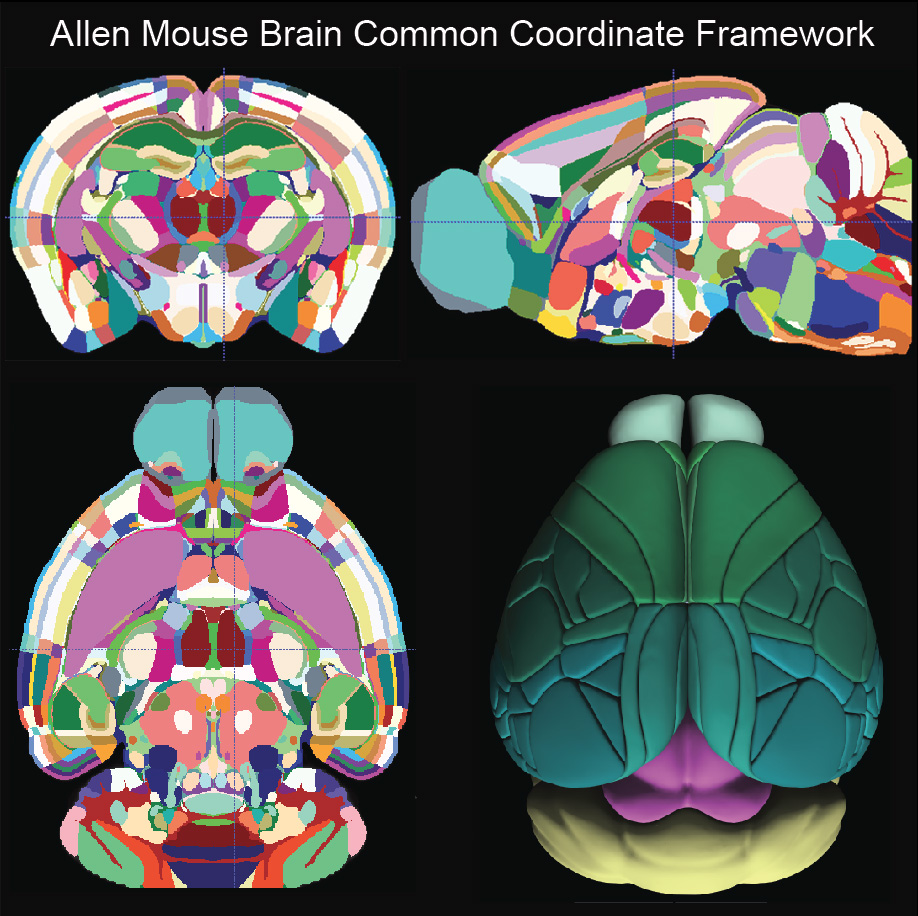
Allen Mouse Brain Common Coordinate Framework anatomical atlas showing cross-sectional brain regions.
Different views of the brain regions in the new atlas

The whole-brain CCFv3 builds on a partial version released in 2016 that mapped the entire mouse cortex, the outermost shell of the brain. Previous versions of the atlas were lower resolution 3D maps, while CCFv3’s resolution is fine enough that it can pinpoint individual cells’ locations. The latest full-brain atlas has been openly available for the community since late 2017, and several different neuroscience teams have already put it to use.

Nick Steinmetz, Ph.D., an Assistant Professor at the University of Washington and an Allen Institute for Brain Science Next Generation Leader, used the atlas in a recent study that looked at neuron activity as mice choose between different images they see in a laboratory test. The study used Neuropixels, tiny electrical probes that can capture the activity of hundreds of neurons at once across several different brain regions.

As they were analyzing their data, it became clear that more parts of the brain were involved in this visual choice than they previously realized, Steinmetz said. They would have to take a big-picture view, and the CCFv3 helped them look at all their results together.

“The atlas was a really necessary resource that enabled the very idea of doing studies at the brain-wide level,” Steinmetz said. “When you’re recording from hundreds of sites across the brain, that introduces a new scale of investigation. You have to have a bigger view of where all the recording sites are, and the CCF is what made that possible.”

An evolving atlas

To make the atlas, the researchers broke up the brain into tiny virtual 3D blocks, known as voxels, and assigned each block a unique coordinate. The data that fed into that 3D construction came from the average brain anatomy of nearly 1,700 different animals. The team then assigned each of those voxels to one of hundreds of different known regions of the mouse brain, drawing careful borders between distinct areas. The datasets that fed into these two aspects of the atlas came from several different kinds of experiments conducted at the Allen Institute over the past several years — the atlas’s backbone of different types of data makes it unique among reference brain atlases, the researchers said.

Historically, brain atlases were drawn in 2D, taking sheet-like views of the brain at different depths and lining them up. For some types of data, this form of brain mapping works well. But for modern neuroscience studies looking at neuron activity or cell characteristics across the entire brain, a 3D atlas gives better context.

The researchers said future iterations of the atlas will likely rely on machine learning or other forms of automation, rather than the laborious manual curation that went into the current version.

“As we know now, atlases should be evolving and living resources, because as we learn more about how the brain is organized, we will need to make updates,” Harris said. “Building atlases in an automatic, unbiased way is where the field is likely moving.”

Citations
No items found.

about the allen institute

The Allen Institute is an independent, 501(c)(3) nonprofit research organization founded by philanthropist and visionary, the late Paul G. Allen. The Allen Institute is dedicated to answering some of the biggest questions in bioscience and accelerating research worldwide. The Institute is a recognized leader in large-scale research with a commitment to an open science model. For more information, visit alleninstitute.org.
explore related stories

explore more stories
news 
“Computational crystal ball” helps predict cell behavior
New technology could lead to better treatments for cancer by allowing scientists to perform virtual experiments
news 
Neuropixels Opto sheds new light into deepest regions of the brain
A single tool measures and manipulates brain cell communication and democratizes advanced neuroscience
news 
Mind trip: How psilocybin changes the brain
New research may help improve psychedelic therapy for neuropsychiatric disorders
news 
Computer model predicts aspects of cognitive performance
The Allen Human Brain Atlas helped researchers design a model that looked at “intrinsic neural timescales”
Allen Impact 2025
Technology and innovation are fueling discovery in science like never before we’re proud to be leading the way. 2025 was a year of tremendous impact...
Scientists unveil the world's most comprehensive AI-powered tool for neuroscience: Brain Knowledge Platform
Massive, first-of-its-kind data resource aims to accelerate medical breakthroughs in brain diseases like Alzheimer’s and Parkinson's
we acceleratedevelopcatalyzeimpact

science done differently. shared with the world.

explore our accelerators

brain science

Mapping every cell, connection, and circuit in the brain—openly shared with the world.

cell science

Decoding how cells become tissues, then programming that knowledge into powerful new research tools.

neural dynamics

Revealing the brain's hidden algorithms that transform neural activity into real-world behavior.

immunology

Creating the deepest open reference for the healthy human immune system ever built.

synthetic biology

Engineering cells to record their own histories, transforming how we understand disease over time.

research

Big questions, open answers, and science built to be shared.

education

Inspiring the next generation of scientists through open science resources.

impact

Our science is empowering researchers and advancing health worldwide.
advancing science through open, collaborative research
Get the allen institute newsletter
Stay informed on the latest breakthroughs in neuroscience, bioscience, and AI-driven research.
allen institute
impactpeople & teamscareers & opportunitiesalumnihistory & founder
science resources
allencell.orgallenimmunology.orgallenneuraldynamics.orgbrain-bican.orgbrain-map.orgmicrons-explorer.org
research
brain sciencecell scienceneural dynamicsimmunologysynthetic biologypublications
education
science educationfield tripsprofessional developmenteducation resources
quick links
newseventsopen sciencepodcastscience resourceshuman brain donationvisit uscontact
follow us/

allen institute, 615 Westlake Ave North, Seattle, WA 98109 +12065487055

© 0000 allen institute. all rights reserved.
privacy policyterms of usecitation policyemployee portalpolicy & compliance