impact
impact
open science
subheadline
careers and opportunities
subheadline
people & teams
people & teams
subheadline
allenites
subheadline
allen institute advisors
subheadline
board of directors
subheadline
shanahan foundation fellowship
subheadline
next generation leaders
subheadline
research
overview
our approach
subheadline
publications
subheadline
open science
subheadline
accelerator
brain science
subheadline
cell science
subheadline
neural dynamics
subheadline
immunology
subheadline
synthetic biology
subheadline
education
education
science education
subheadline
education resources
subheadline
field trips
subheadline
open science
subheadline
open science quest
subheadline
news
news
stories
subheadline
podcast
subheadline
sign up for our newsletter
subheadline
events
events
all events
subheadline
conferences
subheadline
event code of conduct
subheadline
events
open science quest
subheadline
summer workshop on the dynamic brain
subheadline
open science week
subheadline
brain fest
subheadline
science resources
science resources
allencell.org
subheadline
allenimmunology.org
subheadline
allenneuraldynamics.org
subheadline
brain-bican.org
subheadline
brain-map.org
subheadline
microns-explorer.org
subheadline
impact
back to menu
impact
open science
subheading
careers and opportunities
subheading
people & teams
people & teams
subheading
allen institute advisors
subheading
board of directors
subheading
shanahan foundation fellowship
subheading
next generation leaders
subheading
research
back to menu
impact
Label
subheading
Label
subheading
people & teams
education
back to menu
research
Label
subheading
Label
subheading
Heading
news
back to menu
research
Label
subheading
Label
subheading
Heading
events
back to menu
research
Label
subheading
Label
subheading
Heading
science resources
back to menu
science resources
allencell.org
subheading
allenimmunology.org
subheading
allenneuraldynamics.org
subheading
brain-bican.org
subheading
brain-map.org
subheading
microns-explorer.org
subheading
search
stories
news

Allen Institute to become part of ShakeAlert® Earthquake early warning system along the west coast

Emergency alerts provide vital seconds for people to shelter in place or better secure their environment

October 20, 2022
 min read
share/
Emergency alerts provide vital seconds for people to shelter in place or better secure their environment
Thank you! Your submission has been received!
Oops! Something went wrong while submitting the form.

in this article

table of contents will display on published page only
set h2 to populate the table of contents here

Today, the Allen Institute has become the first scientific research institute in the country to be a part of the US Geological Survey-managed ShakeAlert Earthquake Early Warning System. Institute staff will receive emergency alerts on their computer screens that could provide seconds of warning before earthquake shaking begins, allowing individuals to Drop, Cover, and Hold On.

“ShakeAlert will complement our ongoing efforts to mitigate earthquake hazards and enhance the safety of our laboratories,” said Steve Hurley, Director of Environment, Health and Safety at the Allen Institute. “This early warning system is especially important given Seattle’s proximity and position relative to several fault lines in and around the Pacific Northwest.”

ShakeAlert currently uses 1381 seismic stations (with a goal of 1,675 stations by 2025) strategically placed along the West Coast of the United States. These stations detect the faster, usually weaker, p-waves that are the first to radiate from the epicenter of an earthquake. The data from these waves are then used to estimate the location, size (magnitude) and shaking intensity of the quake. These data are transmitted to buildings with early warning systems like the Allen Institute, which can then deliver ShakeAlert-powered alerts to people or trigger automated actions before the slower, more destructive s-waves surge through the area. Distance from the quake’s epicenter is one factor that impacts how much time individuals will have to take protective actions such as Dropping (to the ground), Covering (their body), and Holding On (to stable structures) before shaking begins.

“ShakeAlert Earthquake Early Warning is an important tool in our risk reduction toolbox,” said Robert de Groot of the USGS Earthquake Science Center in Pasadena, CA. “Now that the Allen Institute is ‘Powered by ShakeAlert,’ it is a model for other scientific research facilities throughout Washington, Oregon and California.”

This potentially life-saving detection system has many use cases for the public beyond allowing individuals to shelter in place.
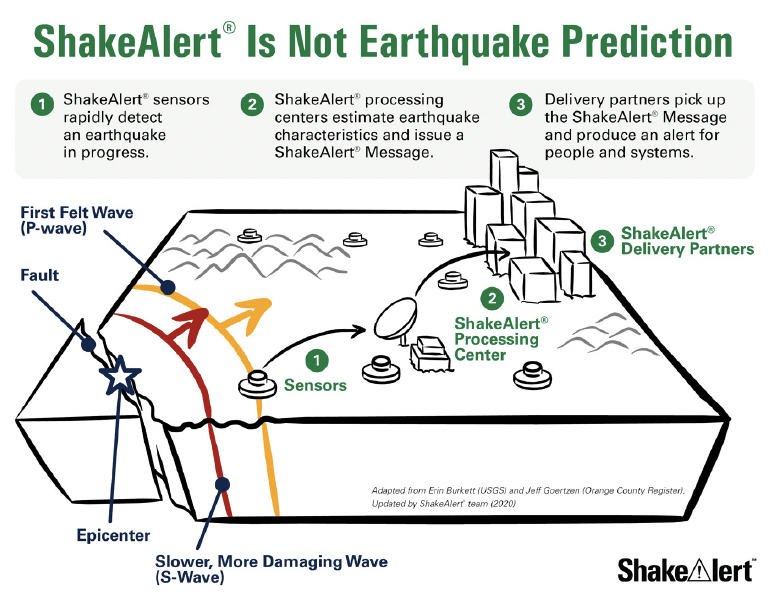
Diagram showing ShakeAlert earthquake detection system workflow from sensors to alert delivery to communities
  • Medical: halting dental operations, surgery, laser procedures
  • Industrial: closing valves, slowing or stopping production lines and sensitive processes, moving employees away from hazardous materials
  • Office: stopping elevators at the nearest floor and opening the doors, moving away from windows to interior/safer spaces
  • Construction: placing cranes and lifts in safe positions, moving people from unsafe locations
  • Utilities: opening/closing critical valves in pipelines; shutting down systems, reroute power, securing field personnel in safe positions
  • Transportation: slowing or stopping trains, stopping airport take-offs and landing, closing vulnerable bridges, slowing or stopping traffic by turning all signals red, including freeway entrances
  • Restaurants: shutting off heat sources, securing/avoiding dangerous areas like deep fryers
  • Schools: warning students and staff to take a protective action such as Drop, Cover, and Hold On
  • Emergency management: alert first-responders in the field to temporarily retreat to safe spaces, triggering doors to open for emergency vehicles, start generators
  • Vehicles: instruct alerted drivers to turn on emergency flasher (to warn others) and to slow down

Earthquake early warning systems like ShakeAlert can save lives, reduce damage to property and infrastructure, reduce economic impacts of damage, and speed the return to normal operations and community recovery.

About ShakeAlert

ShakeAlert® is an earthquake early warning (EEW) system that detects significant earthquakes so quickly that alerts can reach many people before shaking arrives. ShakeAlert is not earthquake prediction, rather a ShakeAlert Message indicates that an earthquake has begun and shaking is imminent.

Citations
No items found.

about the allen institute

The Allen Institute is an independent, 501(c)(3) nonprofit research organization founded by philanthropist and visionary, the late Paul G. Allen. The Allen Institute is dedicated to answering some of the biggest questions in bioscience and accelerating research worldwide. The Institute is a recognized leader in large-scale research with a commitment to an open science model. For more information, visit alleninstitute.org.
explore related stories

explore more stories
news 
“Computational crystal ball” helps predict cell behavior
New technology could lead to better treatments for cancer by allowing scientists to perform virtual experiments
news 
Neuropixels Opto sheds new light into deepest regions of the brain
A single tool measures and manipulates brain cell communication and democratizes advanced neuroscience
news 
Mind trip: How psilocybin changes the brain
New research may help improve psychedelic therapy for neuropsychiatric disorders
news 
Computer model predicts aspects of cognitive performance
The Allen Human Brain Atlas helped researchers design a model that looked at “intrinsic neural timescales”
Allen Impact 2025
Technology and innovation are fueling discovery in science like never before we’re proud to be leading the way. 2025 was a year of tremendous impact...
Scientists unveil the world's most comprehensive AI-powered tool for neuroscience: Brain Knowledge Platform
Massive, first-of-its-kind data resource aims to accelerate medical breakthroughs in brain diseases like Alzheimer’s and Parkinson's
we acceleratedevelopcatalyzeimpact

science done differently. shared with the world.

explore our accelerators

brain science

Mapping every cell, connection, and circuit in the brain—openly shared with the world.

cell science

Decoding how cells become tissues, then programming that knowledge into powerful new research tools.

neural dynamics

Revealing the brain's hidden algorithms that transform neural activity into real-world behavior.

immunology

Creating the deepest open reference for the healthy human immune system ever built.

synthetic biology

Engineering cells to record their own histories, transforming how we understand disease over time.

research

Big questions, open answers, and science built to be shared.

education

Inspiring the next generation of scientists through open science resources.

impact

Our science is empowering researchers and advancing health worldwide.
advancing science through open, collaborative research
Get the allen institute newsletter
Stay informed on the latest breakthroughs in neuroscience, bioscience, and AI-driven research.
allen institute
impactpeople & teamscareers & opportunitiesalumnihistory & founder
science resources
allencell.orgallenimmunology.orgallenneuraldynamics.orgbrain-bican.orgbrain-map.orgmicrons-explorer.org
research
brain sciencecell scienceneural dynamicsimmunologysynthetic biologypublications
education
science educationfield tripsprofessional developmenteducation resources
quick links
newseventsopen sciencepodcastscience resourceshuman brain donationvisit uscontact
follow us/

allen institute, 615 Westlake Ave North, Seattle, WA 98109 +12065487055

© 0000 allen institute. all rights reserved.
privacy policyterms of usecitation policyemployee portalpolicy & compliance