impact
impact
open science
subheadline
careers and opportunities
subheadline
people & teams
people & teams
subheadline
allenites
subheadline
allen institute advisors
subheadline
board of directors
subheadline
shanahan foundation fellowship
subheadline
next generation leaders
subheadline
research
overview
our approach
subheadline
publications
subheadline
open science
subheadline
accelerator
brain science
subheadline
cell science
subheadline
neural dynamics
subheadline
immunology
subheadline
synthetic biology
subheadline
education
education
science education
subheadline
education resources
subheadline
field trips
subheadline
open science
subheadline
open science quest
subheadline
news
news
stories
subheadline
podcast
subheadline
sign up for our newsletter
subheadline
events
events
all events
subheadline
conferences
subheadline
event code of conduct
subheadline
events
open science quest
subheadline
summer workshop on the dynamic brain
subheadline
open science week
subheadline
brain fest
subheadline
science resources
science resources
allencell.org
subheadline
allenimmunology.org
subheadline
allenneuraldynamics.org
subheadline
brain-bican.org
subheadline
brain-map.org
subheadline
microns-explorer.org
subheadline
impact
back to menu
impact
open science
subheading
careers and opportunities
subheading
people & teams
people & teams
subheading
allen institute advisors
subheading
board of directors
subheading
shanahan foundation fellowship
subheading
next generation leaders
subheading
research
back to menu
impact
Label
subheading
Label
subheading
people & teams
education
back to menu
research
Label
subheading
Label
subheading
Heading
news
back to menu
research
Label
subheading
Label
subheading
Heading
events
back to menu
research
Label
subheading
Label
subheading
Heading
science resources
back to menu
science resources
allencell.org
subheading
allenimmunology.org
subheading
allenneuraldynamics.org
subheading
brain-bican.org
subheading
brain-map.org
subheading
microns-explorer.org
subheading
search
stories
news

Allen Institute's Hongkui Zeng, Ph.D., receives prestigious Pradel Research Award from National Academy of Sciences

Hongkui's work has transformed our understanding of the brain. Her bold leadership of a large-scale project to define all the different types of cells...

January 23, 2023
 min read
share/
Hongkui's work has transformed our understanding of the brain. Her bold leadership of a large-scale project to define all the different types of cells that constitute the brain has changed the field of neuroscience
Thank you! Your submission has been received!
Oops! Something went wrong while submitting the form.

in this article

table of contents will display on published page only
set h2 to populate the table of contents here

The National Academy of Sciences has awarded Hongkui Zeng, Ph.D., with the 2023 Pradel Research Award for her seminal work in deepening science’s understanding of cell types and connections in the mammalian brain and leading the development of neuroscience tools and open data resources that catalyze global research. The Pradel Research Award recognizes major contributions to our understanding of the nervous system. Zeng is the Executive Vice President and Director of the Allen Institute for Brain Science, a division of the Allen Institute, and a leading expert in molecular neuroscience, cell type diversity, and neuroanatomy.

“I am deeply honored to receive this distinguished award from the National Academy of Sciences. It’s a prominent recognition of the groundbreaking team science and open science work we do at the Allen Institute that is making a huge impact on science and society,” said Zeng. “I feel deeply indebted to my Allen Institute colleagues and our founders for doing extraordinary research together and making everything possible.”

Zeng joined the Allen Institute for Brain Science in 2006, led its Structured Science Division from 2016 to 2020, and became its Executive Vice President and Director in 2020. She has organized and led multidisciplinary teams to develop and operate high-throughput pipelines to generate large-scale, open-access datasets and tools to accelerate neuroscience discovery, with a focus on characterizing the cell type and circuit organization in the mouse brain as the foundation for understanding brain function and diseases.
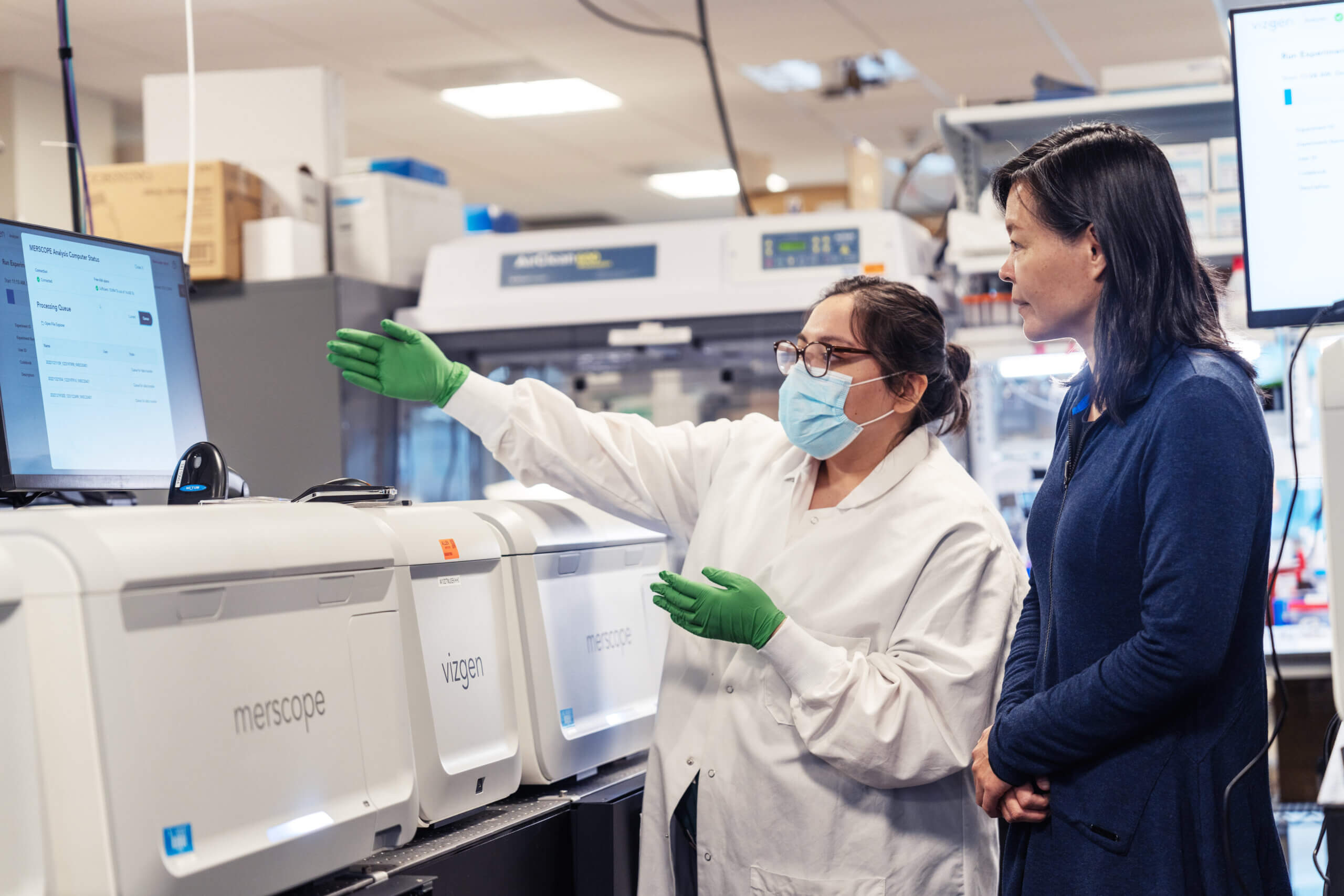
Two scientists in laboratory discussing data at computer near medical diagnostic equipment.
Hongkui Zeng, Executive Vice President, Director of the Allen Institute for Brain Science, with Research Associate Jazmin Campos in the lab.

Since joining the Allen Institute, she has led several key research programs including the Transgenic Technology program (gene modification); the Human Cortex Gene Survey project; the Allen Mouse Brain Connectivity Atlas (mapping connections between different regions of the mouse brain), one of the Allen Insitute’s most widely downloaded and used open-data resources; and most notably, the Cell Types program to create transcriptomic (gene expression) and multimodal cell type classifications that have been widely regarded as high-quality standards in the field.

“Hongkui’s work has transformed our understanding of the brain. Her bold leadership of a large-scale project to define all the different types of cells that constitute the brain has changed the field of neuroscience, laying the groundwork for understanding which cells mediate processes like memory and decision-making, but also which cells go awry in different diseases,” said Rui Costa, D.V.M., Ph.D., President and Chief Executive Officer of the Allen Institute. “Furthermore, Hongkui’s unwavering commitment to collaboration and open access brings this knowledge to the entire scientific community.”

Zeng received her Ph.D. in molecular and cell biology from Brandeis University. Then as a postdoctoral fellow at Massachusetts Institute of Technology, she studied the molecular and synaptic mechanisms underlying brain plasticity and learning. Her current research interests are in understanding neuronal diversity and connectivity in the mouse brain-wide circuits and how different types of neurons work together to process and transform information.

Citations
No items found.

about the allen institute

The Allen Institute is an independent, 501(c)(3) nonprofit research organization founded by philanthropist and visionary, the late Paul G. Allen. The Allen Institute is dedicated to answering some of the biggest questions in bioscience and accelerating research worldwide. The Institute is a recognized leader in large-scale research with a commitment to an open science model. For more information, visit alleninstitute.org.
explore related stories

explore more stories
news 
“Computational crystal ball” helps predict cell behavior
New technology could lead to better treatments for cancer by allowing scientists to perform virtual experiments
news 
Neuropixels Opto sheds new light into deepest regions of the brain
A single tool measures and manipulates brain cell communication and democratizes advanced neuroscience
news 
Mind trip: How psilocybin changes the brain
New research may help improve psychedelic therapy for neuropsychiatric disorders
news 
Computer model predicts aspects of cognitive performance
The Allen Human Brain Atlas helped researchers design a model that looked at “intrinsic neural timescales”
Allen Impact 2025
Technology and innovation are fueling discovery in science like never before we’re proud to be leading the way. 2025 was a year of tremendous impact...
Scientists unveil the world's most comprehensive AI-powered tool for neuroscience: Brain Knowledge Platform
Massive, first-of-its-kind data resource aims to accelerate medical breakthroughs in brain diseases like Alzheimer’s and Parkinson's
we acceleratedevelopcatalyzeimpact

science done differently. shared with the world.

explore our accelerators

brain science

Mapping every cell, connection, and circuit in the brain—openly shared with the world.

cell science

Decoding how cells become tissues, then programming that knowledge into powerful new research tools.

neural dynamics

Revealing the brain's hidden algorithms that transform neural activity into real-world behavior.

immunology

Creating the deepest open reference for the healthy human immune system ever built.

synthetic biology

Engineering cells to record their own histories, transforming how we understand disease over time.

research

Big questions, open answers, and science built to be shared.

education

Inspiring the next generation of scientists through open science resources.

impact

Our science is empowering researchers and advancing health worldwide.
advancing science through open, collaborative research
Get the allen institute newsletter
Stay informed on the latest breakthroughs in neuroscience, bioscience, and AI-driven research.
allen institute
impactpeople & teamscareers & opportunitiesalumnihistory & founder
science resources
allencell.orgallenimmunology.orgallenneuraldynamics.orgbrain-bican.orgbrain-map.orgmicrons-explorer.org
research
brain sciencecell scienceneural dynamicsimmunologysynthetic biologypublications
education
science educationfield tripsprofessional developmenteducation resources
quick links
newseventsopen sciencepodcastscience resourceshuman brain donationvisit uscontact
follow us/

allen institute, 615 Westlake Ave North, Seattle, WA 98109 +12065487055

© 0000 allen institute. all rights reserved.
privacy policyterms of usecitation policyemployee portalpolicy & compliance