impact
impact
open science
subheadline
careers and opportunities
subheadline
people & teams
people & teams
subheadline
allenites
subheadline
allen institute advisors
subheadline
board of directors
subheadline
shanahan foundation fellowship
subheadline
next generation leaders
subheadline
research
overview
our approach
subheadline
publications
subheadline
open science
subheadline
accelerator
brain science
subheadline
cell science
subheadline
neural dynamics
subheadline
immunology
subheadline
synthetic biology
subheadline
education
education
science education
subheadline
education resources
subheadline
field trips
subheadline
open science
subheadline
open science quest
subheadline
news
news
stories
subheadline
podcast
subheadline
sign up for our newsletter
subheadline
events
events
all events
subheadline
conferences
subheadline
event code of conduct
subheadline
events
open science quest
subheadline
summer workshop on the dynamic brain
subheadline
open science week
subheadline
brain fest
subheadline
science resources
science resources
allencell.org
subheadline
allenimmunology.org
subheadline
allenneuraldynamics.org
subheadline
brain-bican.org
subheadline
brain-map.org
subheadline
microns-explorer.org
subheadline
impact
back to menu
impact
open science
subheading
careers and opportunities
subheading
people & teams
people & teams
subheading
allen institute advisors
subheading
board of directors
subheading
shanahan foundation fellowship
subheading
next generation leaders
subheading
research
back to menu
impact
Label
subheading
Label
subheading
people & teams
education
back to menu
research
Label
subheading
Label
subheading
Heading
news
back to menu
research
Label
subheading
Label
subheading
Heading
events
back to menu
research
Label
subheading
Label
subheading
Heading
science resources
back to menu
science resources
allencell.org
subheading
allenimmunology.org
subheading
allenneuraldynamics.org
subheading
brain-bican.org
subheading
brain-map.org
subheading
microns-explorer.org
subheading
search
stories
news

Genes reveal surprising overlaps in brain diseases and disorders

Scientists find patterns in how disease-related genes switch on in the brain

May 15, 2023
 min read
share/
Scientists find patterns in how disease-related genes switch on in the brain
Thank you! Your submission has been received!
Oops! Something went wrong while submitting the form.

in this article

table of contents will display on published page only
set h2 to populate the table of contents here

It turns out there is a limited set of pathways diseases can take through the brain. When viewed through the lens of their genes, brain diseases fall into some surprising patterns, a new study has found. The study authors say this way of sorting brain diseases and psychiatric disorders could potentially identify new targets for treatments.  

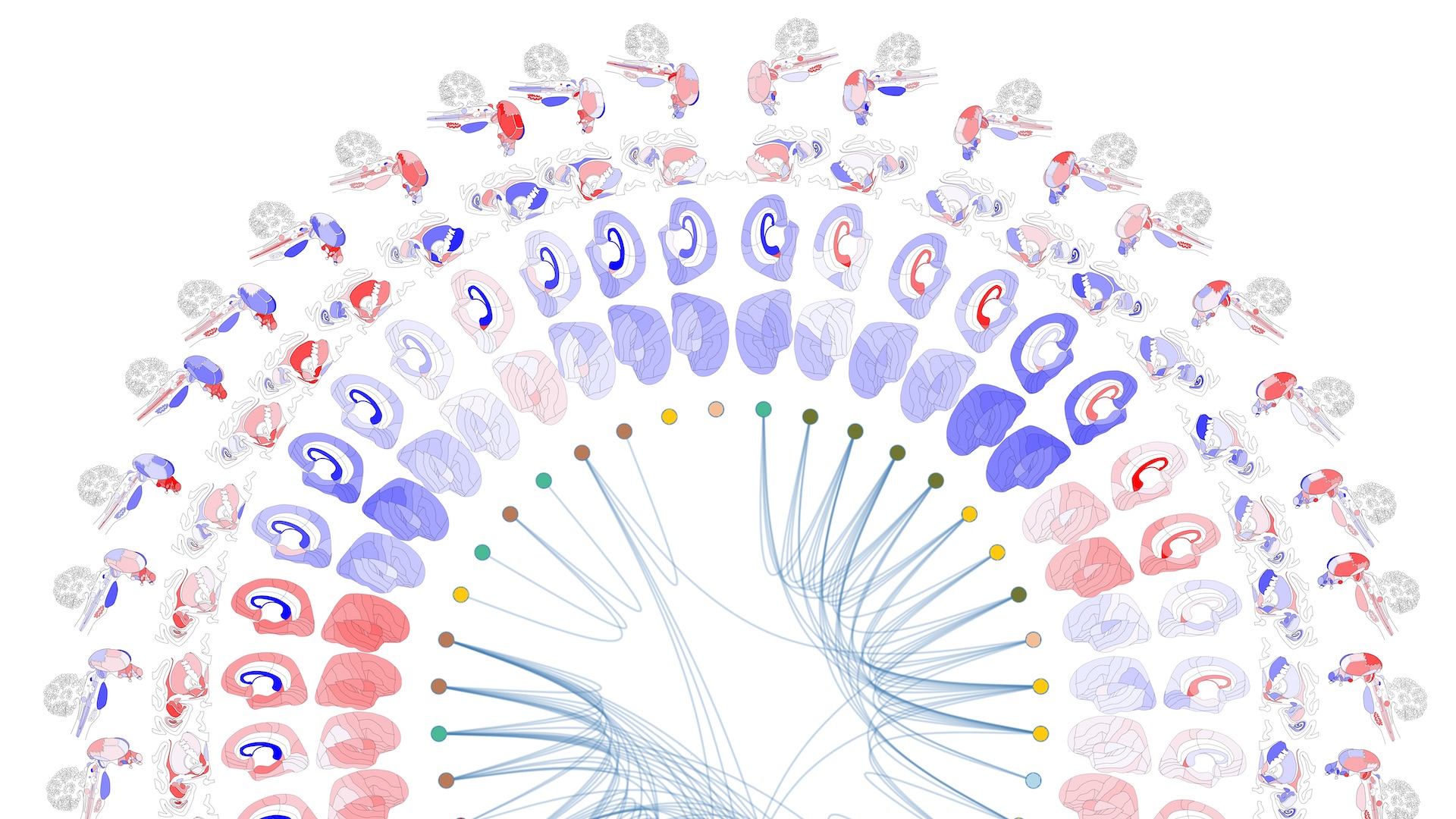
In the study, published in April in the journal PLOS Biology, scientists sorted 40 different brain diseases and disorders by looking at where genes important to those diseases are switched on, or expressed, in the healthy human brain. The Venn diagram of disease-linked genes and their locales revealed some surprising insights — for example, in this analysis, multiple sclerosis looks a lot like brain cancer.

“We thought that we might be able to understand these disorders better, and to better understand how different disorders relate to each other, based on where these genes are expressed,” said Yashar Zeighami, Ph.D., an assistant professor at McGill University who led the study along with Allen Institute Investigator Michael Hawrylycz, Ph.D.

To classify brain diseases by gene expression locale, the scientists turned to one of the Allen Institute’s classic resources, the Allen Human Brain Atlas. First released in 2010, this atlas surveys gene expression across the entire healthy adult human brain, pinpointing where in the brain genes are switched on for nearly all genes in the human genome.  

“It seemed like a natural question: What would gene expression tell us about disease?” said Hawrylycz, who was also one of the lead scientists involved in the creation of the Allen Human Brain Atlas. “In our world, it was a very natural perspective from which to try to classify these diseases.”  

From genes to drug targets

The researchers identified 40 brain diseases and psychiatric disorders for which their genetic causes are at least partially known, including neurodegenerative diseases like Alzheimer’s and Parkinson’s disease; psychiatric disorders such as autism, schizophrenia, and bipolar disorder; brain cancers such as glioblastoma; and several other brain-related diseases. Most of these diseases and disorders are very complicated, genetically speaking. Some disorders arise from mutations in hundreds of different genes, and genetic causes for the same disease often vary from person to person.  

The scientists took the genes associated with each disease and asked where in the healthy human brain those genes are expressed. The team then grouped the diseases based on their gene expression patterns, ending up with five different categories of disease. Many of these groupings sync with the diseases’ known symptoms — brain cancers clustered together, as did psychiatric disorders. But some diseases lined up in interesting ways: multiple sclerosis and migraine disorders share a grouping with cancers; some addiction disorders overlap with psychiatric diseases, while alcoholism paired with Huntington’s disease and Parkinson’s.  

The team also asked which individual neurons and other brain cells switch on disease-related genes, using a different Allen Institute dataset from one region of the cortex, the outermost shell of the brain. They found that genes linked to some diseases, like brain cancers and neurodegenerative diseases like Alzheimer’s disease, tend to cluster in cells known as inhibitory neurons, which shut off other neurons’ activity. Other diseases, including many psychiatric disorders, clustered more with excitatory neurons, those that activate other neurons. Eventually, they want to look at disease-related genes at the level of individual cells across the entire brain, Hawrylycz said.  

This study gets the team one step closer to pinning down the circuits involved in brain disease, said Thomas Nickl-Jockschat, M.D., an associate professor of psychiatry at the University of Iowa and one of the co-authors of the study. And one step closer to finding new drug targets for diseases where better therapies are sorely needed.

“If we understand which molecular pathways are most likely impacted by these diseases, we can look for wholly new drug targets,” Nickl-Jockschat said. “Now we can better understand how these diseases emerge, how genetic risk actually mediates vulnerability in certain brain regions and cells, and we can use that knowledge to ultimately hit the disease where it hurts the disease the most.”  

Citations
No items found.

about the allen institute

The Allen Institute is an independent, 501(c)(3) nonprofit research organization founded by philanthropist and visionary, the late Paul G. Allen. The Allen Institute is dedicated to answering some of the biggest questions in bioscience and accelerating research worldwide. The Institute is a recognized leader in large-scale research with a commitment to an open science model. For more information, visit alleninstitute.org.

explore related stories

explore more stories
news 
“Computational crystal ball” helps predict cell behavior
New technology could lead to better treatments for cancer by allowing scientists to perform virtual experiments
news 
Neuropixels Opto sheds new light into deepest regions of the brain
A single tool measures and manipulates brain cell communication and democratizes advanced neuroscience
news 
Mind trip: How psilocybin changes the brain
New research may help improve psychedelic therapy for neuropsychiatric disorders
news 
Computer model predicts aspects of cognitive performance
The Allen Human Brain Atlas helped researchers design a model that looked at “intrinsic neural timescales”
Allen Impact 2025
Technology and innovation are fueling discovery in science like never before we’re proud to be leading the way. 2025 was a year of tremendous impact...
Scientists unveil the world's most comprehensive AI-powered tool for neuroscience: Brain Knowledge Platform
Massive, first-of-its-kind data resource aims to accelerate medical breakthroughs in brain diseases like Alzheimer’s and Parkinson's
we acceleratedevelopcatalyzeimpact

science done differently. shared with the world.

explore our accelerators

brain science

Mapping every cell, connection, and circuit in the brain—openly shared with the world.

cell science

Decoding how cells become tissues, then programming that knowledge into powerful new research tools.

neural dynamics

Revealing the brain's hidden algorithms that transform neural activity into real-world behavior.

immunology

Creating the deepest open reference for the healthy human immune system ever built.

synthetic biology

Engineering cells to record their own histories, transforming how we understand disease over time.

research

Big questions, open answers, and science built to be shared.

education

Inspiring the next generation of scientists through open science resources.

impact

Our science is empowering researchers and advancing health worldwide.
advancing science through open, collaborative research
Get the allen institute newsletter
Stay informed on the latest breakthroughs in neuroscience, bioscience, and AI-driven research.
allen institute
impactpeople & teamscareers & opportunitiesalumnihistory & founder
science resources
allencell.orgallenimmunology.orgallenneuraldynamics.orgbrain-bican.orgbrain-map.orgmicrons-explorer.org
research
brain sciencecell scienceneural dynamicsimmunologysynthetic biologypublications
education
science educationfield tripsprofessional developmenteducation resources
quick links
newseventsopen sciencepodcastscience resourceshuman brain donationvisit uscontact
follow us/

allen institute, 615 Westlake Ave North, Seattle, WA 98109 +12065487055

© 0000 allen institute. all rights reserved.
privacy policyterms of usecitation policyemployee portalpolicy & compliance