
impact
impact
open science
subheadline
careers and opportunities
subheadline
people & teams
people & teams
subheadline
allenites
subheadline
allen institute advisors
subheadline
board of directors
subheadline
shanahan foundation fellowship
subheadline
next generation leaders
subheadline
research
overview
our approach
subheadline
publications
subheadline
open science
subheadline
accelerator
brain science
subheadline
cell science
subheadline
neural dynamics
subheadline
immunology
subheadline
synthetic biology
subheadline
education
education
science education
subheadline
education resources
subheadline
field trips
subheadline
open science
subheadline
open science quest
subheadline
news
news
stories
subheadline
podcast
subheadline
sign up for our newsletter
subheadline
events
events
all events
subheadline
conferences
subheadline
event code of conduct
subheadline
events
open science quest
subheadline
summer workshop on the dynamic brain
subheadline
open science week
subheadline
brain fest
subheadline
science resources
science resources
allencell.org
subheadline
allenimmunology.org
subheadline
allenneuraldynamics.org
subheadline
brain-bican.org
subheadline
brain-map.org
subheadline
microns-explorer.org
subheadline
impact
back to menu
impact
open science
subheading
careers and opportunities
subheading
people & teams
people & teams
subheading
allen institute advisors
subheading
board of directors
subheading
shanahan foundation fellowship
subheading
next generation leaders
subheading
research
back to menu
impact
Label
subheading
Label
subheading
people & teams
education
back to menu
research
Label
subheading
Label
subheading
Heading
news
back to menu
research
Label
subheading
Label
subheading
Heading
events
back to menu
research
Label
subheading
Label
subheading
Heading
science resources
back to menu
science resources
allencell.org
subheading
allenimmunology.org
subheading
allenneuraldynamics.org
subheading
brain-bican.org
subheading
brain-map.org
subheading
microns-explorer.org
subheading
search
stories
news

Landmark experiment sheds new light on the origins of consciousness

Findings suggest it may be about sensory processing and perception, with possible implications for diagnosing and treating comas or vegetative states.

April 30, 2025
 min read
share/
An experiment seven years in the making has uncovered new insights into the nature of consciousness and challenges two prominent, competing scientific theories.
Thank you! Your submission has been received!
Oops! Something went wrong while submitting the form.

in this article

table of contents will display on published page only
set h2 to populate the table of contents here

authors

Liz Dueweke
Communications and Media Relations Specialist

An experiment seven years in the making has uncovered new insights into the nature of consciousness and challenges two prominent, competing scientific theories: Integrated Information Theory (IIT) and Global Neuronal Workspace Theory (GNWT).

  1. IIT suggests that consciousness emerges when information inside a system (like the brain) is highly connected and unified; and as long as the information remains unified, it will be consciously perceived.
  2. GNWT suggests a network of brain areas spotlight important pieces of information in the brain—bringing it to the forefront of our minds—broadcasting it widely the moment it enters consciousness, and this produces conscious experience.

Researchers tested the two competing theories against one another in 2019 in a collaborative experiment involving human subjects. They published the findings today in Nature, and the study marks a pivotal moment in the goal to understand the elusive origins of consciousness.

“Adversarial collaboration fits within the Allen Institute’s mission of team science, open science and big science, in service of one of the biggest, and most long-standing, intellectual challenges of humanity: the Mind-Body Problem,” said Christof Koch, Ph.D., meritorious investigator at the Allen Institute. “Unravelling this mystery is the passion of my entire life.”
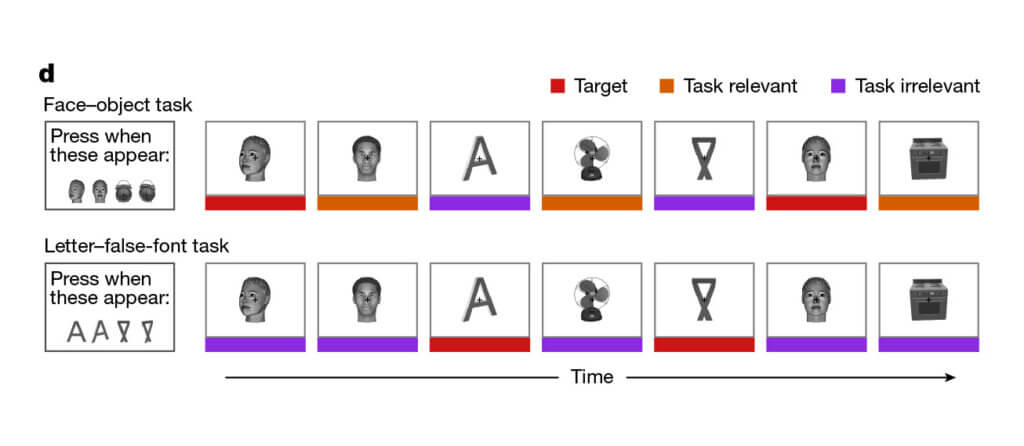
Face and letter recognition task with targets and irrelevant stimuli over time
Participants identified specific targets (like a face or letter) in sequences of high-contrast images. Each trial included three types of images: targets (red), task-related images (orange-red), and unrelated images (purple). Images are courtesy of Michael J. Tarr, Carnegie Mellon University.

The Findings

Research showed that there’s functional connection between neurons in early visual areas of the brain (the areas that process vision, which are at the back of the brain) and the frontal areas of the brain, helping us understand how our perceptions tie to our thoughts. The findings de-emphasize the importance of the prefrontal cortex in consciousness, suggesting that while it’s important for reasoning and planning, consciousness itself may be linked with sensory processing and perception. In other words, intelligence is about doing while consciousness is about being.

The study also found that the back of the brain seems crucial for holding the specific details of what you see, like orientation. While the front part is also involved, especially in identifying the general category of an object, it might not be the main hub for all the visual specifics. This challenges the idea that the front part of the brain holds all the detailed content of our visual experience.

These discoveries have implications for how we understand consciousness. Furthermore, they may shed light on disorders of consciousness such as coma or vegetative state. Identifying where the footprints of consciousness are localized in the brain could help detect “covert consciousness” in unresponsive patients with severe brain injuries—a condition known to occur in about one-quarter of cases as reported in the New England Journal of Medicine last year.
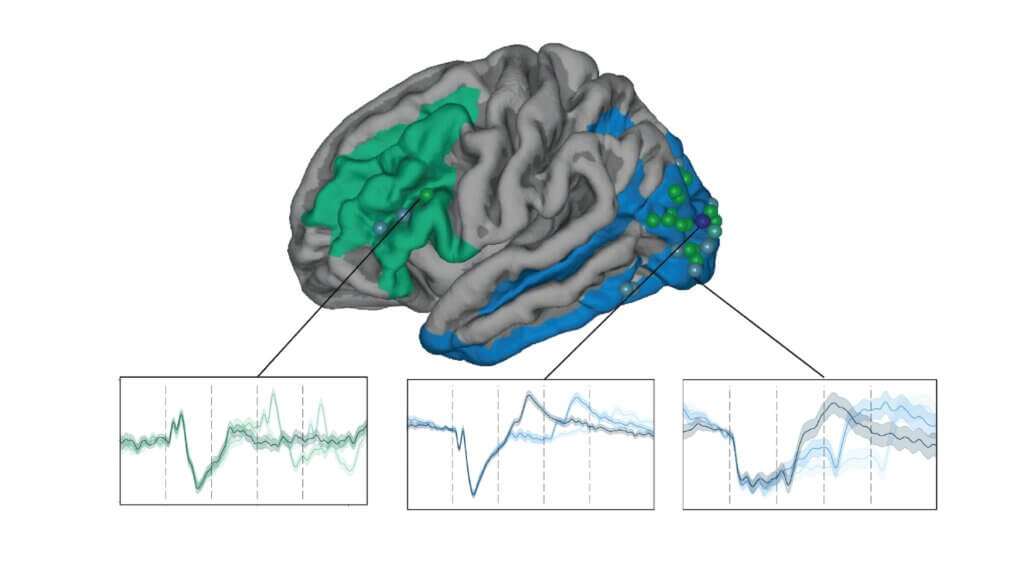
Brain diagram showing green and blue highlighted regions with three corresponding neural activity graphs below
This supplementary figure shows Results of the LMM on the ERP signal in the task irrelevant condition. The location of the electrodes found to be consistent with the theories’ models are shown on the brain surface, with the prefrontal and posterior ROIs depicted in green and blue, respectively.

Neither Theory Came Out on Top

IIT says consciousness comes from the interaction and cooperation of various parts of the brain as they work together to integrate information, like teamwork. The study, however, did not find enough sustained connections in the back of the brain to support this idea. GNWT supports the idea that consciousness happens in the front of the brain, but the study didn’t find enough support for this idea either.

“It was clear that no single experiment would decisively refute either theory. The theories are just too different in their assumptions and explanatory goals, and the available experimental methods too coarse, to enable one theory to conclusively win out over another,” said Anil Seth, Ph.D., a professor of cognitive and computational neuroscience at the University of Sussex. “Having said all this, the findings of the collaboration remain extremely valuable – much has been learned about both theories and about where and when in the brain information about visual experience can be decoded from.

The study involved 256 subjects, which is unprecedented for this kind of experiment. Researchers showed them various visual stimuli and then used three common human brain measurement tools that track blood flow as well as magnetic and electrical activity to study their brains while they looked at the stimuli.

The highly collaborative experiment is the result of a large-scale, open science collaboration that began at a workshop at the Allen Institute in 2018. This innovative approach brought together researchers with differing perspectives to test two theories in a collaborative, yet critical, environment aimed at reducing confirmation bias and accelerating scientific progress.

“Adversarial collaborations are a powerful social process, little used because of their challenging nature, seeking to coordinate the research and associated protocols across many, independent laboratories, and competitive individuals,” said Koch. “The bio-medical field could hugely profit by more such ‘friendly’ competition among theories—neurobiological or others. But it requires a great deal of cooperation and constant work to keep everyone aligned.”

Citations
No items found.

about the allen institute

The Allen Institute is an independent, 501(c)(3) nonprofit research organization founded by philanthropist and visionary, the late Paul G. Allen. The Allen Institute is dedicated to answering some of the biggest questions in bioscience and accelerating research worldwide. The Institute is a recognized leader in large-scale research with a commitment to an open science model. For more information, visit alleninstitute.org.
explore related stories

explore more stories
news 
“Computational crystal ball” helps predict cell behavior
New technology could lead to better treatments for cancer by allowing scientists to perform virtual experiments
news 
Neuropixels Opto sheds new light into deepest regions of the brain
A single tool measures and manipulates brain cell communication and democratizes advanced neuroscience
news 
Mind trip: How psilocybin changes the brain
New research may help improve psychedelic therapy for neuropsychiatric disorders
news 
Computer model predicts aspects of cognitive performance
The Allen Human Brain Atlas helped researchers design a model that looked at “intrinsic neural timescales”
Allen Impact 2025
Technology and innovation are fueling discovery in science like never before we’re proud to be leading the way. 2025 was a year of tremendous impact...
news 
Scientists develop new way to “listen in” on the brain’s hidden language
Paradigm-shifting technology is changing how researchers do neuroscience
we acceleratedevelopcatalyzeimpact

science done differently. shared with the world.

explore our accelerators

brain science

Mapping every cell, connection, and circuit in the brain—openly shared with the world.

cell science

Decoding how cells become tissues, then programming that knowledge into powerful new research tools.

neural dynamics

Revealing the brain's hidden algorithms that transform neural activity into real-world behavior.

immunology

Creating the deepest open reference for the healthy human immune system ever built.

synthetic biology

Engineering cells to record their own histories, transforming how we understand disease over time.

research

Big questions, open answers, and science built to be shared.

education

Inspiring the next generation of scientists through open science resources.

impact

Our science is empowering researchers and advancing health worldwide.
advancing science through open, collaborative research
Get the allen institute newsletter
Stay informed on the latest breakthroughs in neuroscience, bioscience, and AI-driven research.
allen institute
impactpeople & teamscareers & opportunitiesalumnihistory & founder
science resources
allencell.orgallenimmunology.orgallenneuraldynamics.orgbrain-bican.orgbrain-map.orgmicrons-explorer.org
research
brain sciencecell scienceneural dynamicsimmunologysynthetic biologypublications
education
science educationfield tripsprofessional developmenteducation resources
quick links
newseventsopen sciencepodcastscience resourceshuman brain donationvisit uscontact
follow us/

allen institute, 615 Westlake Ave North, Seattle, WA 98109 +12065487055

© 0000 allen institute. all rights reserved.
privacy policyterms of usecitation policyemployee portalpolicy & compliance