impact
impact
open science
subheadline
careers and opportunities
subheadline
people & teams
people & teams
subheadline
allenites
subheadline
allen institute advisors
subheadline
board of directors
subheadline
shanahan foundation fellowship
subheadline
next generation leaders
subheadline
research
overview
our approach
subheadline
publications
subheadline
open science
subheadline
accelerator
brain science
subheadline
cell science
subheadline
neural dynamics
subheadline
immunology
subheadline
synthetic biology
subheadline
education
education
science education
subheadline
education resources
subheadline
field trips
subheadline
open science
subheadline
open science quest
subheadline
news
news
stories
subheadline
podcast
subheadline
sign up for our newsletter
subheadline
events
events
all events
subheadline
conferences
subheadline
event code of conduct
subheadline
events
open science quest
subheadline
summer workshop on the dynamic brain
subheadline
open science week
subheadline
brain fest
subheadline
science resources
science resources
allencell.org
subheadline
allenimmunology.org
subheadline
allenneuraldynamics.org
subheadline
brain-bican.org
subheadline
brain-map.org
subheadline
microns-explorer.org
subheadline
impact
back to menu
impact
open science
subheading
careers and opportunities
subheading
people & teams
people & teams
subheading
allen institute advisors
subheading
board of directors
subheading
shanahan foundation fellowship
subheading
next generation leaders
subheading
research
back to menu
impact
Label
subheading
Label
subheading
people & teams
education
back to menu
research
Label
subheading
Label
subheading
Heading
news
back to menu
research
Label
subheading
Label
subheading
Heading
events
back to menu
research
Label
subheading
Label
subheading
Heading
science resources
back to menu
science resources
allencell.org
subheading
allenimmunology.org
subheading
allenneuraldynamics.org
subheading
brain-bican.org
subheading
brain-map.org
subheading
microns-explorer.org
subheading
search
stories
news

Virtual reality is helping neuroscientists better understand the brain

When Elise Shen goes to work, her morning starts much like that of anyone else with a desk job. She greets her coworkers. She fetches a cup of coffee....

August 2, 2019
 min read
researcher uses VR to trace neurons
share/
Allen Institute researcher uses VR technology to trace the morphology of neur
When Elise Shen goes to work, her morning starts much like that of anyone else with a desk job. She greets her coworkers. She fetches a cup of coffee....
Thank you! Your submission has been received!
Oops! Something went wrong while submitting the form.

in this article

table of contents will display on published page only
set h2 to populate the table of contents here

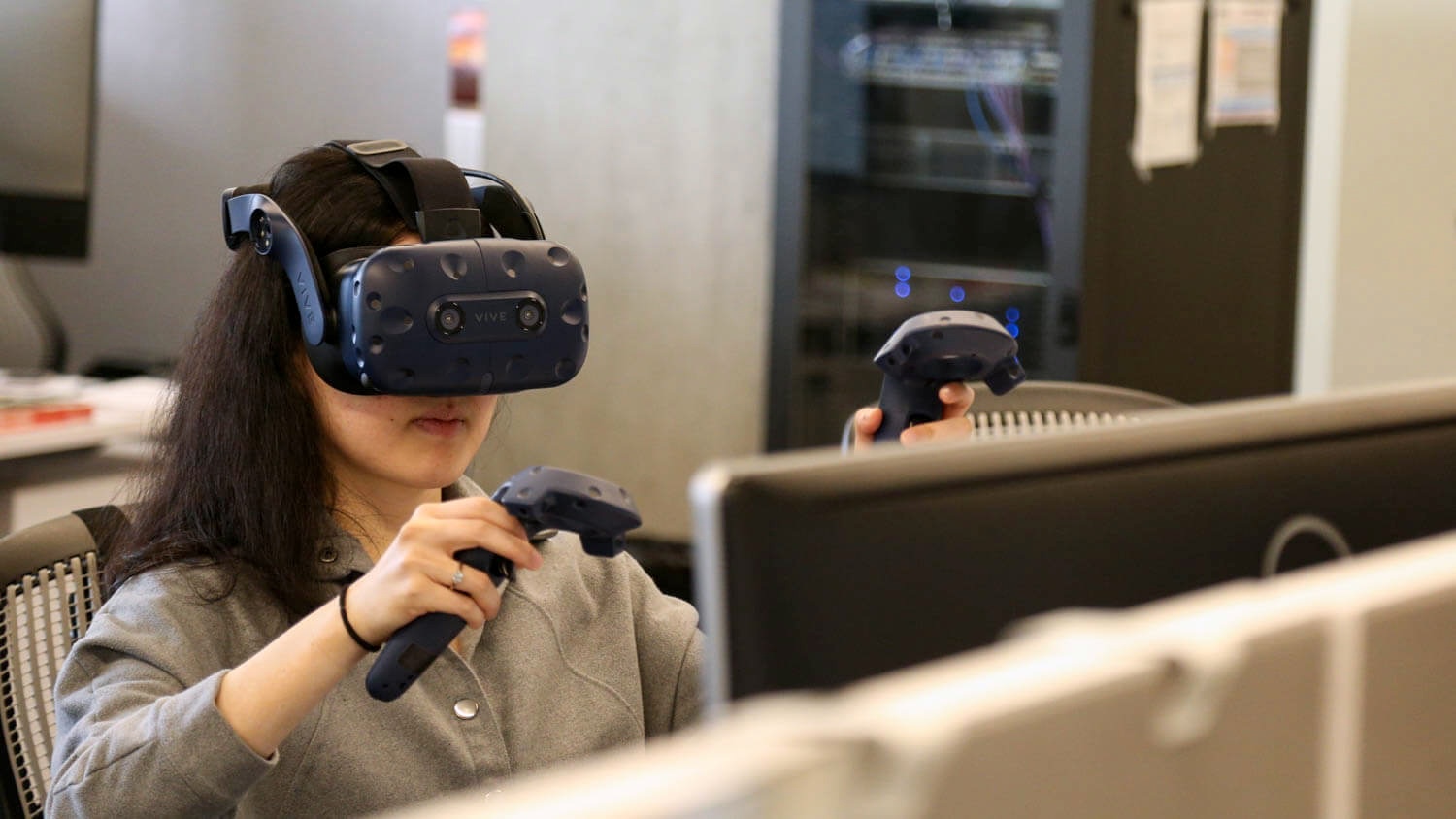
Then she puts on her VR headset.

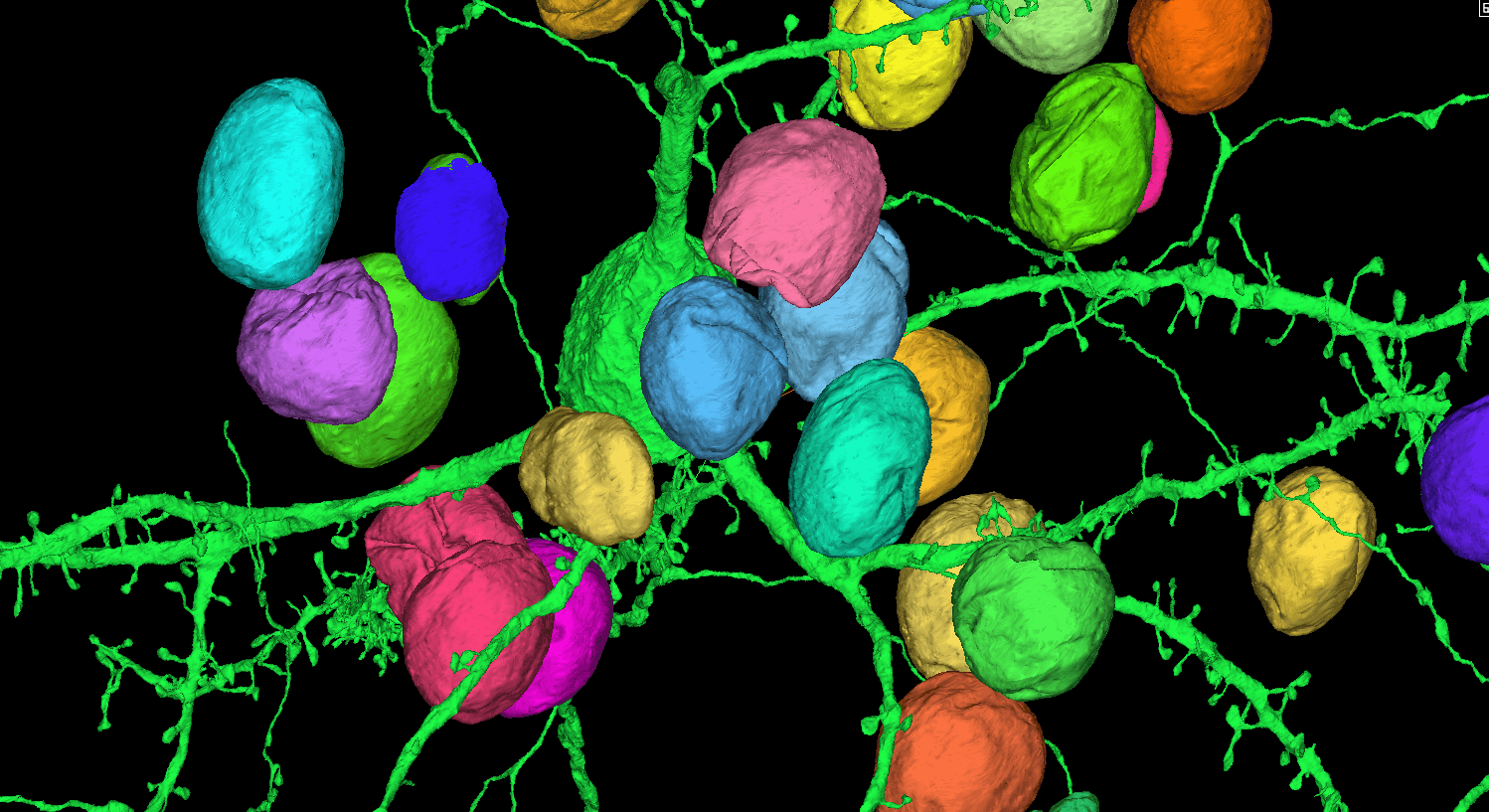
Shen, a neuroanatomy specialist at the Allen Institute, spends her days at her desk carefully tracing the delicate branching filaments of mouse neurons. It’s part of a team effort to better understand neurons — and how they work in the brain — by capturing their precise 3D shapes, also known as their morphology.

Researchers sometimes do work like this on a flat computer screen, attempting to capture a 3D shape in 2D. It doesn’t always work, said Hanchuan Peng, Ph.D., a computer scientist at the Allen Institute for Brain Science, a division of the Allen Institute. It can be hard to see depth in that view, hard to accurately trace the hundreds or thousands of tiny tendrils that branch off each cell and connect to others in the brain.

Researchers at the Allen Institute for Brain Science and Southeast University in Nanjing, China, recently devised a way to use virtual reality to help neuroscientists like Shen — by literally immersing them in the middle of an image of the brain (or part of it).

“If you really want to do this, you need to put the annotator, the human observer, in the middle of the data,” Peng said. “Most conventional tools that people use, you’re observing from outside, like you’re looking through a window.”

The researchers describe the new open-source technology, which they dubbed TeraVR, in a study published today in the journal Nature Communications. The method was developed at the SEU-Allen Joint Center for Neuron Morphology, a collaboration between the Allen Institute and Southeast University, and led by Peng and his team member, Yimin Wang, Ph.D., a computational researcher at Shanghai University and the SEU-Allen Center.

A virtual collaboration

Allen Institute and SEU-Allen Center researchers are using TeraVR to reconstruct mouse neurons from whole-brain images. Other research teams at the Allen Institute and elsewhere reconstruct neurons from thin slices of the brain, but some kinds of neurons send axon connections long distances in the brain, connections that would be missed in smaller segments.

The technology merges artificial intelligence with manual annotation — hand-tracing the neurons’ shape, which Shen describes as similar to coloring. The AI part of TeraVR captures part of the cells’ shape automatically, but so far, a human eye is still needed to accurately reconstruct neurons in their entirety.

The software also uses cloud computing to allow researchers to work on the same neuron at the same time. Neuron annotators in China and in Seattle can collaborate in virtual space to capture a cell’s shape more quickly. Depending on the complexity of the neuron and the strength of the fluorescent label, it can take anywhere from a few days to over a month for one person to reconstruct an entire cell. But this is much faster than previous methods allowed, Peng said.

The researchers also hope the technology could prove useful outside of neuron reconstruction. TeraVR can handle very large datasets: The whole-brain imaging datasets are tens of terabytes large (the origin of TeraVR’s name), so the system could have some use in other contexts where precision is required based on visual information, such as robotic surgery.

The system has been in use at the Allen Institute and at the collaborating sites in China for about a year. Together, the research teams have reconstructed more than 1,000 complete neurons in that time.

“It’s really exciting how quickly people can adapt to this technology and put it to good use,” Peng said.

Citations
No items found.

about the allen institute

The Allen Institute is an independent, 501(c)(3) nonprofit research organization founded by philanthropist and visionary, the late Paul G. Allen. The Allen Institute is dedicated to answering some of the biggest questions in bioscience and accelerating research worldwide. The Institute is a recognized leader in large-scale research with a commitment to an open science model. For more information, visit alleninstitute.org.
explore related stories

explore more stories
news 
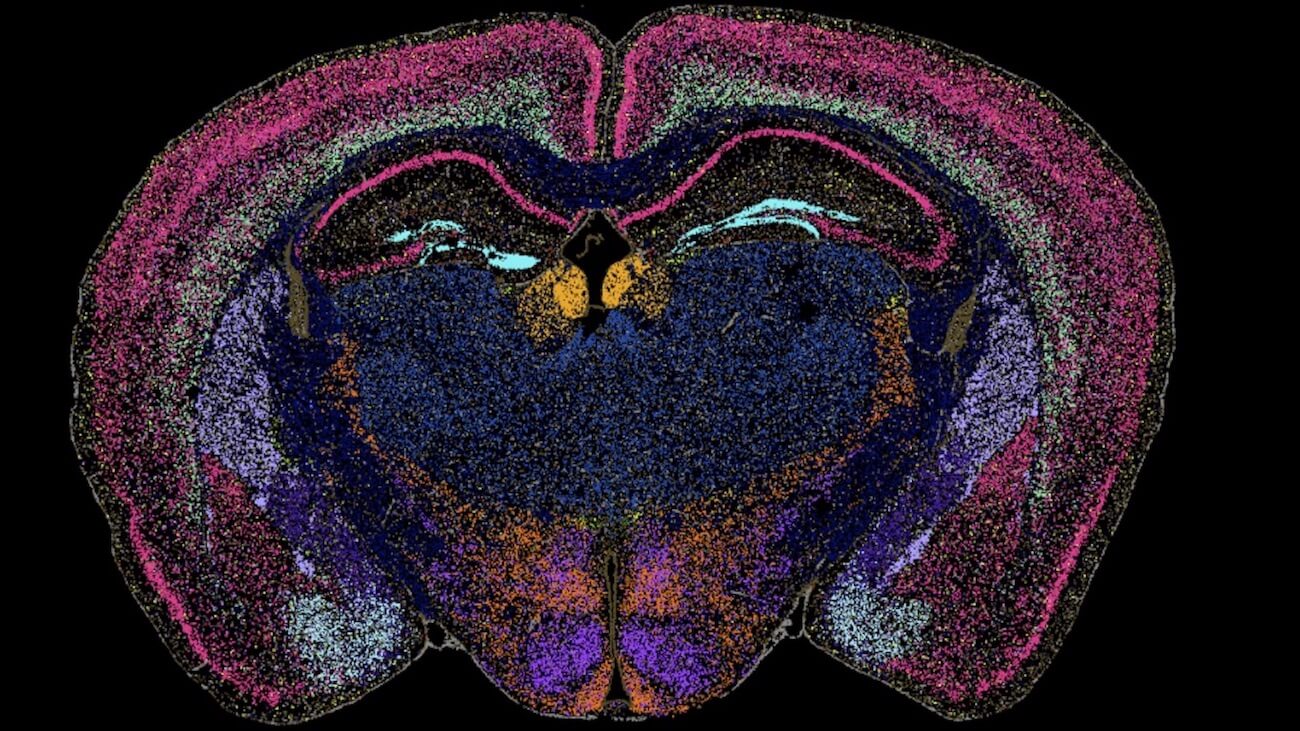
Unraveling the Complexity of the Mammalian Brain
Scientists used advanced, single-cell genomics and spatial mapping technologies to reveal this complex and rich cellular landscape.
news 
Scientists unveil first complete cellular map of adult mouse brain
High-resolution atlas charts neural neighborhoods for more than 5,300 cell types
news 
Projects launch to map brain connections in mouse and macaque
NIH BRAIN Initiative-funded research will lay the groundwork to map entire brains in incredible detail
news 
Mapping the whole human brain: Allen Institute to lead global collaboration
NIH BRAIN Initiative to fund primate brain atlases, maps of developing mouse brain, coordination and knowledge sharing, and brain function research
we acceleratedevelopcatalyzeimpact

science done differently. shared with the world.

explore our accelerators

brain science

Mapping every cell, connection, and circuit in the brain—openly shared with the world.

cell science

Decoding how cells become tissues, then programming that knowledge into powerful new research tools.

neural dynamics

Revealing the brain's hidden algorithms that transform neural activity into real-world behavior.

immunology

Creating the deepest open reference for the healthy human immune system ever built.

synthetic biology

Engineering cells to record their own histories, transforming how we understand disease over time.

research

Big questions, open answers, and science built to be shared.

education

Inspiring the next generation of scientists through open science resources.

impact

Our science is empowering researchers and advancing health worldwide.
advancing science through open, collaborative research
Get the allen institute newsletter
Stay informed on the latest breakthroughs in neuroscience, bioscience, and AI-driven research.
allen institute
impactpeople & teamscareers & opportunitiesalumnihistory & founder
science resources
allencell.orgallenimmunology.orgallenneuraldynamics.orgbrain-bican.orgbrain-map.orgmicrons-explorer.org
research
brain sciencecell scienceneural dynamicsimmunologysynthetic biologypublications
education
science educationfield tripsprofessional developmenteducation resources
quick links
newseventsopen sciencepodcastscience resourceshuman brain donationvisit uscontact
follow us/

allen institute, 615 Westlake Ave North, Seattle, WA 98109 +12065487055

© 0000 allen institute. all rights reserved.
privacy policyterms of usecitation policyemployee portalpolicy & compliance