impact
impact
open science
subheadline
careers and opportunities
subheadline
people & teams
people & teams
subheadline
allenites
subheadline
allen institute advisors
subheadline
board of directors
subheadline
shanahan foundation fellowship
subheadline
next generation leaders
subheadline
research
overview
our approach
subheadline
publications
subheadline
open science
subheadline
accelerator
brain science
subheadline
cell science
subheadline
neural dynamics
subheadline
immunology
subheadline
synthetic biology
subheadline
education
education
science education
subheadline
education resources
subheadline
field trips
subheadline
open science
subheadline
open science quest
subheadline
news
news
stories
subheadline
podcast
subheadline
sign up for our newsletter
subheadline
events
events
all events
subheadline
conferences
subheadline
event code of conduct
subheadline
events
open science quest
subheadline
summer workshop on the dynamic brain
subheadline
open science week
subheadline
brain fest
subheadline
science resources
science resources
allencell.org
subheadline
allenimmunology.org
subheadline
allenneuraldynamics.org
subheadline
brain-bican.org
subheadline
brain-map.org
subheadline
microns-explorer.org
subheadline
impact
back to menu
impact
open science
subheading
careers and opportunities
subheading
people & teams
people & teams
subheading
allen institute advisors
subheading
board of directors
subheading
shanahan foundation fellowship
subheading
next generation leaders
subheading
research
back to menu
impact
Label
subheading
Label
subheading
people & teams
education
back to menu
research
Label
subheading
Label
subheading
Heading
news
back to menu
research
Label
subheading
Label
subheading
Heading
events
back to menu
research
Label
subheading
Label
subheading
Heading
science resources
back to menu
science resources
allencell.org
subheading
allenimmunology.org
subheading
allenneuraldynamics.org
subheading
brain-bican.org
subheading
brain-map.org
subheading
microns-explorer.org
subheading
search
research
brain science

brain science management

leading and organizing institute-wide efforts in deciphering the cellular and circuit organization of the mammalian brains, and how it changes in development, evolution, and diseases
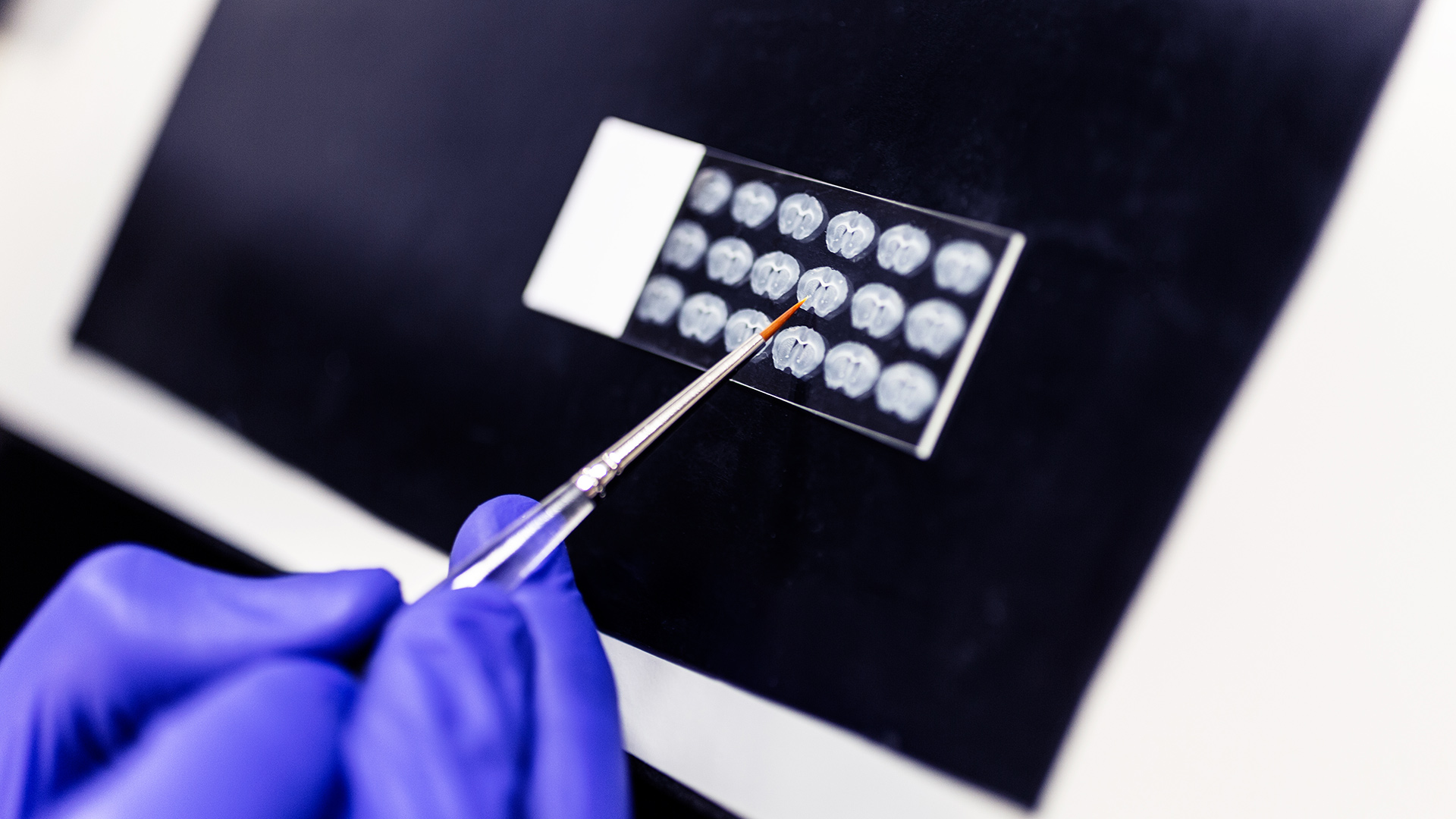
Scientist holding brush pointing at chest X-ray images on dark background

goals and approach/

The Brain Science Management team at the Allen Institute for Brain Science leads our foundational scientific research in deciphering the cellular and circuit organization of the mammalian brains, from mouse to human, and providing open-access resources of data, knowledge and tools to accelerate neuroscience discoveries across the field. We do this by setting strategic goals, leading the development of new technology platforms and pipelines, leading the generation and public dissemination of comprehensive, multimodal datasets characterizing brain cell types and circuit networks, managing scientific operations, and engaging in collaborations with external researchers.

The mammalian brain is our most complex and mysterious organ, comprising millions to billions of cells and orchestrating our behaviors, emotions, cognition, and metabolism. To understand the function of the brain and how its dysfunction leads to brain diseases, it is essential to uncover the cell type composition of the brain, how the cell types are connected with each other and what their roles are in circuit function. At the Allen Institute for Brain Science, we have built multiple technology platforms, including single-cell transcriptomics and multiomics, spatial transcriptomics, single and multi-patching electrophysiology, 3D reconstruction of neuronal morphology, brain-wide connectivity mapping, and synaptic-level connectomics by electron microscopy to characterize the molecular, anatomical, physiological, and connectional properties of brain cell types in a systematic manner, towards the creation of multi-modal cell atlases for the mouse, non-human primate and human brains. Our studies reveal extraordinary cellular diversity and underlying principles of brain organization. They establish foundational resources for deep and integrative investigations of cellular and circuit function, development, and evolution of the mammalian brain.

Scientists in the Brain Science Management department also carry out focused, cross-disciplinary research projects to gain a deeper understanding of the relationship between cell types’ molecular identities and connectional properties, and how cell types respond in various behavioral, pharmacological and diseased conditions.
scientific projects/

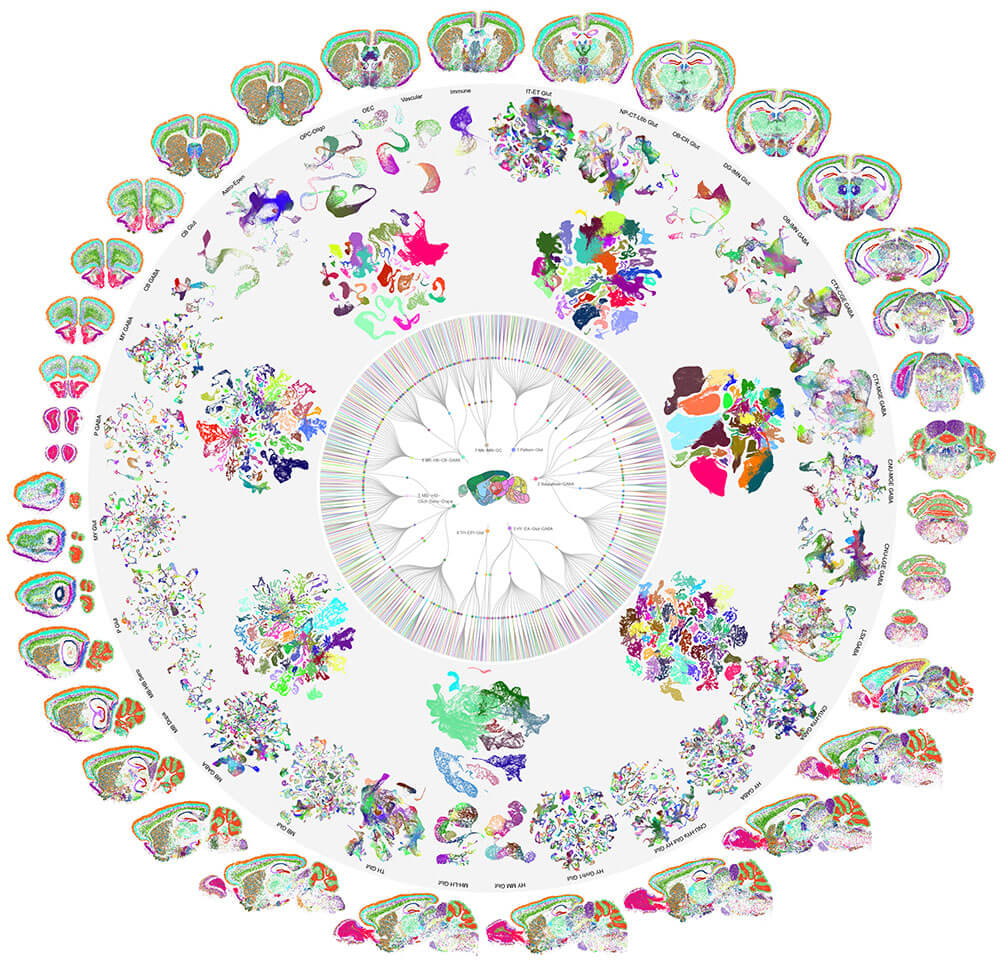
allen whole mouse brain cell type atlas

By combining two whole-brain scale datasets with multi-millions of cells profiled by single-cell RNA-sequencing or the spatial transcriptomic method, MERFISH, we have created a comprehensive and high-resolution transcriptomic and spatial cell type atlas for the whole adult mouse brain. The atlas identified over 5,300 potential cell types, revealing astonishing cell type diversity across the brain, a high degree of correspondence between transcriptomic identity and spatial specificity for each cell type, and unique characteristics of cell type organization in different brain regions. The study also reveals highly diverse expression patterns of various neurotransmitters and neuropeptides in different cell types, and that transcription factors are major determinants of cell type classification in the adult brain. This project is supported by the BRAIN Initiative Cell Census Network (BICCN) with funding from NIH/NIMH.

Allen Brain Cell (ABC) Atlas

Circular brain atlas showing colorful neuroanatomical cross-sections and gene expression maps

developmental mouse brain cell type atlas

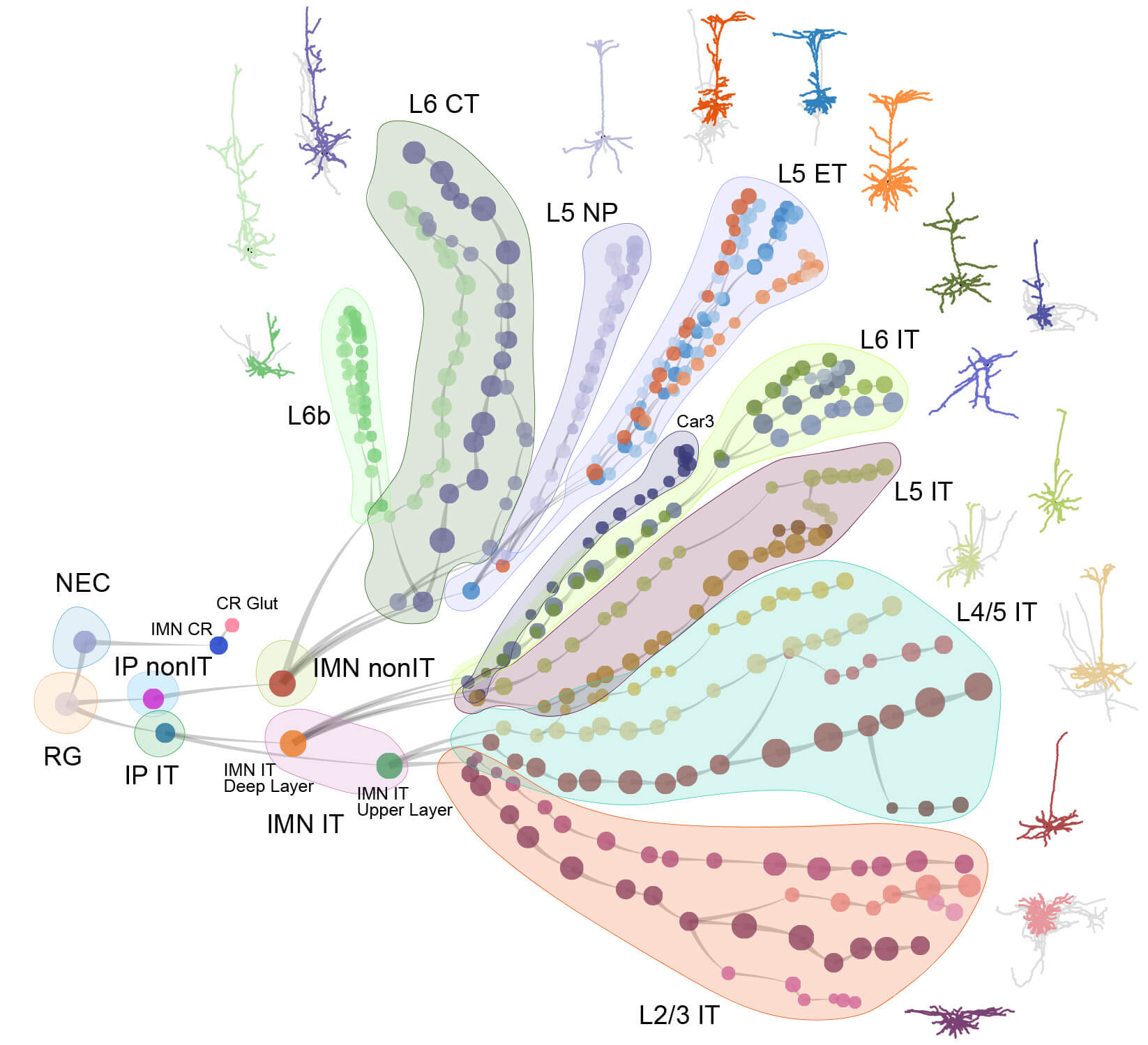
The developing mouse brain is a foundational experimental model for investigation of the origins of cell types in the mammalian brain. We are generating a comprehensive, spatially and temporally resolved, cellular-resolution atlas of the whole developing mouse brain, spanning the entire period of embryonic and postnatal brain development, using single-cell and spatial transcriptomic and multiomic technologies. This work will enable a deep understanding of the mechanisms of mammalian brain development and neurodevelopmental disorders. This project is supported by the BRAIN Initiative Cell Atlas Network (BICAN) with funding from NIH/NIMH.

BICAN: A cell census of the developing human brain

Diagram showing neuron connections and spinal cord layers labeled with anatomical regions and cell types

molecular and cellular adaptations during drug abuse

Drugs of abuse devastate the life of millions of people, yet how these drugs (such as cocaine and opioids) affect the brain remains poorly understood. Utilizing the massive amount of cell-type information we have accumulated, we are conducting a systematic investigation of brain-wide, single-cell level gene expression changes induced by acute or chronic use of cocaine or opioids in mice. This work will lead to the identification of specific cell types and gene targets, as well as generalizable mechanisms, that mediate the addictive effects of these drugs, and facilitate the development of better treatments for drug abuse and addiction. This project is supported by funding from NIH/NIDA.

cell-type based mesoscale connectome of the mouse brain

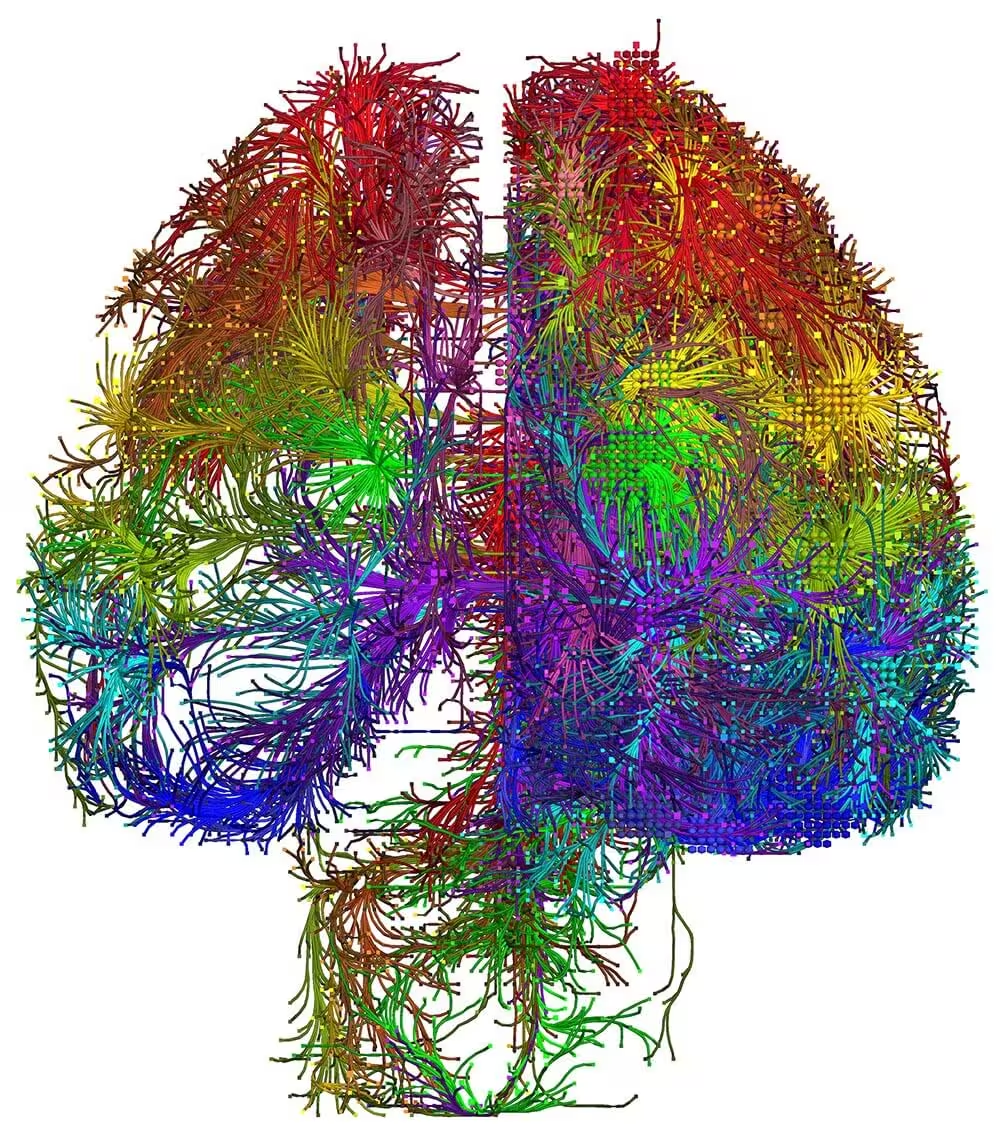
Brain cell types form functionally specific circuits via synaptic and extra-synaptic connections. To unravel the brain-wide circuit networks and create a mesoscale connectome, we have been mapping the input and output connections of specific cell types in the mouse brain using recombinant adeno–associated virus (AAV) mediated anterograde tracing and recombinant rabies virus mediated retrograde trans-synaptic tracing, combined with cell-type targeting genetic tools. A current focus is on understanding the cortex-basal ganglia-thalamus network that mediates brain functions such as movement, reward and cognition. This project is partly supported by the BRAIN Initiative Cell Census Network (BICCN) with funding from NIH/NIMH.

Allen Mouse Brain Connectivity Atlas

Transgene mouse line characterization

Colorful brain neural network visualization with red, green, blue, and purple interconnected lines.

barcoded connectomics

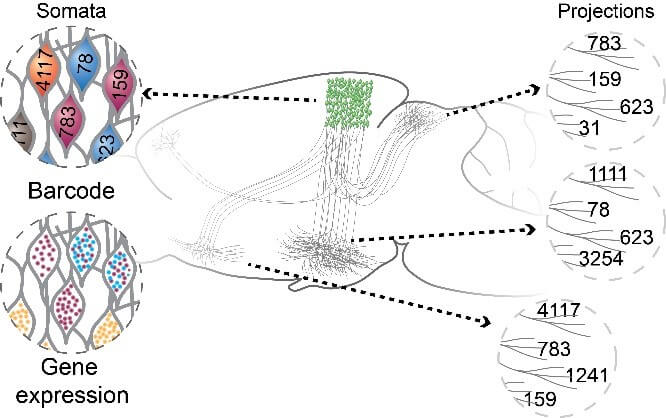
Neural circuits, the physical substrates that enable conscious thoughts and complex behaviors, are composed of myriad interconnected neurons. Unraveling the connections of different types of neurons thus provides a foundation for understanding brain structures and functions. However, tracing thin individual axons with nanometer-scale diameters, which are also tightly packed with many other axons, across centimeters of brain matter is very labor intensive and error-prone. To overcome these challenges, we develop RNA barcoding and in situ sequencing-based techniques to map neuronal types and connections with unprecedented throughput and resolution. By making circuit mapping expotentially faster, cheaper, and more accurate, we aim to understand brain-wide organization of cell type connectivity, their development, and their evolution.

Barcoded Connectomics team

Diagram showing neural projections from somata, barcode, and gene expression to brain regions with numerical labels.

brain science leadership team

Ed Lein
Executive Vice President and Director of Brain Health Accelerator
Hongkui Zeng
Executive Vice President and Director, Brain Science

scientific staff members

Farzaneh Abolmaali
Scientist II
Matt Aitken
Technical Program Manager III
Macarena Aloi
Associate Scientific Program Manager
David J. Anderson

California Institute of Technology
Jeanelle Ariza Torres
Manager, Histology
Paola Arlotta
Harvard University
Angela Ayala
Research Associate II
Colin Bacon
Research Associate I
Katherine Baker
SW Engineer II
Pamela Baker
Scientific Data Engineer II
Trygve Bakken
Investigator, Assistant
Stuard Barta
Research Associate II
Yoav Ben-Simon
Assistant Investigator
Bert Bertagnolli
Research Associate, Sr.
Ashwin Bhandiwad
Scientist II
Ravi Bhowmik
Research Associate II
Cameron Bielstein
Manager, SWE
Agnes L. Bodor
Scientist III
Derrick Brittain
SW Engineer III
Agata Budzillo
Scientist II
Alex Cahoon
Hardware Engineering Manager
Sam Caldwell
Senior Scientific Project and Alliance Manager
Edward M. Callaway
Salk Institute for Biological Studies
Luke Campagnola
Scientist III
Thanh Cardenas
Research Associate, Sr.
Tamara Casper
Research Associate Sr. Supervisor
Anish Chakka
Manager, Bioinformatics
Tom Chartrand
Scientist III
Soumya Chatterjee
Scientist III
Xiaoyin Chen
Assistant Investigator
Lindsey Ching
Data Analyst
Ananya Chowdhury
Scientist II
Jennie Close
Senior Scientist
Forrest Collman
Associate Director, Data and Technology
Ian Convy
Scientist I
Rosa Cossart
French National Institute of Health and Medical Research (Inserm)
Nuno Maçarico da Costa
Investigator
Tanya L. Daigle
Investigator, Assistant
Rachel Dalley
Sr. Manager, Morphology
Scott Daniel
Software Engineer III
Bethanny Danskin
Scientist I
Nick Dee
Sr. Manager, Tissue Processing
Karl Deisseroth
Stanford University
Marie Desierto
Research Associate Supervisor
Song-Lin Ding
Principal Scientist
Yi Ding
Bioinformatics Analyst III
Peter DiValentin
Manager, SWE
Tim Dolbeare
Associate Director, Data and Technology
Nadezhda Dotson
Research Associate III
Deepanjali Dwivedi
Scientist I
Michael D. Ehlers
CSO & Venture Partner | Apple Tree Partners
Luke Esposito
Executive Director, Scientific Operations
Katie Fancher
Research Associate III
Emilia Favuzzi
Harvard Medical School
Rebecca Ferrer
Research Associate II
Tracy Finnemore
Research Associate II
Michal Fortuna
Scientist II, NHP Biodistribution Lead
Alex Fraser
Research Associate II
Yuanyuan Fu
Scientist 1
Mariano Gabitto
Investigator, Assistant
Rohan Gala
Scientist III
Aaron Garcia
Scientist I
Jazmin Garcia
Scientific Project Coordinator II
Emily Gelfand
Data Analyst II
Olga Gliko
Scientist, Sr.
Jeff Goldy
Bioinformatics Analyst III
Bryan Gore
Senior Scientist
Nathan Gouwens
Assistant Investigator
Kim Gruver
Scientist I
Kathryn Gudsnuk
Senior Scientific Project Manager
Rong Guo
Scientist III
Alan Guthrie
Mechanical Engineer III
Carliana Halterman
Research Associate III
Michael Hawrylycz
Investigator, Sr. Informatics and Data Science
Rebecca Hodge
Investigator, Assistant
Janna Hong
Shanahan Postbac Fellow
Marcus Hooper
Scientist II
Rachel Hostetler
Scientist I
Alvin Huang
Research Associate I
Mike Huang
Software Engineer II
Yasmeen Hussain
Senior Scientific Project and Alliance Manager
Viren Jain
Google
Katelyn James
Research Associate II
Tim Jarsky
Associate Director, Electrophysiology
Erich Jarvis
Rockefeller University
Kelly Jin
Scientist III
Nelson Johansen
Scientist II
Atlas Jordan
Research Associate I, Tissue Processing
Brian Kalmbach
Investigator, Assistant
Omar Kana
Scientist I
Eitan S. Kaplan
Senior Scientific Project and Alliance Manager
Shannon Khem
Research Associate II
Dong-Wook Kim
Scientist II
Christine Kim
Research Associate I
Megan Koch
Research Associate I
Michael Kunst
Scientist, Sr.
Hsienchi Kuo
Scientist II
Rana Kutsal
Research Associate II
Hsin-Yu (Jane) Lai
Scientist I - ML/AI algorithms for Alzheimer's Disease
Will Laird
Research Associate I
we acceleratedevelopcatalyzeimpact

science done differently. shared with the world.

explore our accelerators

brain science

Mapping every cell, connection, and circuit in the brain—openly shared with the world.

cell science

Decoding how cells become tissues, then programming that knowledge into powerful new research tools.

neural dynamics

Revealing the brain's hidden algorithms that transform neural activity into real-world behavior.

immunology

Creating the deepest open reference for the healthy human immune system ever built.

synthetic biology

Engineering cells to record their own histories, transforming how we understand disease over time.

research

Big questions, open answers, and science built to be shared.

education

Inspiring the next generation of scientists through open science resources.

impact

Our science is empowering researchers and advancing health worldwide.
advancing science through open, collaborative research
Get the allen institute newsletter
Stay informed on the latest breakthroughs in neuroscience, bioscience, and AI-driven research.
allen institute
impactpeople & teamscareers & opportunitiesalumnihistory & founder
science resources
allencell.orgallenimmunology.orgallenneuraldynamics.orgbrain-bican.orgbrain-map.orgmicrons-explorer.org
research
brain sciencecell scienceneural dynamicsimmunologysynthetic biologypublications
education
science educationfield tripsprofessional developmenteducation resources
quick links
newseventsopen sciencepodcastscience resourceshuman brain donationvisit uscontact
follow us/

allen institute, 615 Westlake Ave North, Seattle, WA 98109 +12065487055

© 0000 allen institute. all rights reserved.
privacy policyterms of usecitation policyemployee portalpolicy & compliance