
impact
impact
open science
subheadline
careers and opportunities
subheadline
people & teams
people & teams
subheadline
allenites
subheadline
allen institute advisors
subheadline
board of directors
subheadline
shanahan foundation fellowship
subheadline
next generation leaders
subheadline
research
overview
our approach
subheadline
publications
subheadline
open science
subheadline
accelerator
brain science
subheadline
cell science
subheadline
neural dynamics
subheadline
immunology
subheadline
synthetic biology
subheadline
education
education
science education
subheadline
education resources
subheadline
field trips
subheadline
open science
subheadline
open science quest
subheadline
news
news
stories
subheadline
podcast
subheadline
sign up for our newsletter
subheadline
events
events
all events
subheadline
conferences
subheadline
event code of conduct
subheadline
events
open science quest
subheadline
summer workshop on the dynamic brain
subheadline
open science week
subheadline
brain fest
subheadline
science resources
science resources
allencell.org
subheadline
allenimmunology.org
subheadline
allenneuraldynamics.org
subheadline
brain-bican.org
subheadline
brain-map.org
subheadline
microns-explorer.org
subheadline
impact
back to menu
impact
open science
subheading
careers and opportunities
subheading
people & teams
people & teams
subheading
allen institute advisors
subheading
board of directors
subheading
shanahan foundation fellowship
subheading
next generation leaders
subheading
research
back to menu
impact
Label
subheading
Label
subheading
people & teams
education
back to menu
research
Label
subheading
Label
subheading
Heading
news
back to menu
research
Label
subheading
Label
subheading
Heading
events
back to menu
research
Label
subheading
Label
subheading
Heading
science resources
back to menu
science resources
allencell.org
subheading
allenimmunology.org
subheading
allenneuraldynamics.org
subheading
brain-bican.org
subheading
brain-map.org
subheading
microns-explorer.org
subheading
search
stories
news

Scientists can now target the cells at the center of ALS

For the first time ever, scientists have developed a precise genetic toolkit that can target the exact nerve cells destroyed by ALS-a discovery that...

June 16, 2025
 min read
share/
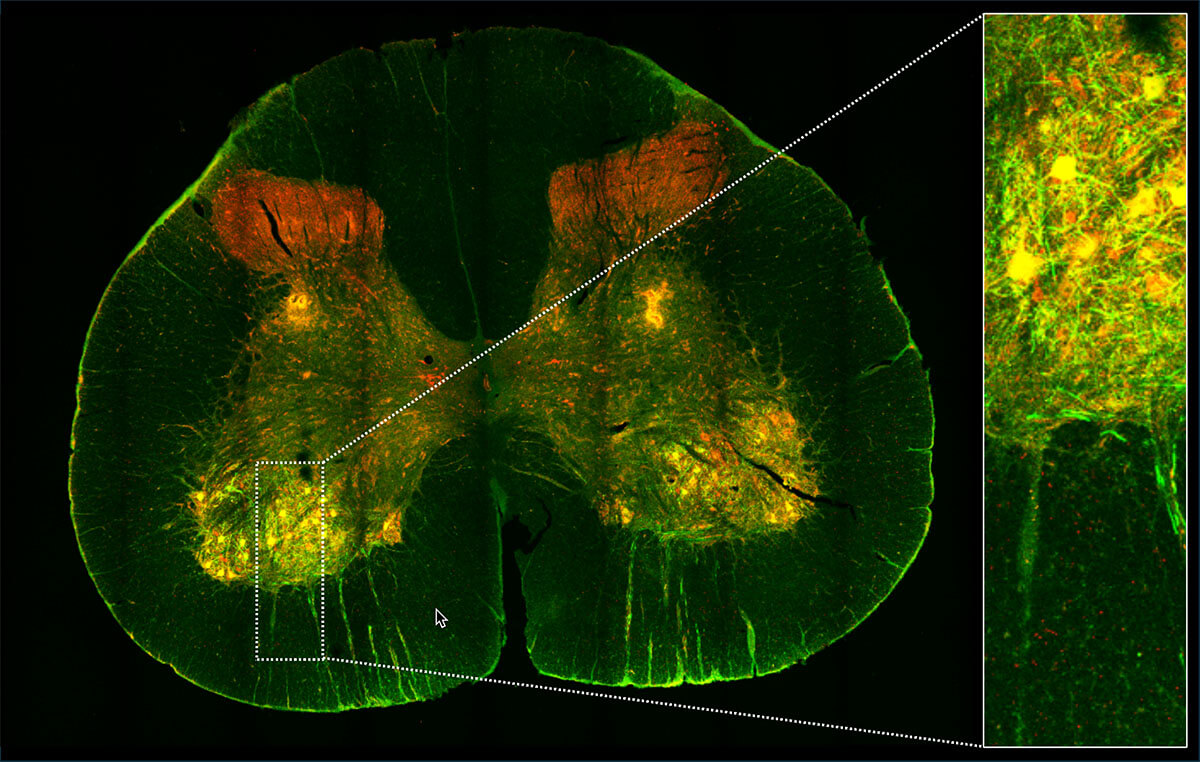
Enhancer AAV driving a bright fluorescent protein (green signal) was delivered to mice non-invasively and the intact spinal cord was imaged using lightsheet microscopy. Spinal motor neurons are revealed by the AAV in great detail throughout the entire length of the spinal cord and in thin spinal cord sections from each level of cord.
For the first time ever, scientists have developed a precise genetic toolkit that can target the exact nerve cells destroyed by ALS—a discovery that...
Thank you! Your submission has been received!
Oops! Something went wrong while submitting the form.

in this article

table of contents will display on published page only
set h2 to populate the table of contents here

authors

Liz Dueweke
Communications and Media Relations Specialist

ALS is a cruel disease. It robs the body of its ability to control itself—the ability to move, the ability to communicate. While there are currently no effective treatments to reverse its debilitating symptoms, Allen Institute researchers have opened a window of hope.

For the first time ever, scientists have developed a precise genetic toolkit that can target the exact nerve cells destroyed by the disease and potentially deliver therapies where they are needed most—a discovery that could dramatically speed up the quest for a cure. The findings were recently published in the journal Cell Reports.

Why it Matters

Amyotrophic lateral sclerosis (ALS) is a progressive and devastating disease that gradually kills off motor neurons in the brain and spinal cord that control voluntary muscle movement. As these neurons die, people with ALS lose the ability to move, speak, and eventually breathe. Despite decades of research, there’s still no effective treatment or cure. Unlike many other brain cells, motor neurons in the spinal cord have been extremely hard to reach with genetic tools. This has slowed down research and made it hard to test new treatments in the cells that matter most.

This new genetic tool acts like a “GPS system” to specifically find and label motor neurons—without affecting any other type of cell—offering a new way to study ALS from the inside out and deliver therapeutic agents that could prevent the cells connected to the disease from dying.  

How Scientists Did It

Enhancer AAVs are one type of genetic tool. Scientists began by creating a cellular map by analyzing spinal cord tissue from different species, looking at each cell individually and analyzing their molecular makeup. From that map they found short pieces of DNA, known as enhancers, that work like on/off switches in cells, changing their gene expression and in turn their function or properties in some way.  

These enhancers activate only in specific neurons, making them the perfect tools for delivering targeted treatments or labels to those cells. Researchers then inserted these genetic switches into harmless viruses, along with a glowing protein that lights up under special microscopes to label the cells and verify that the targeting was successfully. These harmless viruses simply act as “delivery trucks” to send a therapeutic or functional cargo into the cell.
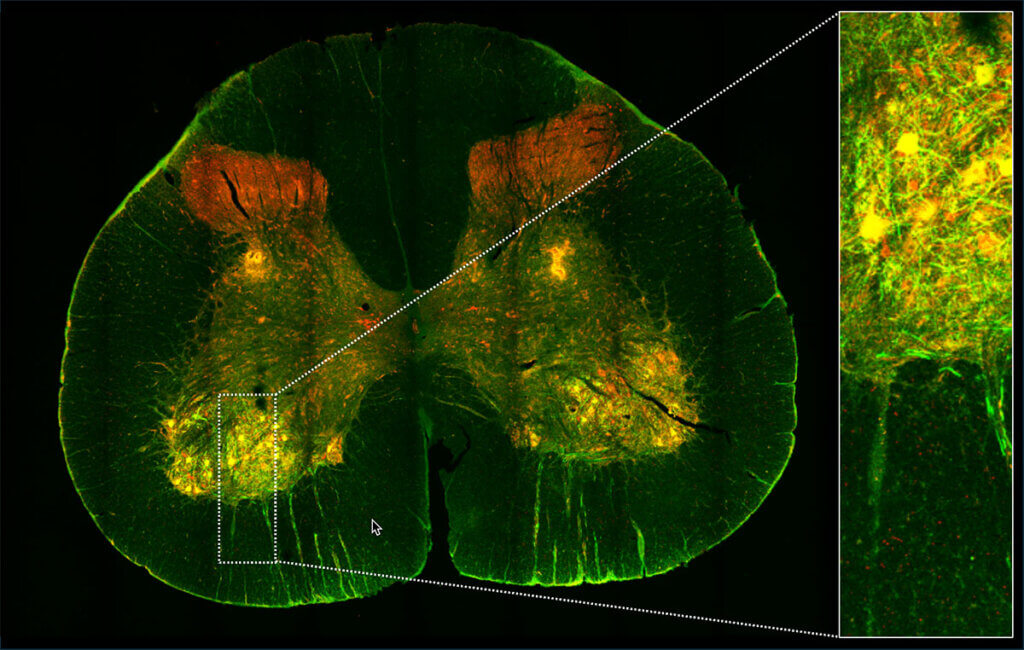
Fluorescence microscopy brain tissue scan showing neural activity with magnified detail view.
Image of a spinal cord section taken from the lumbar region. An enhancer AAV expressing a bright fluorescent protein in motor neurons was delivered to the animal and spinal cord sections were stained to reveal viral label in choline acetyltransferase or ChAT positive neurons (yellow = merge of two channels; green virus and red ChAT). Right inset image shows motor neuron cell bodies and axons emanating from the spinal cord tissue.

What this Could Mean for People with ALS

In the short term, researchers can now study how ALS develops in animal models, offering a better understanding of how the disease works. This could lead to new drug targets or biomarkers that tell doctors how fast the disease is progressing.

Eventually, this same system could be used to deliver gene therapies directly to motor neurons in the brain to protect them and prevent them from dying. Because it targets only the affected neurons, potential treatments could come with fewer side effects.

The toolkit could even pave the way for personalized ALS treatments. By studying different types of motor neurons, researchers might learn why ALS progresses differently in different people, and then tailor therapies to match. Right now, researchers are looking for partnerships to take these tools to the clinical space and fast track them for trials to start in just a few years.  

“I know that timeline does sound long, and patients need something right now,” said Tanya Daigle, Ph.D., lead author on the research and associate investigator at the Allen Institute. “But the average time in drug development is about 15 years, so this would be astonishing progress.”

A Hopeful Sign for Success in Humans

What makes the findings exciting is that the genetic tools worked across multiple animal species, which increases the likelihood they will also work in humans. The “delivery trucks” successfully found and labeled motor neurons, lighting them up, while leaving other cells untouched. Scientists were also able to combine multiple enhancers to build a single tool to target two types of motor neurons: those in the brain and those in the spinal cord. Both fall victim to ALS, so reaching them at once is a major scientific advance.

This discovery gives researchers a new way forward. For decades, motor neurons have been largely out of reach, leaving scientists with few research options. With this new genetic toolkit, they have a better roadmap to find answers—and possibly even cures. For people living with ALS and their loved ones, it brings something that’s been in short supply: hope.

“I think it’s an exciting time to be a molecular neuroscientist,” said Daigle. “I became a scientist for exactly this moment in time, when something we do in the lab could benefit the people dealing with this horrible disease. It robs people of their loved ones—their husbands, fathers, wives, mothers. And I think that’s why a lot of us in science become scientists. The potential to impact humanity like this is a very exciting thing.”

‍

Citations
No items found.

about the allen institute

The Allen Institute is an independent, 501(c)(3) nonprofit research organization founded by philanthropist and visionary, the late Paul G. Allen. The Allen Institute is dedicated to answering some of the biggest questions in bioscience and accelerating research worldwide. The Institute is a recognized leader in large-scale research with a commitment to an open science model. For more information, visit alleninstitute.org.

explore related stories

explore more stories
news 
Scientists complete first drafts of developing mammalian brain cell atlases
New research reveals how early brains form and the critical periods that could help diagnose and treat brain disease.
news 
What makes us human? Detailed cellular maps of the entire human brain reveal clues
You have 3,000+ different kinds of brain cells, and more insights from the largest human brain cell atlases created to date
news 
So you want to donate your brain to science
Monte Strohl donated his brain to research after his death, hoping to fuel science and help others with neurodegenerative conditions.
news 
Mapping the whole human brain: Allen Institute to lead global collaboration
NIH BRAIN Initiative to fund primate brain atlases, maps of developing mouse brain, coordination and knowledge sharing, and brain function research
video 
Where does Alzheimer's begin?
Pinpointing the cellular roots of Alzheimer's disease to find new targets for treatments and therapies.
news 
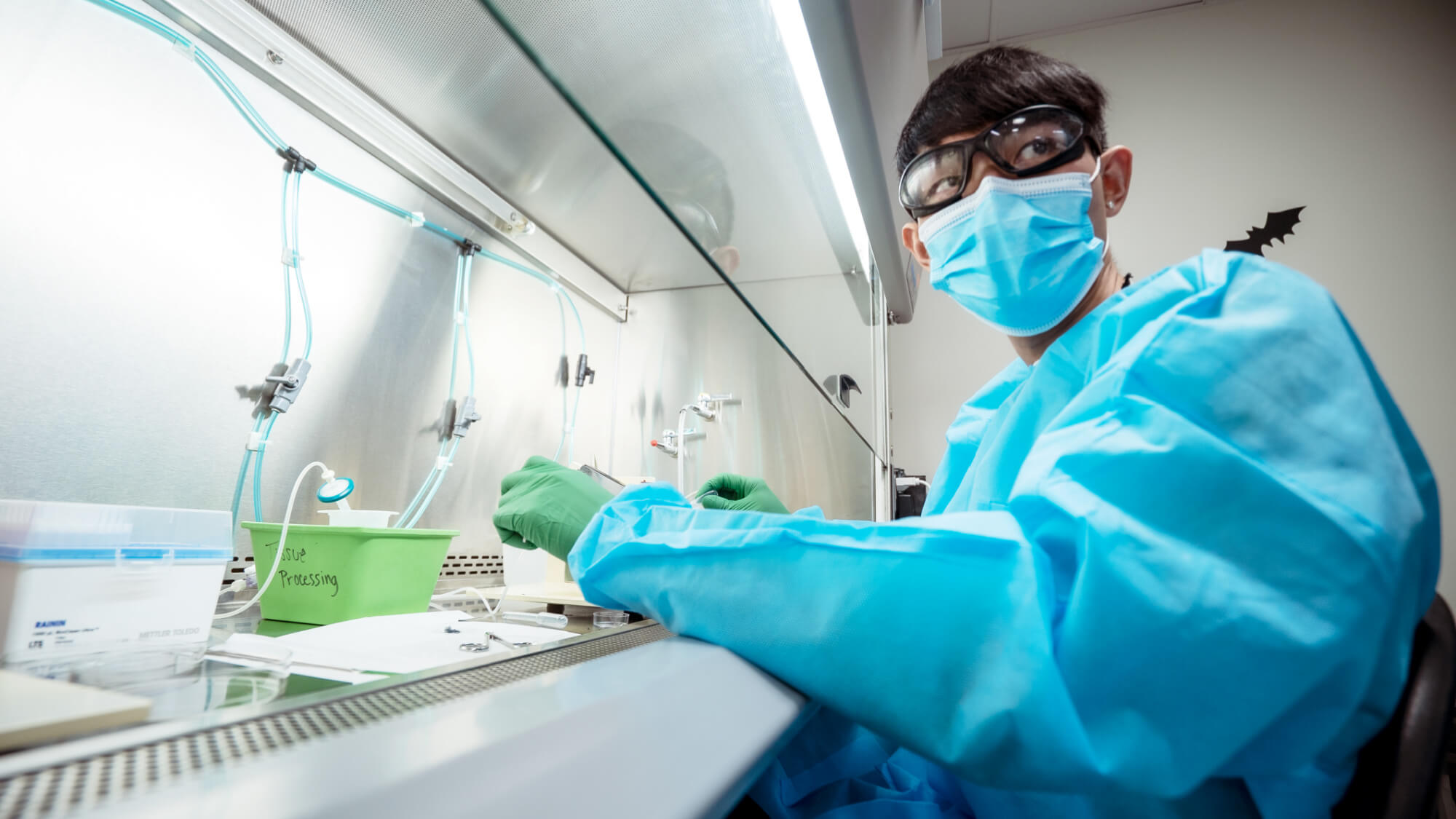
A day in the (neuroscience) life: Tissue Processing
The researchers in this lab prepare brain tissue for several other teams at the Allen Institute
we acceleratedevelopcatalyzeimpact

science done differently. shared with the world.

explore our accelerators

brain science

Mapping every cell, connection, and circuit in the brain—openly shared with the world.

cell science

Decoding how cells become tissues, then programming that knowledge into powerful new research tools.

neural dynamics

Revealing the brain's hidden algorithms that transform neural activity into real-world behavior.

immunology

Creating the deepest open reference for the healthy human immune system ever built.

synthetic biology

Engineering cells to record their own histories, transforming how we understand disease over time.

research

Big questions, open answers, and science built to be shared.

education

Inspiring the next generation of scientists through open science resources.

impact

Our science is empowering researchers and advancing health worldwide.
advancing science through open, collaborative research
Get the allen institute newsletter
Stay informed on the latest breakthroughs in neuroscience, bioscience, and AI-driven research.
allen institute
impactpeople & teamscareers & opportunitiesalumnihistory & founder
science resources
allencell.orgallenimmunology.orgallenneuraldynamics.orgbrain-bican.orgbrain-map.orgmicrons-explorer.org
research
brain sciencecell scienceneural dynamicsimmunologysynthetic biologypublications
education
science educationfield tripsprofessional developmenteducation resources
quick links
newseventsopen sciencepodcastscience resourceshuman brain donationvisit uscontact
follow us/

allen institute, 615 Westlake Ave North, Seattle, WA 98109 +12065487055

© 0000 allen institute. all rights reserved.
privacy policyterms of usecitation policyemployee portalpolicy & compliance