
impact
impact
open science
subheadline
careers and opportunities
subheadline
people & teams
people & teams
subheadline
allenites
subheadline
allen institute advisors
subheadline
board of directors
subheadline
shanahan foundation fellowship
subheadline
next generation leaders
subheadline
research
overview
our approach
subheadline
publications
subheadline
open science
subheadline
accelerator
brain science
subheadline
cell science
subheadline
neural dynamics
subheadline
immunology
subheadline
synthetic biology
subheadline
education
education
science education
subheadline
education resources
subheadline
field trips
subheadline
open science
subheadline
open science quest
subheadline
news
news
stories
subheadline
podcast
subheadline
sign up for our newsletter
subheadline
events
events
all events
subheadline
conferences
subheadline
event code of conduct
subheadline
events
open science quest
subheadline
summer workshop on the dynamic brain
subheadline
open science week
subheadline
brain fest
subheadline
science resources
science resources
allencell.org
subheadline
allenimmunology.org
subheadline
allenneuraldynamics.org
subheadline
brain-bican.org
subheadline
brain-map.org
subheadline
microns-explorer.org
subheadline
impact
back to menu
impact
open science
subheading
careers and opportunities
subheading
people & teams
people & teams
subheading
allen institute advisors
subheading
board of directors
subheading
shanahan foundation fellowship
subheading
next generation leaders
subheading
research
back to menu
impact
Label
subheading
Label
subheading
people & teams
education
back to menu
research
Label
subheading
Label
subheading
Heading
news
back to menu
research
Label
subheading
Label
subheading
Heading
events
back to menu
research
Label
subheading
Label
subheading
Heading
science resources
back to menu
science resources
allencell.org
subheading
allenimmunology.org
subheading
allenneuraldynamics.org
subheading
brain-bican.org
subheading
brain-map.org
subheading
microns-explorer.org
subheading
search
stories
news

Allen Institute scientists igniting curiosity of young minds

Students at the University of Puget sound are gaining valuable real-world insight and training using the Allen Institute's cutting edge resources and...

December 15, 2025
 min read
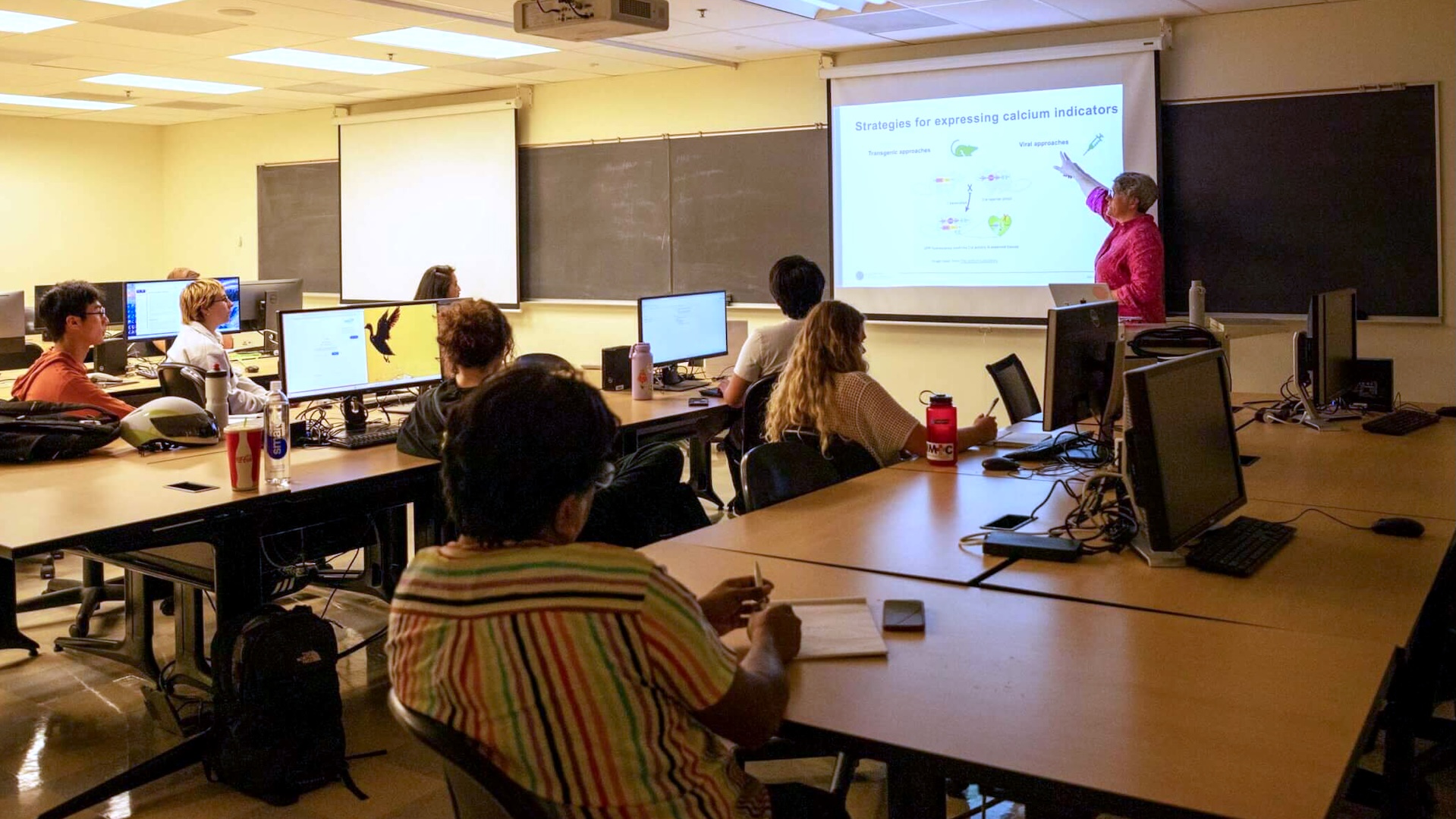
Saskia de Vries, Ph.D., teaching a class at the University of Puget Sound
share/
Saskia de Vries, Ph.D., teaching a class at the University of Puget Sound / photo credit: Erik Dinnel, 2025
Students at the University of Puget sound are gaining valuable real-world insight and training using the Allen Institute's cutting edge resources and data.
Thank you! Your submission has been received!
Oops! Something went wrong while submitting the form.

in this article

table of contents will display on published page only
set h2 to populate the table of contents here

authors

Peter Kim
Associate Director, Communications & Media Relations

Three weeks of intensive, hands-on neuroscience training by Allen Institute scientists gave students at the University of Puget Sound a glimpse into the future. “We are getting to learn the science that will be in textbooks in a few years,” said Dominique Langevin, a senior at the university. They are part of an advanced neuroscience class being taught, in part, by scientists from the Allen Institute.  
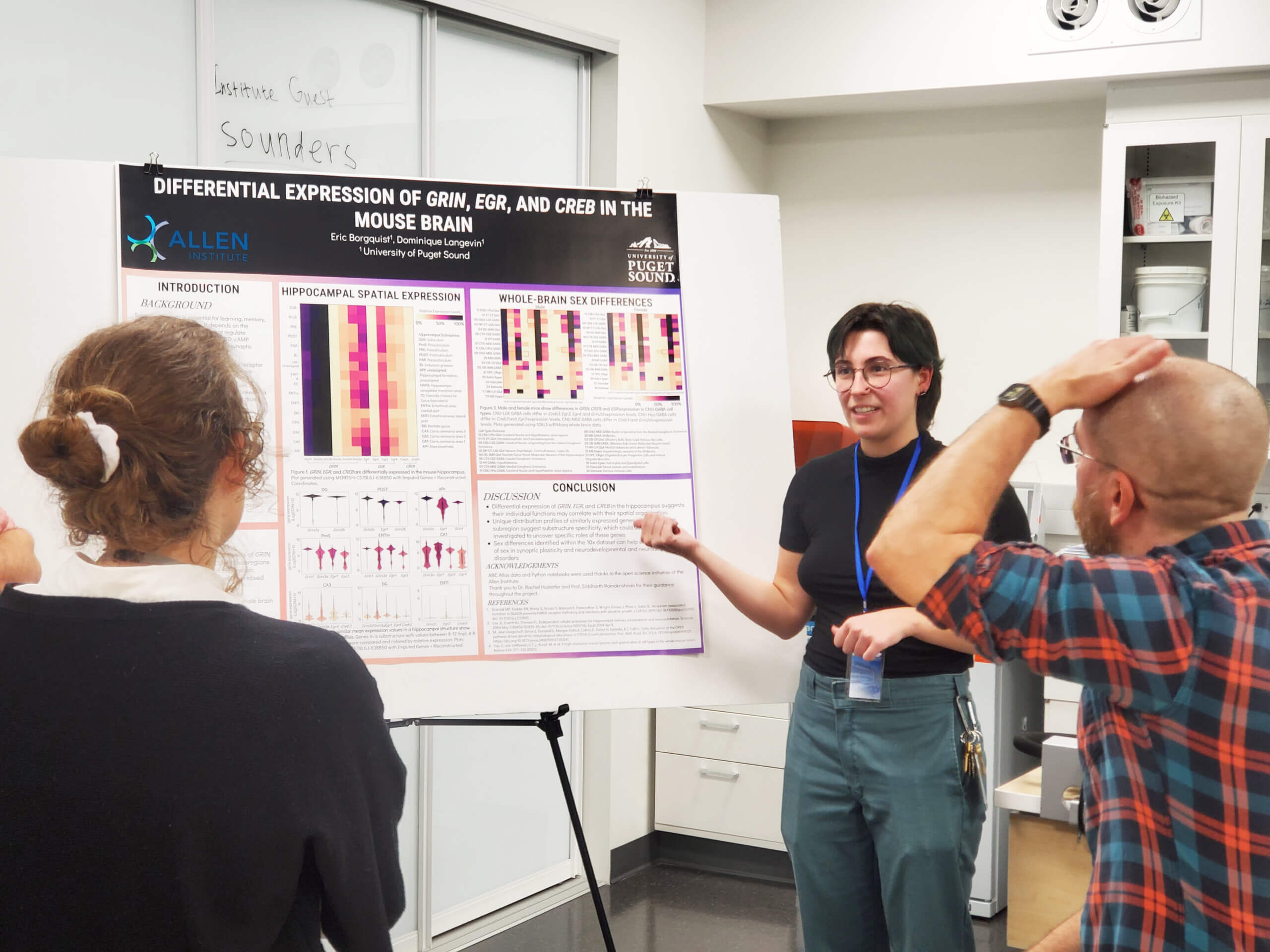
Researcher presenting neuroscience poster on brain gene expression to two attendees at academic conference.
Dominique Langevin, a student at the University of Puget Sound, presenting research at a poster session at the Allen Institute (December 2025)

The researchers used the Institute’s real-world data and technology to train students on computational neuroscience and data analysis techniques that will be vital for careers in the field. “Research positions are increasingly looking for these skills, and I’m grateful that this course is providing me with the experience that will be relevant to my future career,” said Langevin, who plans on pursuing a Ph.D. in neuroscience and a career in research.

Su-Yee Lee, Ph.D., a scientist at the Allen Institute, demonstrated the versatility and utility of python, an industry-standard coding language, using optical physiology and behavior datasets from the Allen Institute. Students learned how to access and analyze these massive datasets while trying to quantify how correlations in neural activity change before and after a mouse learns a task—advanced concepts and techniques that are preparing students for life in the real scientific world. “Students aren’t just working on a classroom exercise with neat and tidy answers. They’re analyzing data that’s part of ongoing research and that process can be challenging and messy, but adventurous,” said Lee.
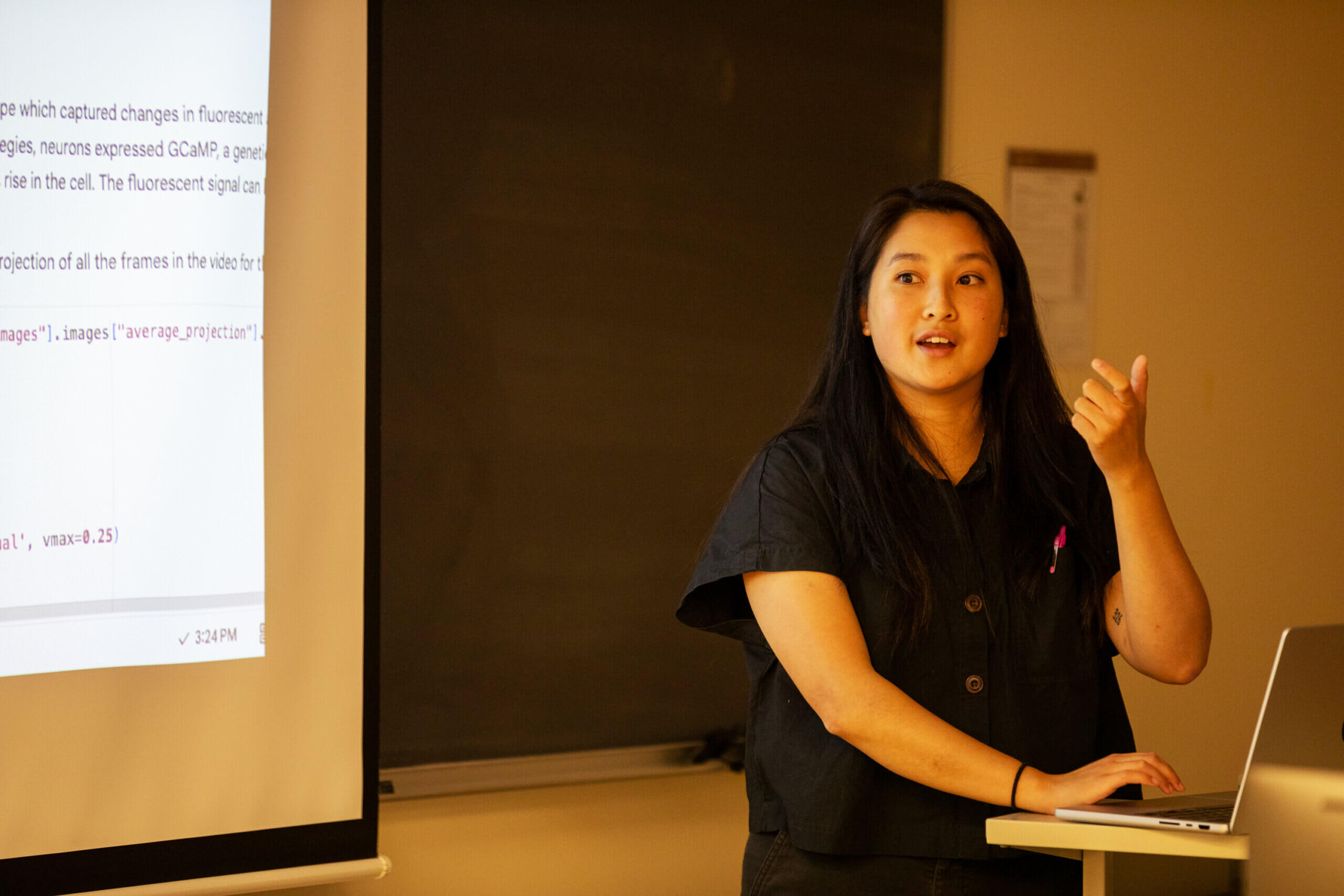
Woman giving presentation about fluorescent imaging, gesturing while standing near laptop and projection screen
Su-Yee Lee, Ph.D., scientist at the Allen Institute (Photo credit: Erik Dinnel)

Madison Hening is one of the students who rose to that challenge. “My background in research has solely been in a wet lab setting, and I have had minimal experience with coding. This class has inspired me to fill my knowledge gap in computer science. I plan on taking a computer science class in the Spring so that I can better prepare to possibly work at a research institute after graduating.”  

For Hening, this goal is personal: Her father was diagnosed with early onset Alzheimer’s and Lewy body dementia (LBD) about a year and a half ago. “As my family has been navigating this new diagnosis, my curiosity towards the biological functioning of the disease and ongoing Alzheimer’s and LBD research has increased greatly,” she said.  
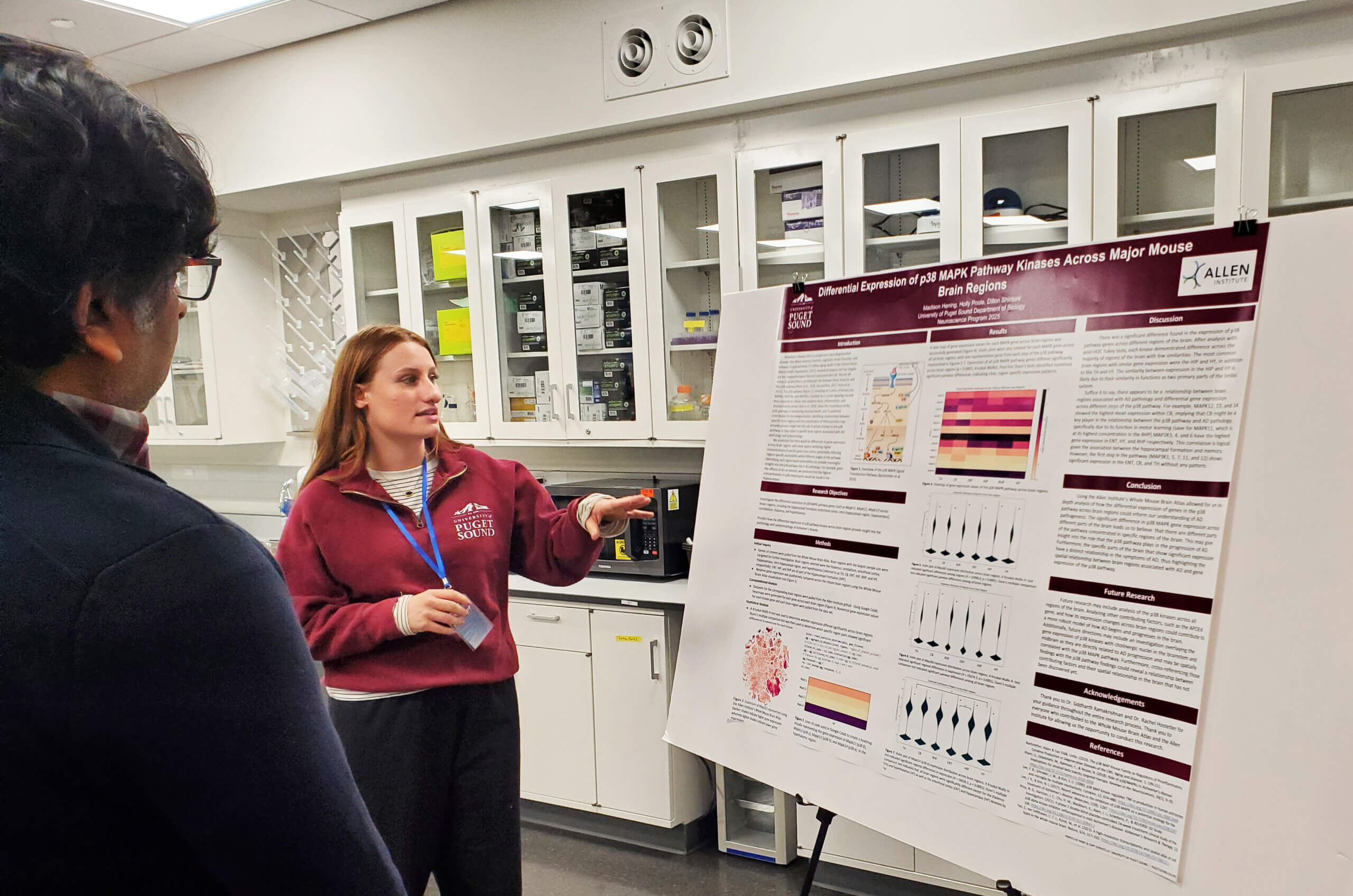
Researcher presents scientific poster on MAPK pathway kinases in mouse brain to visiting attendee in lab.
Madison Hening, a student at the University of Puget Sound, presenting research at a poster session at the Allen Institute (December 2025)

At the end of the 16-week course—three of which involved instruction by Allen Institute scientists—students worked on a final capstone project that they presented at a scientific poster session. Hening’s probed the spatial arrangement of the p38 MAP kinase pathway using the Allen Institute’s Mouse Brain Atlas. “The p38 pathway is linked to Alzheimer’s disease because it is associated with oxidative stress and p38 has been linked to the phosphorylation of tau, one of the mechanisms that contributes to the pathogenesis of Alzheimer’s disease. I chose this topic because my dad, and I feel very passionate about contributing to and investigating research related to the disease and neurodegeneration in general,” said Hening.
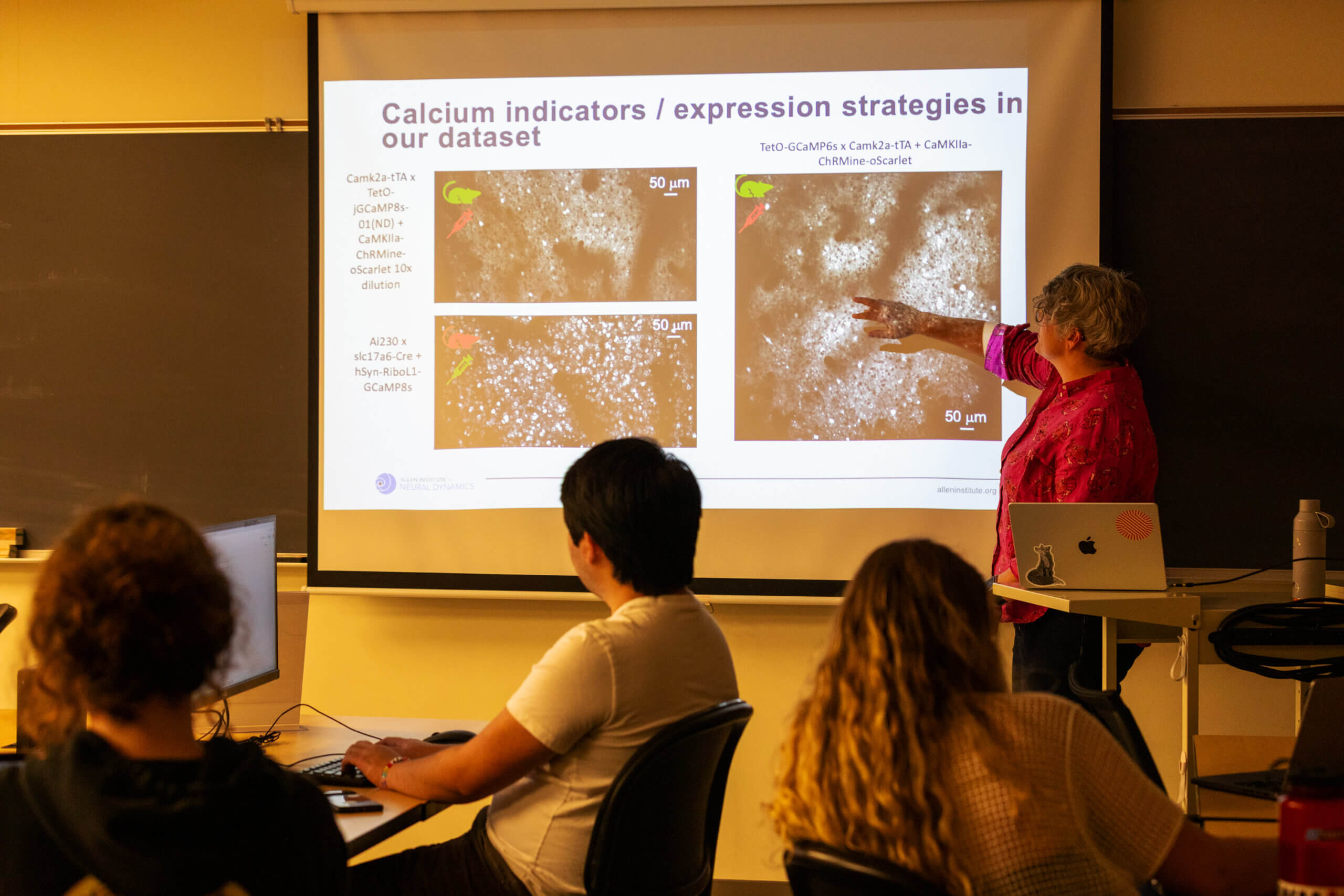
Scientist presenting calcium indicators microscopy images to audience during research seminar
Saskia de Vries, Ph.D., associate director of data and outreach at the Allen Institute, teaching students at the University of Puget Sound (Photo credit: Erik Dinnel)

At a time when science is rapidly evolving because of innovations in artificial intelligence and technological advances, learning from working scientists living the current reality is extremely valuable. “Neuroscience is a very broad research field, containing molecular, behavioral, and computational work. I think it’s important to show that there is no ‘one way’ to be a neuroscientist, and that many of us have a variety of interests and skillsets,” said Rachel Hostetler, Ph.D, a scientist at the Allen Institute who also taught part of the course. “I think it’s important for students to be able to ask questions directly to people working in the field and to learn about the day-to-day life of a scientist, and for them to see that scientists work in many environments beyond academia.”  

Learning about the brain through cutting-edge tools, techniques, and datasets is also imparting more philosophical lessons that shape views beyond the lab. “I cannot stop telling people about the ‘functional twin’ that was made using the calcium imaging data from the MICrONS dataset. I think it raises interesting questions about mindedness, perception, and artificial phenomenal experiences; and I can’t wait to see how the dataset is expanded,” said Langevin. “I think that studying the cellular and molecular processes of the brain is the best way to bring us closer to understanding our own nature and makes me feel more connected to myself and the world.”
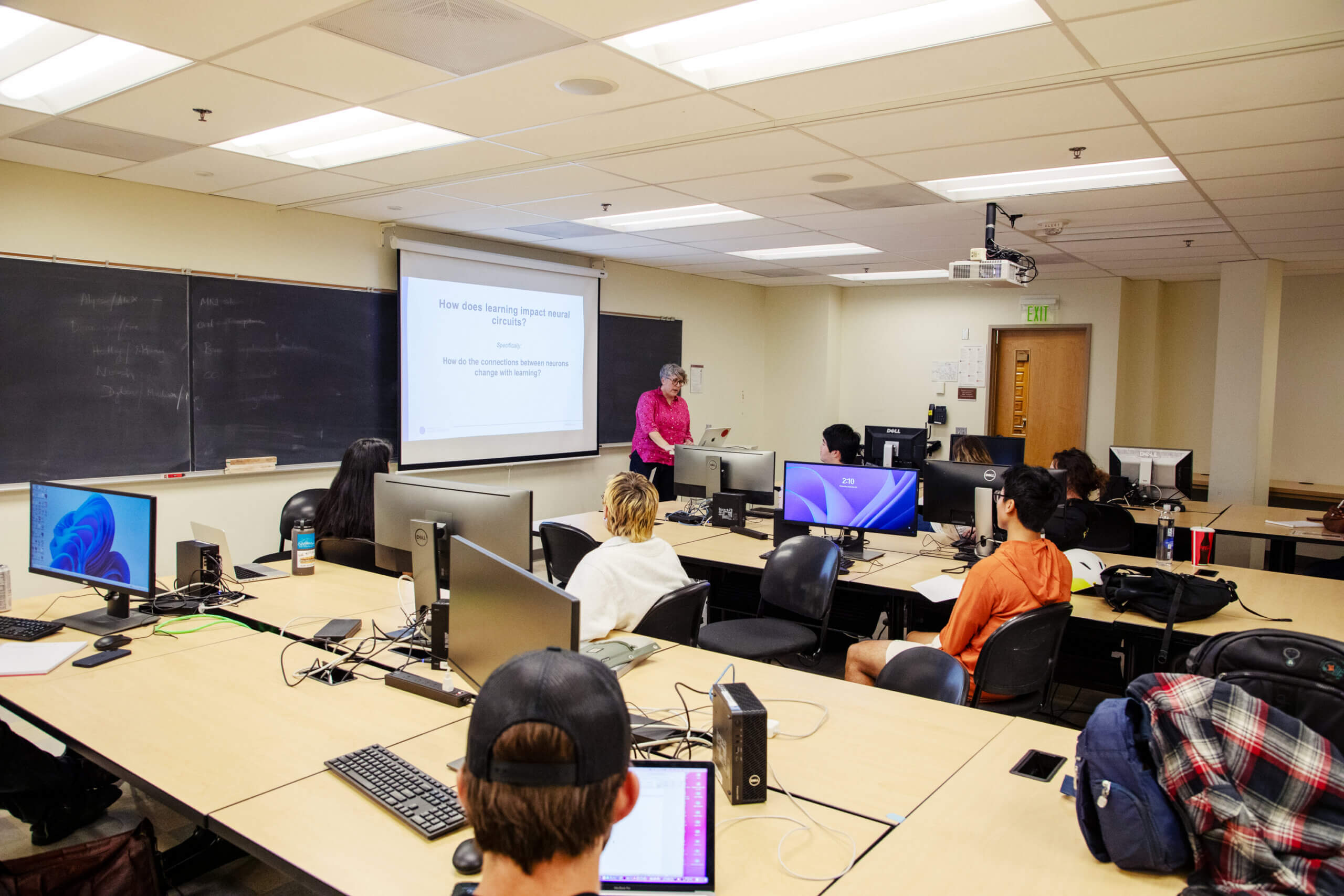
Instructor teaching neuroscience class to students at computers in classroom
Saskia de Vries, Ph.D., teaching a neuroscience class at the University of Puget Sound (Photo credit: Erik Dinnel)

Siddharth Ramakrishnan, Ph.D., neuroscience professor at the University of Puget Sound says the experience also helped students recognize the bigger picture beyond the books and experiments in a way that will advance science for all. “One of the big foresights of the Allen Institute is the open science model and that the data should be open to everybody and everyone should have access to it, which I think is a really big ethical ethos to take actually,” said Ramakrishnan.

“These students will go on to become researchers or medical professionals or scientists and will take that with them that when they design experiments, when they produce things, it should be accessible, it should be open, and they should be sharing it with everyone. Working with this data and working with these researchers will help them realize that yes, it is possible. I don’t have to sit behind a paywall. I don’t have to be constantly competing with everybody. I can actually be collaborating and be open with all the things that I do.”

Citations
No items found.

about the allen institute

The Allen Institute is an independent, 501(c)(3) nonprofit research organization founded by philanthropist and visionary, the late Paul G. Allen. The Allen Institute is dedicated to answering some of the biggest questions in bioscience and accelerating research worldwide. The Institute is a recognized leader in large-scale research with a commitment to an open science model. For more information, visit alleninstitute.org.
explore related stories

explore more stories
news 
Neuropixels Opto sheds new light into deepest regions of the brain
A single tool measures and manipulates brain cell communication and democratizes advanced neuroscience
Allen Impact 2025
Technology and innovation are fueling discovery in science like never before we’re proud to be leading the way. 2025 was a year of tremendous impact...
news 
Scientists develop new way to “listen in” on the brain’s hidden language
Paradigm-shifting technology is changing how researchers do neuroscience
news 
Karel Svoboda and Jay Shendure elected to National Academy of Medicine
The honor recognizes leaders who have demonstrated outstanding achievement and made lasting contributions to the advancement of the medical sciences,...
news 
Scientists shoot lasers into brain cells to uncover how illusions work
Supported by the Allen Institute's OpenScope program, the findings could help us better understand neuropsychiatric disorders like schizophrenia and...
news 
Collaboration Expands Research Tool to Help Crack the Code on Parkinson’s and Other Neurodegenerative Diseases
A new view of Parkinson's Disease
we acceleratedevelopcatalyzeimpact

science done differently. shared with the world.

explore our accelerators

brain science

Mapping every cell, connection, and circuit in the brain—openly shared with the world.

cell science

Decoding how cells become tissues, then programming that knowledge into powerful new research tools.

neural dynamics

Revealing the brain's hidden algorithms that transform neural activity into real-world behavior.

immunology

Creating the deepest open reference for the healthy human immune system ever built.

synthetic biology

Engineering cells to record their own histories, transforming how we understand disease over time.

research

Big questions, open answers, and science built to be shared.

education

Inspiring the next generation of scientists through open science resources.

impact

Our science is empowering researchers and advancing health worldwide.
advancing science through open, collaborative research
Get the allen institute newsletter
Stay informed on the latest breakthroughs in neuroscience, bioscience, and AI-driven research.
allen institute
impactpeople & teamscareers & opportunitiesalumnihistory & founder
science resources
allencell.orgallenimmunology.orgallenneuraldynamics.orgbrain-bican.orgbrain-map.orgmicrons-explorer.org
research
brain sciencecell scienceneural dynamicsimmunologysynthetic biologypublications
education
science educationfield tripsprofessional developmenteducation resources
quick links
newseventsopen sciencepodcastscience resourceshuman brain donationvisit uscontact
follow us/

allen institute, 615 Westlake Ave North, Seattle, WA 98109 +12065487055

© 0000 allen institute. all rights reserved.
privacy policyterms of usecitation policyemployee portalpolicy & compliance